Get Full Government Meeting Transcripts, Videos, & Alerts Forever!
Get email alerts on the Zoning Rezoning topic
No spam. Unsubscribe anytime.
Applicant told to rezone, seek conditional use permit for aggregate laydown yard in Nassau County pre-application review
Summary
Developer Derek Ivory presented plans for an aggregate supply and laydown yard; staff advised rezoning, a future land-use map amendment and a conditional use permit, plus accessibility, paving and stormwater requirements.
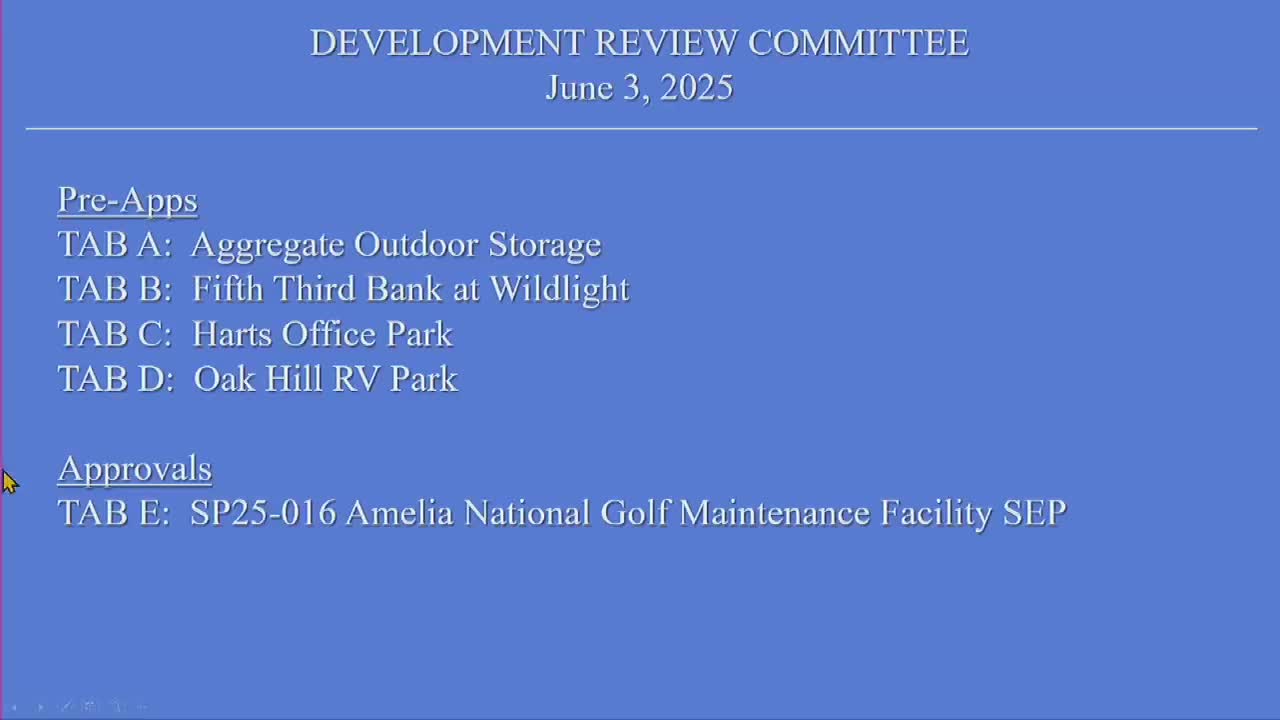
Derek Ivory, owner of AI Express LLC, told the Nassau County Development Review Committee on June 3 that he wants to operate an aggregate supply and laydown yard on a vacant parcel and make materials available to contractors and the public.
The committee’s planning staff said the parcel is currently zoned Open Rural with an agricultural future land use, which does not permit the proposed use. “You’re going to need to rezone your property to Commercial Intensive and also amend the future land use map to commercial,” Stephanie Kaiser, planner, told Ivory. Staff said a conditional use permit would also be required before the site could operate.
The discussion focused on regulatory and technical requirements the applicant must meet before filing detailed engineering plans. Caleb Hurst of Development Services said the county requires driveway locations that meet commercial standards, paved loading and vehicle-use areas (unless an alternate surface is approved), and a six-foot sidewalk along frontage or a fee-in-lieu. He also said the site must meet the county’s Article 10 stormwater and drainage requirements and include standard engineering and construction-inspection notes.
County building and health staff discussed on-site facilities. Keith Ellis, building official, said a commercial site that is open to the public must provide at least one unisex restroom and at least one accessible parking space. Cathy Vanzant of Environmental Health confirmed porta‑potties are commonly used on such sites but asked whether the applicant planned to provide water or permanent bathrooms. Ivory said water would be used only for dust control and that porta‑potties would generally be used.
The committee repeatedly emphasized the process steps. “In order to develop it, you do have to go through our development review process,” Hurst said. Staff summarized the sequence: obtain zoning and future-land-use approvals and a conditional-use permit (public hearings), then hire an engineer to prepare a site plan meeting the county’s code and stormwater standards, and then submit for site-plan review and inspections.
Committee members offered clarifications and options: paved areas are the standard but alternatives can be requested; porta‑potties may be acceptable for temporary conditions but not as a permanent substitute for required plumbing if the use expands; accessibility and minimum plumbing requirements apply to any permanent sales or office structures.
No formal action or vote was taken at the meeting; the item was a pre-application discussion and staff directed the applicant on the next steps and code requirements.
The committee moved on to the next pre-application after providing the applicant contact points for follow-up.