Get Full Government Meeting Transcripts, Videos, & Alerts Forever!
Get email alerts on the City Budget topic
No spam. Unsubscribe anytime.
Oxnard presents balanced preliminary FY2025–26 budget; warns Measure O sunset could cut $20 million
Summary
Assistant City Manager Eric Sonstegard presented the City of Oxnard’s preliminary fiscal year 2025–26 budget on a roughly 50‑minute presentation, showing a balanced general fund at $243.7 million and outlining risks including the scheduled sunset of Measure O in 2029 and ongoing litigation that is limiting bond financing.
Assistant City Manager Eric Sonstegard presented the City of Oxnard’s preliminary recommended budget for fiscal year 2025–26 in a nearly 50‑minute presentation, and said staff will present the proposals to the City Council during a public hearing on June 3 and return on June 17 for adoption consideration.
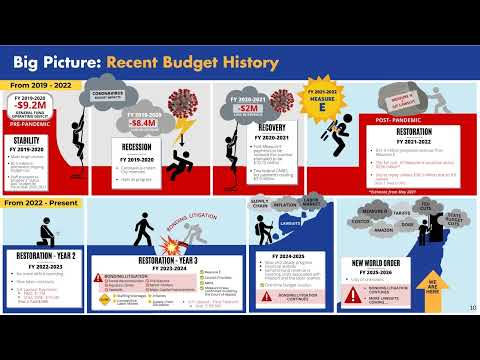
Sonstegard said the proposed general fund is balanced at $243.7 million in revenues and the same amount in expenditures, and that across all funds staff estimate $593.3 million in revenue against $660.0 million in proposed expenditures. “We are proposing a conservative budget,” Sonstegard said, describing roughly a 3.3% increase in both revenues and expenses and an approximately $8 million change in the general fund year‑over‑year.
Why it matters: city leaders said the budget maintains service levels and the council’s reserve goal while warning of future risks that could reduce revenues substantially. The largest near‑term risk identified is the scheduled sunset of Measure O, the half‑cent sales tax voters approved in February 2008; Sonstegard said its expiration on March 31, 2029, could reduce annual general‑fund revenue by about $20 million.
Key revenue and spending details - Revenue mix: Sonstegard said property tax accounts for roughly 31% of city revenues and the city receives about 17% of a typical property tax dollar. Sales tax (including Bradley‑Burns and local measures) makes up just under half of general fund revenue; city shares total about 3 percentage points of a 9.25% local sales tax rate implemented for some transactions on April 1, 2021. - Citywide totals: staff presented a general fund revenue and expenditure figure of $243.7 million; all‑fund revenues of $593.3 million and proposed all‑fund expenditures of $660.0 million. Measure O program expenditures exceed Measure O revenues by nearly $10 million, staff said, and the Measure O fund carries a previously accumulated surplus that will be used for projects and debt service. - Requests vs. recommendations: departments identified roughly $20 million in supplemental needs; staff recommended funding about $2.8 million of that total. Additional recommended items include new positions and reclassifications totaling about $1.1 million and $3.8 million in previously negotiated labor contract cost increases.
Restorations, capital and service highlights Sonstegard summarized progress on the City Council’s five‑year priorities: quality of life, economic development, public safety, infrastructure and natural resources, and organizational effectiveness. Examples he cited include reopening the Durley Youth Center, expanding youth programming (projected to serve about 147,000 youth, up from about 98,000 before Measure E restorations), restored tree‑pruning (from under 2,000 trees annually before Measure E to about 9,000 annually now), and more than $72 million invested in streets and alleys since 2021 that raised the pavement condition index from 64 to 67.
Public safety and operations Sonstegard said public safety and public works comprise the largest share of general fund expenditures and confirmed both police and fire are understaffed compared with peer agencies. He highlighted operational metrics and constraints: the police department’s average emergency response time was 3 minutes, 46 seconds in 2024 (down from 4:13 in 2023), the fire department installed more than 2,500 smoke detectors in 2024 and made other prevention investments, but vehicle and apparatus procurement delays are lengthy — for example, fire engines ordered in early 2022 are not expected to be received and put into service until 2026, and some equipment remains in service well past its expected lifespan.
Reserves, credit and financing constraints Staff recommended maintaining the council’s reserve policy target of 16.6% of operating expenses (equivalent to two months of operating expenditures). Sonstegard said reserves rose from about $3.4 million (roughly 2.2%) during the city’s fiscal stress years to the current targeted level and that staff will recommend adding approximately $1.5 million to reserves in 2025–26. He also noted the city’s issuer credit rating has improved to S&P double‑A minus after earlier upgrades.
Constraints and risks Sonstegard repeatedly described “uncertainty” from local, state and federal sources, including a state law under consideration he said could change sales tax distributions for large facilities, and continuing litigation that has limited the city’s ability to issue municipal bonds for major capital projects. He warned these factors, combined with flattened sales tax growth statewide and potential federal or state funding cuts, could reduce revenues and force service reductions in some jurisdictions.
Next steps and public engagement Staff plans a public hearing on the proposed budget on June 3; Sonstegard said staff will return to the council on June 17 for potential adoption. He encouraged residents to review the online proposed budget documents and provide input at the hearing.
Sources and direct attribution: all quotes and figures in this article are drawn from Eric Sonstegard, Assistant City Manager, in the City of Oxnard budget presentation made available by city staff.