Get Full Government Meeting Transcripts, Videos, & Alerts Forever!
Get email alerts on the Wastewater Operations topic
No spam. Unsubscribe anytime.
Red Hook officials report progress on wastewater-plant repairs as residents press for environmental review
Summary
Village leaders said contractors have begun repairs at the Red Hook Commons wastewater treatment site and weekly lab testing is in place, while residents raised concerns about odors, discharge quality and streambank erosion and urged a formal environmental assessment and moratorium on expansion.
Red Hook Mayor Karen Smythe said Thursday that contractors have begun targeted repairs and stepped-up testing at the village's wastewater treatment facilities after repeated odor complaints and lab results showing elevated discharge parameters.
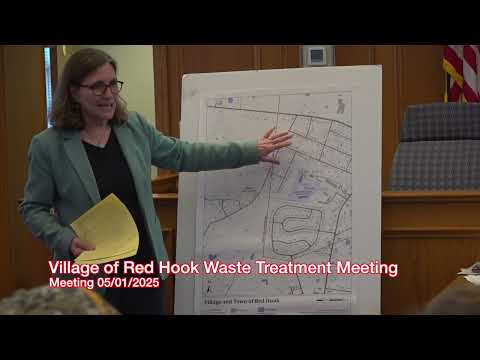
"This is our second wastewater treatment plant operation informational meeting," Smythe said, opening the session. She and village staff described a sequence of mechanical and operational fixes implemented since late 2023 and a targeted "blitz" of the site by Delaware Engineering that began March 31.
The mayor said the village has added a dedicated page on the municipal website to consolidate monthly operator reports and other documents and will post routine updates there. She also reviewed the site's history: the property where the plants sit was an apple orchard in 1949, underwent an environmental cleanup completed in July 2006 at about $1.7 million, and the Red Hook Commons discharge permit was established in February 2007; Red Hook Commons opened with about 94 apartments shortly afterward.
Delaware Engineering's operator, Robert Flores, told the meeting crews began reestablishing disinfection immediately by switching to chlorine tablets while UV units are repaired. "We've been able to start disinfection...we've been getting into single digits," Flores said of measured indicator counts used to gauge disinfection effectiveness. He said crews have reestablished a biologic population in the plants' aeration basins after earlier washout problems linked to oversized pumps on the equalization tank.
Village staff and the contractor described a schedule for next-week repairs to return the older Red Hook Commons plant to service, replace valves, re-bed sand filters and put the UV disinfection units back into automatic operation. The older plant has been taken offline and its flow has been routed to the newer plant while those repairs proceed.
Officials said the village has increased sampling frequency: daily operational tests at the site and weekly lab samples are being sent to an external laboratory. Smythe said DEC (the New York State Department of Environmental Conservation) will not permit a return to monthly lab sampling until regulators are satisfied with stable results. The mayor said Delaware Engineering will also perform periodic audits of operations, "Maybe for the first year, they do an audit every quarter," she said.
Technical details discussed at the meeting included: - Combined average flow for the period cited was about 48,000 gallons per day; the permit limit cited for the newer plant was 50,000 gallons per day. - The older plant historically treated roughly 10,000'12,000 gallons per day and has a listed capacity of about 25,000 gallons per day. - Operators reported dissolved oxygen measurements in the aeration basins well above the minimum (daily testing showed about 9.8 mg/L versus a 7 mg/L threshold cited in discussion). - Engineers identified an operational cause for prior biological washout: pumps on the equalization tank produced intermittent, excessive instantaneous flows that flushed mixed liquor out of the biological tanks. The corrective strategy is to reduce pump stroke/flow and even the outflow from the equalization tank to preserve biomass.
Regulatory and staffing items Village leaders said the prior operator's assistant left and that a DEC inspection led to a directive that a certified assistant operator be on-site. Smythe said Delaware Engineering currently provides the assistant operator and that the village will procure a longer-term operations contractor through a request-for-proposals process; the village expects to solicit at least three firms and review proposals. Smythe also said the village will respond to a DEC letter that asked for specific items to be done or a plan to reach compliance by May 10.
Community concerns and environmental review Several residents described continuing intermittent odors and noted local streambank erosion and wetland changes downstream of the discharge. Neighbors said some smell episodes were transient (lasting minutes) and variable with wind and site conditions; others said they detected sewage-like odors early in the morning.
One meeting participant proposed a moratorium on any sewer expansion and on applying for expansion-related grant funds until an environmental assessment and remediation of damaged private properties are completed. A representative of the Salt Hill/Sawkill watershed community urged the village to pursue a fuller environmental-impact assessment of the site and to coordinate with watershed experts; she also announced a May 17 watershed community event at Bard College that will include experts and public programming.
Mayor Smythe acknowledged the concerns and said the village plans to begin the environmental-assessment process and to work with local watershed groups and state agencies. She said the village must also identify funding sources to support a thorough environmental review and remediation work and that some planning steps and applications take time.
Next steps and oversight Smythe and staff summarized near-term actions: continue weekly lab sampling and daily operational checks; complete next-week repairs to valves, sand filters and UV systems; return the older plant to service to reduce flow through the newer plant; perform quarterly audits by the interim engineering firm for at least the first year; and run a competitive procurement for the long-term operations contract.
Smythe scheduled a follow-up informational meeting for June 5 and asked residents to continue reporting odors and problems so staff can respond. "We are checking, and we're in case somebody was going over right now," she said near the meeting's close, underscoring ongoing on-site monitoring.
The meeting produced no formal vote. Officials said they will continue to coordinate with DEC and other agencies and to post reports and updates on the village wastewater page.