Get Full Government Meeting Transcripts, Videos, & Alerts Forever!
Get email alerts on the Open Space Planning topic
No spam. Unsubscribe anytime.
Staff outlines open space element update, seeks commission input on goals and priorities
Summary
Planning staff presented draft goals and an updated process for Santa Barbara’s open space element, including equity, habitat protection, regional connections and implementation actions; commissioners offered feedback on metrics, accessibility, and collaboration with other departments.
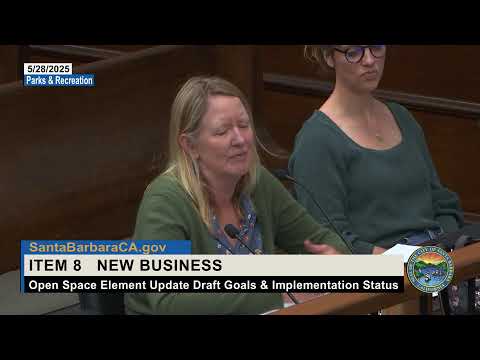
City planning staff and the Parks and Recreation Department presented an update May 28 on the ongoing revision of Santa Barbara’s open space element, outlining draft goals, mapping work and a timetable for public review and adoption.
Staff said the update will include narrative context, an inventory and updated maps, and a goals‑policies‑implementation framework consistent with the general plan. Draft goals presented to the commission include: enhancing livability through a diverse open-space network; securing stable, adequate funding for maintenance and acquisition; improving regional connections to Los Padres National Forest and neighboring jurisdictions; protecting and restoring sensitive habitats and tribal cultural resources; ensuring equitable access to parks across neighborhoods; and managing open space for ecological resilience under a changing climate.
Staff reported outreach to residents (including Earth Day events), an interdepartmental working group with Parks, Airport and Sustainability staff, and collaboration with the Botanic Garden for species guidance. They proposed refining some older policies: converting some community-garden expectations on vacant land into lower-maintenance interim open-space uses; expanding voluntary collaboration with private landowners who hold ecologically valuable stands; and updating policy maps and priority-area lists.
Commissioner feedback: Commissioners suggested adding measurable performance indicators (for example, percent of residents within a 10-minute walk of a park), explicitly linking the open space element to wildfire/resilience planning, making community-garden language flexible for interim uses (pocket parks, pollinator plantings), and addressing accessibility and safe infrastructure access around open-space parcels. Staff said the parks and recreation master plan (scheduled for July) would contain more detailed implementation and prioritization work, and that the open space element should remain a broad, 20‑ to 30‑year policy framework.
Timeline and next steps: Staff said inventory and mapping work will continue through early summer 2025, drafting will proceed over summer 2025, public and decision-maker review will occur later in 2025, and the target is adoption hearings in winter 2025/2026. The commission asked staff to continue coordination with public works and transportation on access and safety around park parcels.