Get Full Government Meeting Transcripts, Videos, & Alerts Forever!
Get email alerts on the Aviation And Land Use topic
No spam. Unsubscribe anytime.
Resident warns planning commission that San Jeramo Airpark replat could reduce stormwater capacity and encroach on FAA airspace
Summary
A resident told the San Antonio Planning Commission that a proposed replat would reduce stormwater detention area and volume at San Jeramo Airpark and urged protection of federally defined airspace; commissioners took no formal action on the comment during the consent hearing.
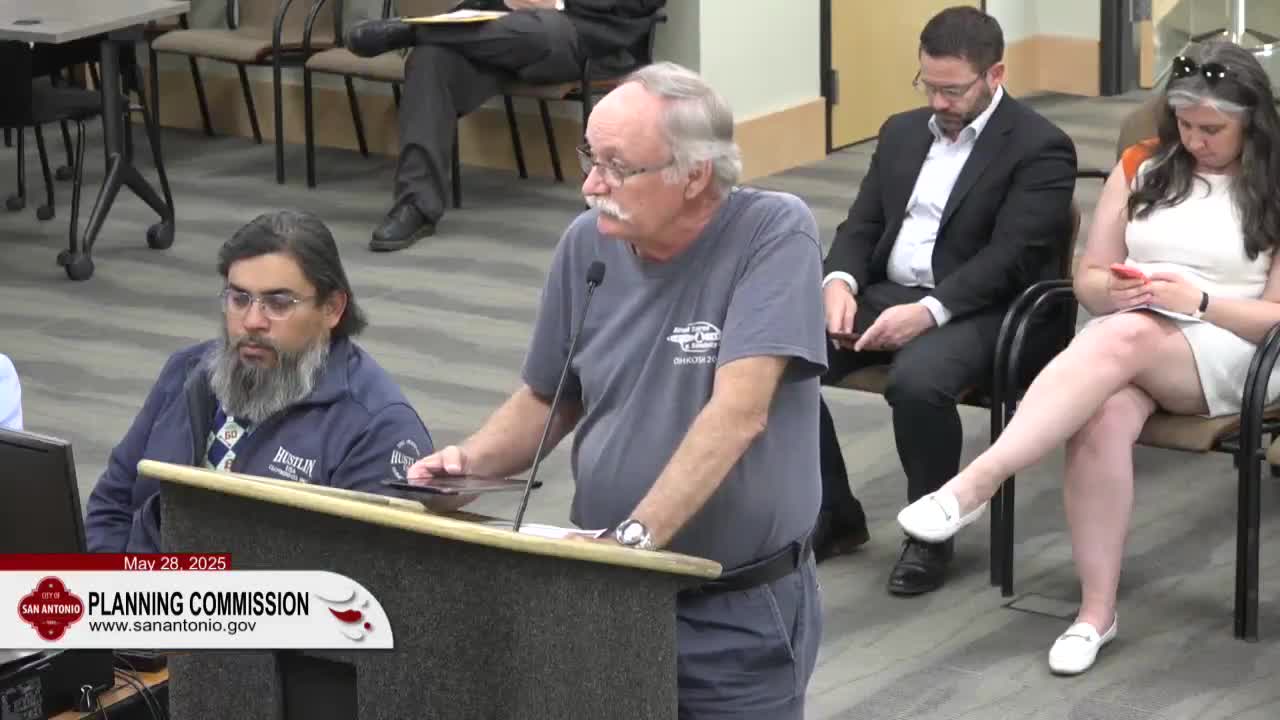
Wayne Walt, a nearby resident, told the San Antonio Planning Commission on May 28 that a proposed replat near San Jeramo Airpark would reduce the site—s stormwater detention area and volume and urged the commission to consider potential flooding and FAA-defined airspace impacts.
Walt, who identified himself as speaking as an individual, said San Jeramo Airpark has operated at the site for about 40 years and is a private airport with public access. "We estimate there's about 2,500 flight operations per year at San Jeramo Airport," Walt said, and he described the field as a practice location for medevac helicopters and for Bexar County Sheriff—s Office flight training. He also said the airport hosts youth "Young Eagle" events that introduce students to aviation and STEM opportunities.
Walt told commissioners he is concerned the replat reduces stormwater detention area and volume, which he said would reduce the parcel—s resilience to larger storms. He noted that the standard design storm applied in the jurisdiction is a 25-year storm unless the area meets a threshold that triggers a 100-year design standard, and he said reducing detention "takes away resilience in case you do get a larger storm." Walt said runoff routed through a new channel on the west side of a nearby KB Homes development could overflow onto the airpark because the park sits at a lower elevation.
Walt also raised airspace safety concerns, citing FAA-mapped surfaces and the federal regulation that defines protected airspace. He described a central runway safety area and surrounding transition and approach surfaces, and asked the commission to "think about that airspace and help us protect it to protect both the pilots that are flying in" and people on the ground.
No formal action or staff direction on the concerns was recorded in the meeting transcript. The comment was given during the combined hearing/consent portion of the meeting; commissioners proceeded with the consent agenda afterward.