Get Full Government Meeting Transcripts, Videos, & Alerts Forever!
Get email alerts on the Education Budget Cuts topic
No spam. Unsubscribe anytime.
Camas School District details staffing cuts and program reductions amid $15 million shortfall; parents and students protest music cuts
Summary
Superintendent John told the board the district still faces a roughly $15 million budget gap and outlined personnel eliminations and program reductions. Dozens of students, parents and teachers urged the board to preserve middle‑school and high‑school music programs during public comment.
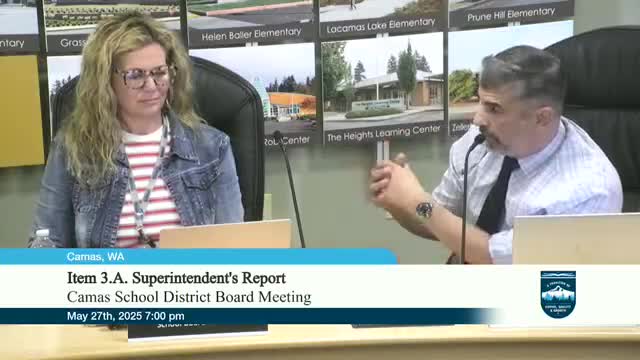
Superintendent John told the Camas School District Board of Directors on May 27 that the district faces a projected budget shortfall of roughly $15,000,000 and summarized reductions the administration has made so far.
John said the district had reached about $11.5 million in projected savings after multiple rounds of cuts but that ‘‘even with the deep cuts that we've made, we still have not reached $15,000,000’’ and that further steps would be required unless other revenue materializes. He described staffing and program changes the district will implement in the fall and stressed that ongoing union negotiations and final salary calculations could affect the final figures.
The superintendent and staff listed specific personnel and program impacts. The district notified 69 teachers of reductions and said 31 certificated full‑time equivalents were currently displaced without placements. District leadership also said a mix of central‑office positions, school leadership roles and support staff were eliminated or reduced, including: an assistant superintendent position that will not be refilled in December; central office registrars; technology support; an accountant and payroll staff; and school‑level deans and assistant principals at several campuses. The community education director position also will not be refilled, the superintendent said.
Why it matters: the cuts are driven by multi‑year enrollment declines, rising operating costs and a funding model the district described as outdated. The superintendent said Camas’ state funding is tied to Washington’s prototypical model, which the district and board members said does not reflect local cost pressures such as housing and labor. John said Camas’ regionalization factor has fallen from about 12% to 6% while nearby districts such as Seattle receive higher regionalization adjustments.
Board members and administration emphasized the district tried to protect core courses and extracurricular programs where possible. The superintendent listed a long set of programs the district plans to preserve, including theater, marching band, most choral and instrumental ensembles at the high‑school level, AP courses and career and technical education pathways. He said some 0‑period offerings (before‑school classes) such as jazz choir and some zero‑period ceramics and sky singers were eliminated or reduced, and said the district is negotiating a stipend model with the teachers’ union (CEA) to permit teachers to offer certain co‑curricular offerings on stipend where feasible.
Public comment and community reaction: the meeting’s public‑comment segment drew 15 registered speakers and many students, teachers and parents who urged the board to preserve middle‑school and high‑school music programs. Students described music classes as ‘‘family’’ and said programs such as Sky Singers and middle‑school jazz provide social and academic benefits. A Sky Ridge student, Helen Feliciano, told the board, “Sky Singers is more than just a class. It's a place where we're pushed to grow musically and personally,” and urged the board not to eliminate the 0‑period ensemble.
Music teachers and community advocates warned that reductions would cause lasting loss of expertise and that programs cut are difficult to restore. Middle‑school music specialist Dustin Hundley said the district should not convert jazz to a stipend‑only club model and urged the board to retain current instructional staffing: “You have the people right now that can do the job. You need to keep them.” Several parents described young students who had developed academically and socially through district music offerings and asked the board to pursue alternatives to the proposed staffing reductions.
District context and next steps: administration said its projected gap is driven by enrollment that is lower than budgeted (the district reported FTE enrollment as of May 15 was 6,897, about 71 students below the fall projection) and that state funding per student does not fully cover local costs. The superintendent said the district expects to finish calculations this summer and that final savings could be affected by union contract outcomes; he estimated the district was “approximately at $11,500,000 of that $15,000,000” and that reaching $12,000,000 would put the district in a position to present a balanced budget in August with short‑term borrowing options.
Board members and staff encouraged community members to engage in legislative advocacy and to contact state lawmakers to press for updates to the prototypical funding model. The superintendent said the district will continue cost containment, examine potential short‑term borrowing from capital reserves if needed, and prioritize safety and class‑size protections when considering any add‑backs.
Ending: the board did not vote on reversing the staffing decisions during the meeting. Several board members acknowledged the public testimony and said they will continue to pursue state and local advocacy and to brief the community as negotiations and final budget calculations continue.