Get Full Government Meeting Transcripts, Videos, & Alerts Forever!
Get email alerts on the Public Safety Traffic topic
No spam. Unsubscribe anytime.
Milwaukee Police launch directed patrol mission, tow trucks to blunt organized street takeovers
Summary
MPD told the committee it has started a summer-directed patrol mission with 10 squads and four tow trucks, plus cross-jurisdictional partners, to address fast-forming, organized street takeovers that block roadways and endanger bystanders and first responders.
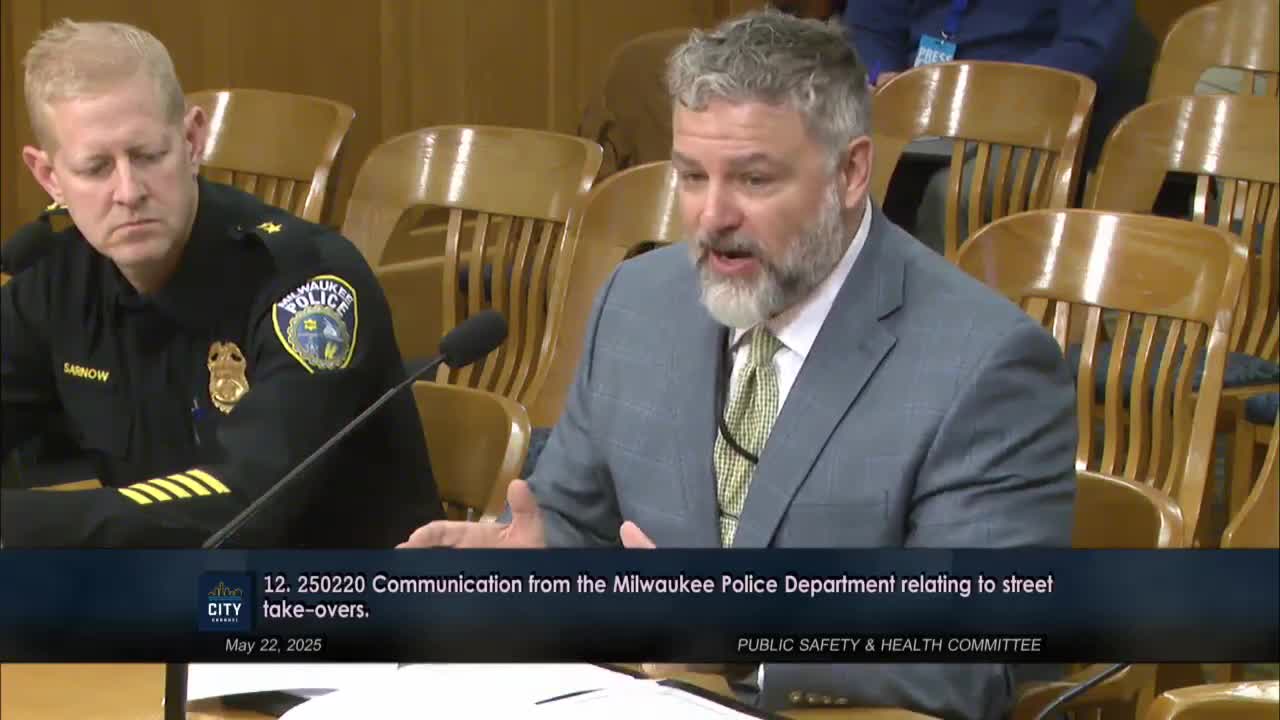
The Milwaukee Police Department told the Public Safety & Health Committee on May 22 that it has opened a directed patrol mission (DPM) to address organized street takeovers after months of growing complaints from business owners and residents.
Captain Phil Simmert, commander of the Fusion Division, and other MPD officials described takeovers as fast-forming gatherings in which drivers block intersections, perform burnouts and donuts, set off fireworks and sometimes shoot at first responders. "These vehicles don't have license plates," Simmert said during the presentation describing enforcement challenges; he added that participants often use temporary or flip plates and encrypted apps to coordinate.
MPD said the initial DPM will deploy 10 squads (five north, five south), two supervisory squads, two lieutenants and four tow trucks (two per side) dedicated to the effort during high-risk periods this summer. Officials said the department is also coordinating with the Milwaukee County Sheriff's Office and other regional partners and is gathering social-media and community tips to pre-deploy units.
Inspector Paul Lau emphasized that takeovers can be dangerous and noted that many events dissipate or relocate rapidly once officers arrive. That mobility, combined with disguised plates and masked participants, has limited immediate arrests and tows so far. MPD said its strategy balances rapid response (dispatch and DPM units), follow-up investigations using video and other intelligence, and public outreach to discourage participation.
The department has created a hot-spot map of roughly 50 locations ranked by frequency, and officials asked aldermen and community groups to share local intelligence and security videos that might help investigators identify repeat offenders. The committee held the communication and asked MPD to return with updates on enforcement results, tow counts and arrests.
President Perez asked that MPD provide a mid-summer briefing on DPM outcomes and community outreach plans; the department agreed to distribute the map of prioritized locations to aldermen and neighborhood partners.
Committee members praised the targeted effort but pressed MPD for measurable follow-up: counts of citations, vehicles towed and arrests; clearer public-facing guidance on how and when to report suspected takeovers; and stronger outreach to commercial property owners to secure private lots and limit congregation points.