Get Full Government Meeting Transcripts, Videos, & Alerts Forever!
Get email alerts on the Community Violence Intervention topic
No spam. Unsubscribe anytime.
Milwaukee committee hears progress report on Forward for Life community violence-intervention program
Summary
City and Medical College presenters told the Public Safety & Health Committee that Forward for Life, a hospital- and community-based violence-intervention program, has expanded services and shows positive early evaluation results; speakers urged more stable funding and community partnerships.
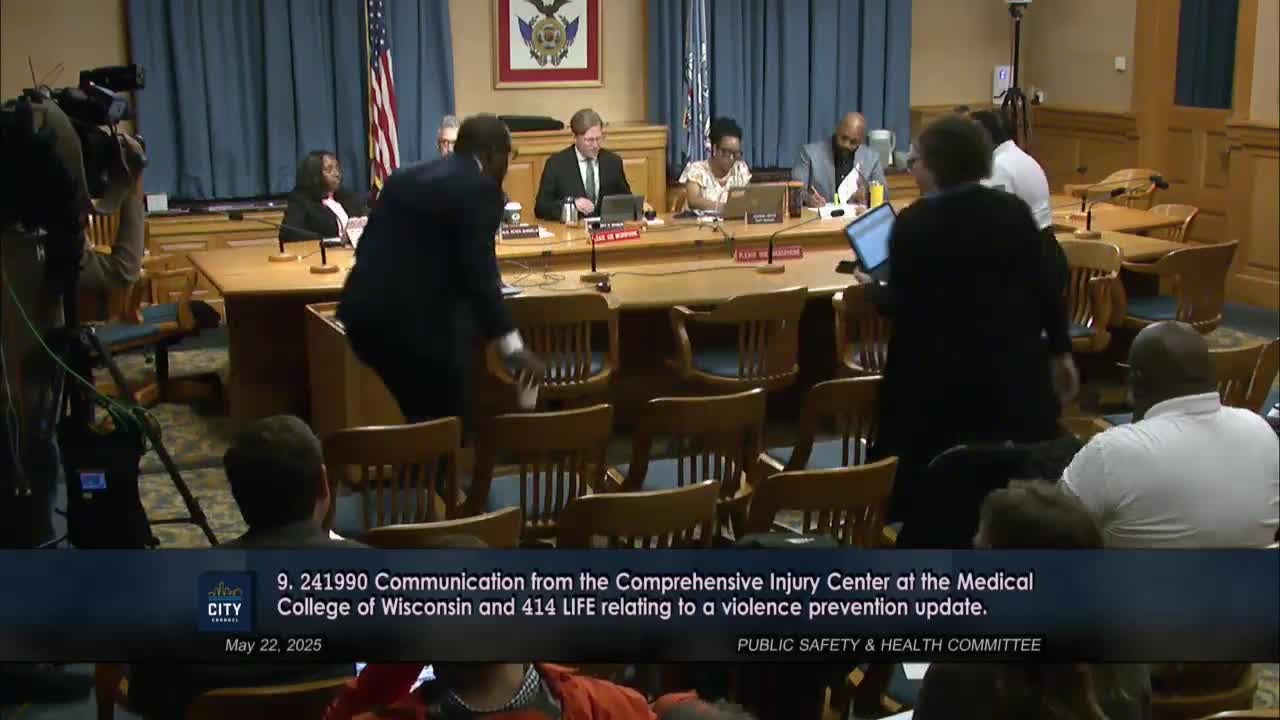
The Public Safety & Health Committee on May 22 heard a detailed update on Forward for Life, Milwaukee's hospital- and community-based violence-interruption program, including program structure, evaluation findings and ongoing funding needs.
The presentation, delivered by Reggie Moore, director of the Division of Community Safety Policy and Engagement at the Medical College of Wisconsin's Comprehensive Injury Center, and Lynn Lewis, director of Forward for Life, described a two-pronged model: hospital responders who provide immediate, on-scene support for people injured by violence and community teams that mediate conflicts, provide case management and run school- and neighborhood-based prevention work.
Moore said the program is modeled on evidence-based Cure Violence approaches and aims to treat violence as a public-health problem. "This is a public-health approach that is evidence based and informed," Lewis said, explaining that the program deploys credible messengers and outreach workers trained in conflict mediation, mental-health first aid and other specialized curricula.
Program evaluation presenters from the Comprehensive Injury Center summarized phase 1 and phase 2 findings. The evaluation found that a majority of mediations were resolved or conditionally resolved, the hospital component has made thousands of referrals since 2019 and school-based workshops reported immediate self-reported gains: roughly 93 percent of participating students said they felt somewhat to much better prepared to avoid or prevent violence after workshops.
Mark Briggs, hospital responder supervisor, and David Sinclair, outreach supervisor, described daily operations and the 24/7 nature of hospital response. Briggs said hospital responders and outreach staff recorded more than 1,200 referrals to the hospital-based team since the program began and logged substantial canvassing and outreach hours in 2023 and 2024.
The committee also heard participant testimony. Eric Sturgis, who was shot last year and later supported by Forward for Life, described care coordination at Froedtert Hospital and follow-up housing and therapy assistance: "They helped me get the resources I needed to get out of housing," he told the committee, describing hotel placement and later permanent housing support.
Presenters and committee members emphasized gaps in follow-up services needed for families and survivors, notably immediate housing assistance and mental-health capacity. The evaluation team recommended continuing to clarify program expectations for frontline staff, expand participant-facing communications and strengthen linkages to housing and clinical services.
Alderwoman Marina Moore, which sponsored the item, and other committee members asked for regular updates and stronger coordination with city departments and county partners. Committee members asked the Medical College and Forward for Life to return with a follow-up report on program outcomes and implementation milestones.
The committee held the communication for future updates and thanked program staff and participants for the presentation.