Get Full Government Meeting Transcripts, Videos, & Alerts Forever!
Get email alerts on the Student Discipline topic
No spam. Unsubscribe anytime.
Board reviews revisions to 2025–26 student code of conduct; cellphone language added to match new law
Summary
The district presented recommended changes to the 2025–26 student code of conduct, including K–2 adjustments to the consequences matrix and statutory language added to reflect House Bill 1105 (effective July 1, 2025) on cell phones. Trustees questioned the timing and severity levels for repeat minor misconduct and asked for clarifications to the
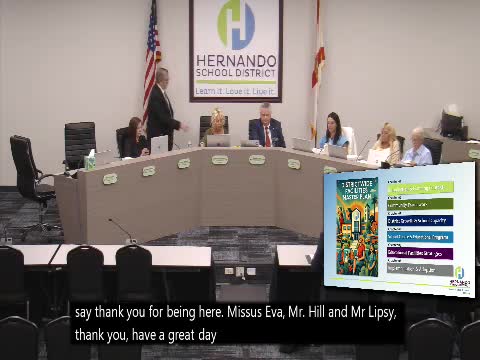
Jill Colossa, director of student services, presented recommended updates to Hernando County Schools' student code of conduct at the board's May 20 workshop, including new language required by recent legislation and changes intended to reflect developmental differences for younger students.
Colossa told trustees that the proposed draft adds K–2 rows to the discipline matrix for a subset of codes and incorporates the text of House Bill 1105 (effective July 1, 2025) regarding cellphones and wireless communication devices. "What you see there under cell phone and wireless communication devices is verbatim what's in the law," Colossa said.
Board members pressed staff on how the matrix handles repeat minor misconduct. Trustee Johnson said he was concerned that some behaviors’ consequences do not escalate until the fourth or fifth occurrence, which he said could normalize misbehavior. Ryan Wilson, the district's discipline hearing officer, explained that some codes (for example, classroom disrespect combined with insubordination) were combined for counting purposes and that cumulative counts could reach a fourth offense only after multiple incidents of either behavior.
Colossa and administrators said the matrix is designed to progress through corrective steps — including parent contact, in‑school suspension and short‑term out‑of‑school suspension for repeated conduct — while also requiring consideration of interventions and supports before moving to the most severe penalties. The presenters noted that major safety‑level infractions continue to carry strict consequences and that data show a decline in major infractions year to year.
Trustees requested a clarifying edit to the draft in one place that refers to notifying a valedictorian or salutatorian who commits a major infraction; they asked staff to explicitly identify which codes constitute "major infractions" (the presentation identified levels three and four as majors). Trustees also asked staff to correct instances where the interim superintendent title and other names were outdated in the packet.
No final vote was recorded; Colossa said staff would make the clarifications and return the revised text for the board’s consideration.