Get Full Government Meeting Transcripts, Videos, & Alerts Forever!
Get email alerts on the Facilities Master Plan topic
No spam. Unsubscribe anytime.
Consultant outlines 17‑month districtwide facilities master plan; board presses for more bids and local engagement
Summary
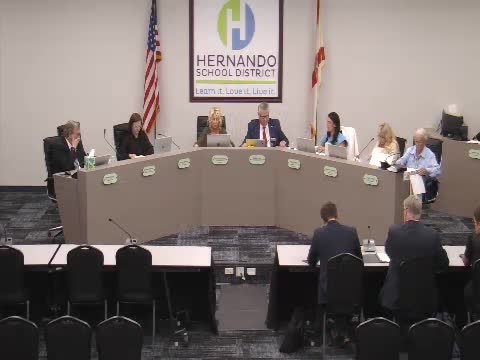
Consultants hired by the Hernando County School Board outlined a districtwide educational facilities master‑planning process on Tuesday that emphasizes community‑driven engagement alongside data analysis and rezoning options.
Consultants hired by the Hernando County School Board outlined a districtwide educational facilities master‑planning process on Tuesday that emphasizes community‑driven engagement alongside data analysis and rezoning options.
At a workshop presentation, Jim Lipsey, identified as the district school planner, introduced Kathy Eboe and Nick Hill of JB Pro and said the project would combine growth forecasts, enrollment analysis and broad community engagement to produce a multi‑year master plan. "How can Hernando's public schools become their school of choice?" Lipsey asked, citing the need to pair vision and programmatic priorities with where new capacity is built.
The consultants proposed a three‑element process — analysis, planning and confirmation — tied to a public engagement program split into three geographic engagement areas (West, Central and East). JB Pro estimated the work would take about 17 months, include multiple workshops and local events (the firm described facilitating the first event for each element in each engagement area) and produce a six‑chapter final educational facilities plan. The written estimate presented to the board totals about $435,000, with hourly rates shown in the packet for transparency.
Board members and staff pressed the consultants on technical details of the analysis. Lipsey and Eboe explained differences between state COFTI (capital outlay full‑time equivalent) projections, which the presenters said are trend‑based, and local forecasts using student generation rates from firms such as Davis/Demographics and Benesh/Tyndale Oliver. JB Pro said the latter method accounts for approved but not yet occupied residential development and can produce notably higher enrollment forecasts; the presentation cited student generation rates of about 0.5 and 0.3 students per single‑family home in different methods as an example of how projections diverge.
Board members also raised practical fiscal concerns. Presenters and staff clarified that state funding is based on actual yearly full‑time‑equivalent enrollment, that impact fees are typically collected when building permits are issued (not at project approval), and that only limited upfront mitigation payments — proportionate‑share agreements or specific surcharges in some planned developments — are available early to the district. The consultants advised that planning up front is fiscally prudent because relocation or changes after construction are costly.
Several board members said they supported the engagement approach but objected to awarding the work without comparisons. Multiple trustees asked the administration to seek additional proposals or otherwise meet purchasing requirements before contracting. The consultants said the proposal is based on a competitively bid process used by a municipality and would be tailored to a school district; board members countered that municipalities and school districts are not "apples to apples." Lipsey acknowledged other, lower‑cost scopes were drafted that limited geographic engagement or staff support.
JB Pro described tools and deliverables: student generation and capacity modeling, an interactive web engagement platform, drafts of proposed boundary changes and a recommended capital improvement program with an initial five‑year schedule. The consultants said they would train district staff to run additional local events after facilitating the initial sessions, and would provide board briefings approximately three‑quarters of the way through each project element.
Board discussion also touched on recent rezoning efforts, community turnout at past meetings and the need to "go to where people are" for engagement — at festivals, schools and PTO meetings rather than relying solely on evening workshops. Trustees noted past rezoning efforts had failed because the process was perceived as "number driven" rather than community driven.
No final contract or budget authorization was recorded at Tuesday's workshop. Several board members asked staff to return with additional vendor options and to confirm whether purchasing rules require competitive bids for this scope before committing district funds.
The board generally signaled interest in pursuing a facilities master plan, but directed staff to provide comparisons and follow procurement rules before authorizing the proposed contract.
Ending: The presentation closed with the consultants offering alternate, lower‑cost scopes and the board asking staff to gather at least two additional firm proposals or otherwise justify a single‑source award before committing capital funds. The consultants will update the district with requested procurement details and revised scopes if the board directs moving forward.