Get Full Government Meeting Transcripts, Videos, & Alerts Forever!
Get email alerts on the Affordable Housing topic
No spam. Unsubscribe anytime.
Orange County holds public hearings on five‑year HOME plan; staff recommends focusing funds on repairs and short‑term rental assistance
Summary
Orange County housing staff presented a draft 2025–2029 HOME Consolidated Plan and a 2025 Annual Action Plan recommending the county concentrate HOME funds on home repair and tenant‑based rental assistance to preserve existing housing and reduce homelessness.
Orange County housing staff presented a draft 2025–2029 HOME Consolidated Plan and the 2025 Annual Action Plan during the board’s May 20 meeting, recommending that the county concentrate its expected HOME funding primarily on home preservation programs and tenant‑based rental assistance rather than on competitive awards for development and acquisition.
Housing Director Blake Rosser told the Board the consolidated plan work began in September with Central Pines Regional Council as consultant, and included five community engagement sessions and more than 130 completed surveys. He said the county’s public input showed top priorities of “home preservation, rental assistance, increasing supply of affordable housing, and providing homeless services.” Rosser added that a UNC Community Practice Lab analysis found a roughly $2,000,000 shortfall for home‑repair needs and an almost 200‑home wait list for repairs.
Why it matters: County staff and community groups said modest, predictable annual HOME allocations work best when concentrated on repairs and short‑term rental subsidies because the local HOME award — roughly $400,000 a year for the Orange County consortium — is too small to move large development projects and the federal rules add administrative burdens to development awards. Rosser said splitting the award about half for repair/rehab and half for tenant‑based rental assistance would likely help roughly 30–40 households a year; at the current staffing and scale, he estimated the repair program could fix about 20 homes per year from the HOME portion of funds.
Public commenters and county advisory boards strongly supported that focus. Lynn Nelson, vice chair of the Affordable Housing Advisory Board, said the board “support[s] the proposed 2025–2029 consolidated plan” and recommended directing most funding to households earning under 30 percent and between 30–50 percent of area median income and to preservation through home repair and tenant assistance. David Remington of Orange County Justice United urged the commissioners to prioritize repair funding, saying, “for the cost of building one new unit of affordable housing, 10 or more existing homes could receive even rather extensive repairs.”
Several residents described deteriorating homes, mold and foundation problems, and the risk of displacement if repairs do not occur. Dolores Bailey, executive director of Empowerment Incorporated, said she supported repair funding but asked county staff to plan longer‑term for homelessness services and stressed outreach and program design so the funds reach people of greatest need.
Plan details and constraints: The draft staff recommendation would allocate roughly half of the consortium HOME award to repair and rehabilitation work and half to tenant‑based rental assistance. Rosser said the draft also assumes a 10 percent administrative set‑aside and the HUD‑mandated 15 percent CHDO (Community Housing Development Organization) set‑aside for qualifying developers. He told the board that HUD notified the consortium of the final allocation amount the prior week and that the county’s award was about $9,000 higher than expected; staff said the packet would be updated with exact dollar figures when finalized.
Staff noted other local funding sources will continue to support development and acquisition work: the county’s capital/bond CIP includes set‑aside funds intended for development and acquisition projects. Rosser and several commissioners said that, because the HOME allocation is small relative to development costs, concentrating HOME on repairs and short‑term rental assistance reduces administrative burden and “moves the needle” faster on immediate housing stability.
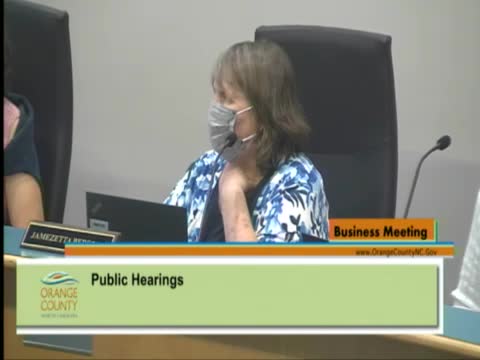
Board action and next steps: The Board opened and closed public hearings for both the consolidated plan (item 5A) and the 2025 Annual Action Plan (item 5B) at the May 20 meeting after receiving public comment and hearing staff presentations. The board did not adopt the final plan at the meeting; Rosser said the public comment period remains open through June 9 and that the collaborative and municipalities will consider the final draft in mid‑June with a targeted county approval date on the June 17 agenda. After municipal approvals the consolidated plan will be submitted to HUD.
What remained unresolved at the meeting: Residents asked how applications will be processed, whether mobile homes or manufactured housing will be eligible for repairs, and whether some HOME repair awards will be loans with liens (staff said larger essential single‑family rehab awards can carry 0% interest loans while smaller urgent repairs typically do not). Commissioners asked staff to expand outreach through churches, neighborhood groups and the Home Preservation Coalition and to clarify program eligibility and how the county will coordinate the HOME repair programs with existing county and nonprofit repair efforts.
Community reaction and context: Several speakers, including Justice United and residents from historically Black neighborhoods, framed repair funding as a tool to reduce displacement and preserve long‑time communities. Rosser summarized community engagement across the county and emphasized that the recommended focus was a local collaborative decision to maximize immediate impact while preserving options for development funding through other county resources.
The Board will return the final consolidated plan and the Annual Action Plan for adoption after the public comment period and municipal approvals; staff will present exact dollar figures and program implementation details in the coming weeks.