Get Full Government Meeting Transcripts, Videos, & Alerts Forever!
Get email alerts on the Policing And Public Safety topic
No spam. Unsubscribe anytime.
Community groups urge Houston council to tag police contract amid budget shortfall and racial‑profiling concerns
Summary
Speakers at the May 20 Houston City Council meeting urged councilors to delay approval of a proposed police contract, citing a projected budget shortfall, racial disparities in traffic stops and use-of-force incidents, and limited public transparency.
Community groups, former law enforcement officers and advocates urged the Houston City Council on May 20 to delay action on a proposed police contract and related budget moves, saying the city faces a multi‑million‑dollar shortfall and that Houston Police Department practices show racial disparities.
At the meeting, speakers pressed councilors to "tag" the contract—that is, postpone a vote—while council and city finance staff resolve questions about an ongoing drainage case and the city controller's ability to certify the budget.
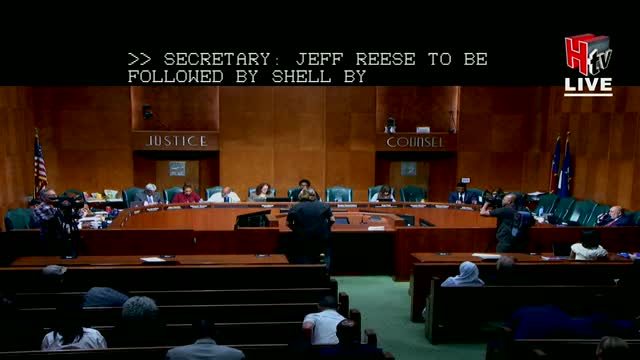
Former Harris County Sheriff's Department sergeant Jeff Reese, who said he served 26 years, told the council that much of the disputed policing comes from routine traffic stops. "Most of these are minor traffic stops. Some cities have actually had their officers stop enforcing the minor traffic offenses because this is where usually where you get into these self fulfilling prophecy," Reese said, arguing departments should focus on more serious crime.
Community activist Shelby Stewart cited 2023 Houston Police Department stop data and highlighted neighborhood impacts: "If you have African American men and women put together and they make over 50% and a 22% of the population, that sounds like a serious problem," Stewart said, naming several neighborhoods including Acres Home, Sunnyside, Third Ward and Denver Harbor.
Organizers and advocates tied the policing debate to the broader city budget. Terry Chen, a community organizer with WOODY Juntos, said the proposed raises in the police contract are unaffordable and would worsen an already projected shortfall. "The raises are estimated to cost $832,000,000 over the course of the agreement and at least $76,000,000 this year alone," Chen said, and warned the money could mean cuts to other services.
Several speakers linked budget concerns to a separate legal matter. Activist Tracy Hamblin said the city's budget "is in violation of multiple court orders and the city charter" in relation to an ad valorem drainage case, and said a court requirement to transfer $100,000,000 into a drainage fund is not reflected in the proposed budget. "We don't have the money to give the police department a raise," she said, urging councilors to tag the item.
Other public commenters urged stronger oversight and quicker use of profiling data. Civil rights lawyer Randall Callanan, representing community groups including the Greater Houston Coalition for Justice, urged monthly review of police stop data and recommended implicit‑bias testing and supervisory review for outlier officers. "If there could be more of a quicker review of that data to see, like, on a monthly basis, what exactly, is happening," Callanan said, "we should look into that."
DeMaris Gonzalez of the Texas Organizing Project linked policing concerns to immigrant communities and criticized coordination between local policing and federal immigration enforcement. "For several months, the Houston Police Department has been collaborating with ICE, contributing to the separation of hundreds of families," Gonzalez said.
Representatives of law‑enforcement groups also spoke. Ellis Stafford, president of the National Organization of Black Law Enforcement Executives (NOBLE), offered the group's expertise to the council on reform and data interpretation. "We don't want any funding or anything. Everything from how to reduce crime, how to reduce racial profiling, how to recruit. We can help you usher in new officers from veins of recruiting that probably have been overlooked," Stafford said.
Councilors did not vote on the police contract during the hearing. Several council members responded to individual public commenters, and council staff and members pledged follow‑up with constituents who raised personal complaints or asked for meetings. No formal city action on the contract was recorded during the session.
Speakers repeatedly urged elected officials to delay the contract vote until the drainage case and the city's budget certification are resolved, and to increase transparency around negotiations. The council is expected to consider related budget and contract items at upcoming meetings; no vote was taken on May 20.