Get Full Government Meeting Transcripts, Videos, & Alerts Forever!
Get email alerts on the City Budget topic
No spam. Unsubscribe anytime.
City of Chico presents conservative proposed 2025–26 budget as revenues flatten
Summary
City staff presented a cautious proposed fiscal 2025–26 budget on May 20, outlining flat projected revenues, growing pension and community services obligations, and limited new staff additions. Council directed staff to return with follow-ups during the budget process.
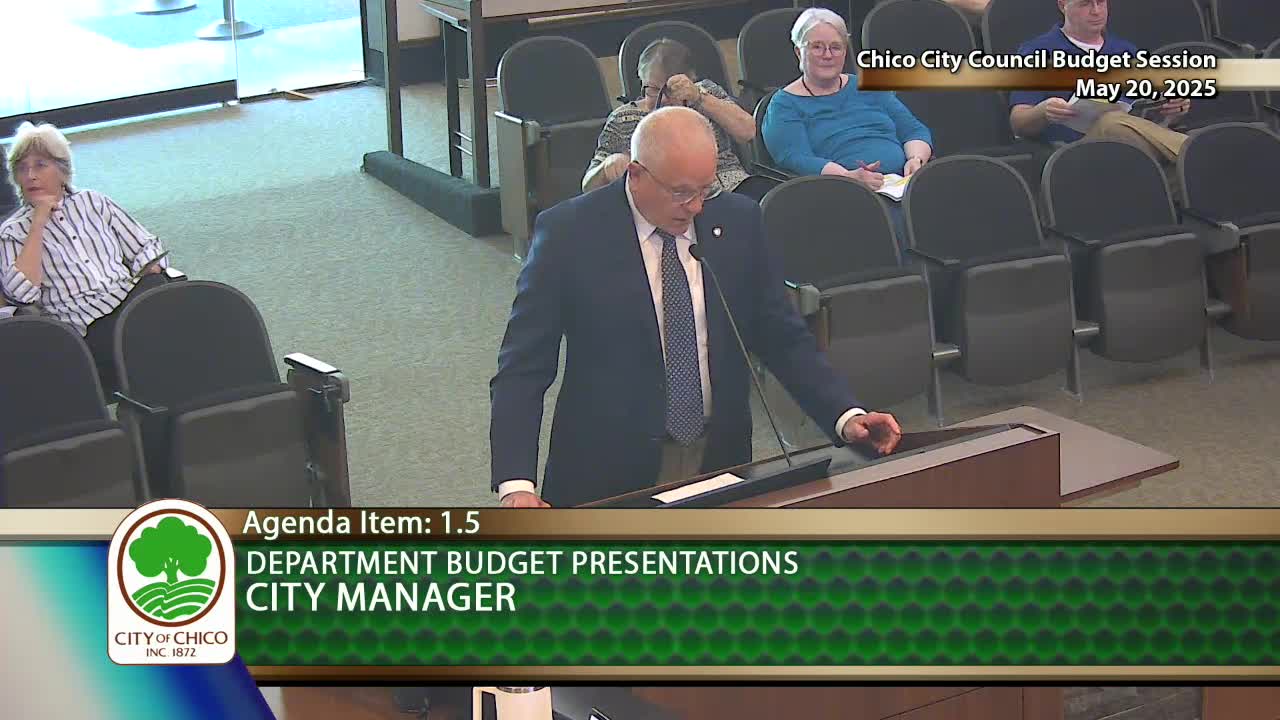
City Manager Mark Sorensen and Administrative Services Director Barbara Martin presented the city’s proposed fiscal 2025–26 budget, telling the City Council that overall revenues are expected to be nearly flat and the draft plan is intentionally conservative. The budget message describes a difficult revenue outlook driven primarily by slowed sales tax growth, rising benefits costs and the phaseout of temporary grants that had supported community services.
Martin said sales tax — the city’s largest single discretionary revenue stream — remains volatile and that consultant HDL’s most recent statewide data through December 2024 show about a 1% statewide decline for the current year; local projections include a decline in the Bradley-Burns tax from prior expectations. She said the draft budget shows a net change of roughly 0% for the general fund next fiscal year (noting settlement proceeds of $1.7 million that affect that line). Martin also highlighted Measure H revenue as a stabilizing, but still-young, source of funding.
Why it matters: the budget funds most city operations, covers public safety and infrastructure work, and directs transfers into reserves and replacement funds that protect long-term fiscal stability. The city’s conservative posture aims to maintain service levels while reducing risk from uncertain outside funding and investment market swings.
Key details - The budget adds a single new permanent full-time position: a low-voltage (network cable) technician; the rationale is that hiring one technician will reduce contracted costs. - Community Services Fund obligations for homelessness-related activities were presented at about $5.2 million annually; previously those costs were offset partially by grants that are now phasing out. - The city’s emergency reserve is projected to be above $15 million at the end of 2025–26. A Section 115 pension trust balance was projected at about $8 million. - CalPERS unfunded accrued liability was reported from the city’s actuarial data at about $177 million; required payments for CalPERS were described as a major cost driver and hard to predict.
Martin said the general-fund operating activities (revenues less ongoing operating costs) remain in surplus and that surplus dollars are used to fund capital projects, transfers, and pension/reserve accounts per policy. She emphasized salary and benefits as the city’s largest ongoing cost, noting scheduled salary step increases, an insurer estimate for health insurance rate changes, and sensitivity to CalPERS investment returns.
Council reaction and next steps Council asked multiple clarifying questions about the Measure H/Bradley-Burns sales tax differences, the Section 115 pension trust, and which funds pay for particular programs. Council members expressed interest in additional analysis where budget trade-offs would be needed, and the city manager and finance staff said they will bring follow-up information back as the budget process continues. No final budget adoption was made at the presentation; staff will return with additional detail before the final budget adoption deadline.
Ending City staff described the proposed 2025–26 budget as conservative and designed to protect service levels amid uncertain revenue and rising long-term liabilities. Council members asked for follow-up detail on specific spending priorities and reserves during the upcoming sessions before final adoption.