Get Full Government Meeting Transcripts, Videos, & Alerts Forever!
Get email alerts on the Municipal Buildings Energy topic
No spam. Unsubscribe anytime.
Carbondale environmental board reviews town building electrification, water stress, composting plans; board recommends new member
Summary
Trustees and staff heard updates on a state electrification grant for Town Hall and retro‑commissioning at the rec center, rising water stress and a smart‑meter pilot recommendation, discussions about expanding composting services, and a trustee committee vote recommending Beth Schumaker to the environmental board.
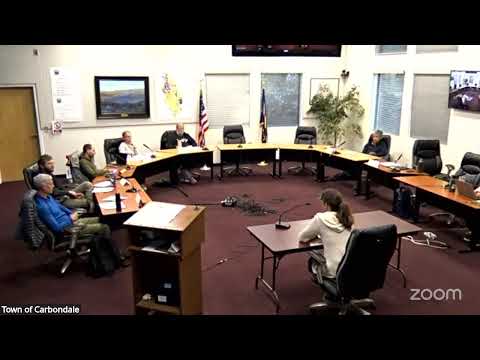
Carbondale trustees and staff on an environmental board meeting reviewed progress on a state electrification grant for Town Hall, retro‑commissioning work at the recreation center, a proposed path toward “net zero” building measures, early results from a smart water‑meter pilot and several utility projects tied to a strained 2025 water year. The board also heard an extended presentation from Evergreen 0 Waste on expanding composting and voted to recommend resident Beth Schumaker for appointment to the environmental board.
The meeting opened with a buildings update presented by a CLEAR contractor working under the town contract. The contractor said the state energy office had executed a large electrification grant for Town Hall and that Lauren Gister would transition the project; staff still must repair structural roof issues before new mechanical equipment can be installed. The contractor said the grant is a multiyear award the town must spend within two years and described it as “over a hundred thousand dollars.”
The contractor reported separate work at the recreation center: Trane will install new HVAC controls and provide staff training to reduce energy and demand charges. Staff said better control of ventilation and mechanical schedules could move the rec center off a higher Excel demand rate and potentially save the town “$30,000 or more a year” for that building if successful.
Board members discussed training and contractor capacity in the valley. The CLEAR contractor said two technical workshops on air‑source heat pumps had reached dozens of local contractors (one session drew roughly 48 attendees, another about 25) and that further webinars and an in‑person session were planned for the summer and early September.
Trustees also discussed building codes and a staff proposal to develop an aspirational “path to net zero” roadmap. The board was told the recently adopted building code package “encourages” electrification but does not require all‑electric new construction. Staff noted code thresholds (the contractor cited a 5,000‑square‑foot threshold in the adopted code) where higher home‑energy‑rating requirements apply for projects that connect to gas. The board agreed staff will assemble research and convene a community conversation this summer before considering potential mandatory measures, such as requiring home‑energy assessments for existing buildings in Carbondale. Staff estimated residential assessments for single‑family units could range from about $50 (heavily subsidized or free programs) up to several hundred dollars for more detailed evaluations; larger commercial audits would cost more.
On greenhouse‑gas accounting, staff said the town will update its last inventory (2017) after utility data is released in June and expects a refreshed inventory by September.
Utilities and water: staff described 2025 as a low water year. A utilities manager said South Meadow Creek flows are roughly half of last year’s levels and one well at the Roaring Fork well field is offline because of age‑related failure; the well awaits redrilling. The manager said the hydro project startup has a June target after previous delays. The board was also notified of a Second Street sewer replacement scheduled for this summer affecting about four blocks.
On metering, staff said a smart water‑meter pilot is complete and that the town manager will present results and a recommendation to the board of trustees next Tuesday. The manager said the system would provide customers near‑real‑time usage data, leak notifications and improved utility leak‑detection capabilities; staff reported the total deployment cost was likely lower than earlier projections.
Housing: staff reported that a nearby mobile home park (behind Honey Butter, next to the wastewater plant) is listed for sale and that residents are exploring a resident‑owned purchase. Staff described a local nonprofit (Thistle/ROC—Resident Owned Communities) that helps resident groups organize and buy parks, and warned pricing and timing were uncertain; staff said there was an external offer on the property and estimated a response window of roughly 120 days for the residents’ offer (staff called the timeline approximate).
Composting and waste diversion: Alyssa (Alissa in the transcript) Bridal, owner of Evergreen 0 Waste, outlined concerns about the town’s recent community drop‑off approach and recommended a model in which a contractor (Evergreen) operates and manages any local drop‑off site rather than the town being the direct customer. She cautioned that early communications and bear‑safety guidance had been inconsistent and that unmanaged drop‑offs can create contamination and wildlife hazards. Bridal proposed several near‑term ideas: a subsidized subscription pilot (she suggested a 6‑month trial period rather than three months), targeted commercial engagement (restaurants and large food producers diverting organics), and production of educational materials or a training video for event organizers. Bridal provided rough cost guidance for a professional video at about $8,000–$12,000 and said a subscription service could be offered at low monthly rates (she suggested roughly $10/month as an affordable pilot), with the town using existing bag‑fee funds or other municipal funds to subsidize low‑income residents or HOAs.
Board business and votes: the trustees approved the April 21 meeting minutes by voice vote (motion made on the consent agenda and carried; meeting record shows “Aye” but does not list a roll‑call tally). Later the board voted to recommend that the board of trustees appoint Beth Schumaker to the environmental board; the recommending body recorded the motion and a voice vote of “Aye.”
Why it matters: the items discussed combine near‑term infrastructure work (roof repairs and HVAC controls) that enable state grant funding with longer‑term policy choices about building electrification, home assessments and how the town uses limited staff capacity and municipal funds to expand sustainability programs. Water supply constraints and infrastructure repairs also create immediate operational risk for utilities and influence priorities for capital work.
Looking ahead: staff said the Town Hall electrification design work will wait for roof repairs and for final grant execution with the state; the smart‑meter recommendation will appear at the trustees’ next meeting; the VCAPS (Vulnerability, Consequences and Adaptation Plan) update may be presented publicly once materials are condensed; and the town and community partners will continue discussions this summer about building assessment policies, composting pilots and resident options for the mobile home park.