Get Full Government Meeting Transcripts, Videos, & Alerts Forever!
Get email alerts on the Wetlands Mitigation topic
No spam. Unsubscribe anytime.
Pocomoke City discusses options to mitigate fairgrounds wetland disturbance; staff to evaluate off-site parcel
Summary
Pocomoke City Council and staff discussed mitigation options for wetland disturbance at the fairgrounds and directed engineering and permitting consultants to inspect a potential off-site site and report back.
Pocomoke City Council and staff discussed mitigation options for wetland disturbance at the fairgrounds and directed engineering and permitting consultants to inspect a potential off-site site and report back.
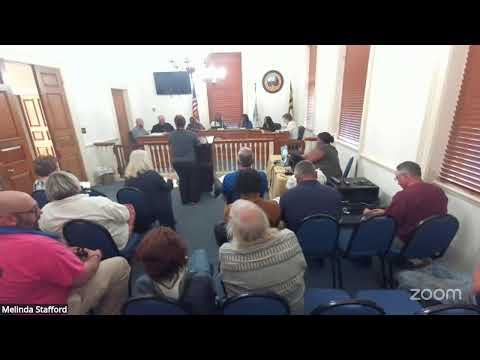
The discussion, led in the meeting by “Mister Wyatt,” described two mitigation paths: option A, restoring the disturbed area on-site to its prior condition; and option B, providing mitigation off-site by converting or restoring a separate property into wetlands. Wyatt said consultants GMV (engineering) and Coastal Compliance (mitigation) had reviewed the situation and outlined likely regulatory and cost consequences. Council and staff agreed to have consultants evaluate a city parcel behind the solar panels as a possible off-site mitigation site and to report their findings to the council.
The matter matters because the city must satisfy environmental permitting and mitigation requirements — including review and approval by the Maryland Department of the Environment (MDE) — before finishing remediation work. Councilors and staff discussed potential impacts to fairgrounds use and event programming if the city pursues an on-site restoration versus off-site mitigation.
Wyatt described technical tradeoffs and the depth of regulatory review. He told the council the city has two primary options: return the fairgrounds area to its prior condition, which he said would likely require extensive work and ongoing regulatory scrutiny, or identify an off-site parcel that could be converted to wetlands as compensation.
On costs and scale, Wyatt said permits alone would be “approximately $10,000” regardless of the mitigation approach and that the larger mitigation and restoration work could raise costs “around $100,000” in his estimate. He described the likely mitigation footprint discussed by consultants as on the order of a few acres; he cited a candidate parcel of roughly 3.3 acres and discussed mitigation ratios that consultants had referenced (for example, a 1.5:1 or 1:1 replacement ratio depending on regulator guidance).
Council members and staff emphasized process and approvals. “We have to find a property,” Wyatt said, adding that any off-site parcel would need MDE approval. Council members asked the consultants to pause active field work until the council and staff agreed next steps so the city would not spend consultant money unnecessarily. Council direction at the end of the discussion asked staff to have GMV and Coastal Compliance visit the identified parcel behind the solar panels, determine whether it is suitable for mitigation, and return to council with findings.
Public commenters and fairgrounds stakeholders spoke in support of finding a mitigation path that preserves the site’s usability for events. One commenter who identified herself as a fairgrounds stakeholder thanked the council and said volunteers and equipment would be available to assist if the city pursues mitigation work.
Next steps: staff will have GMV and Coastal Compliance inspect the solar-panel–adjacent parcel and report back to council with suitability, likely permitting requirements, and updated cost estimates. The council did not take a formal vote on a mitigation plan at this meeting; the action recorded was direction to staff and consultants to investigate and return with recommendations.