Get Full Government Meeting Transcripts, Videos, & Alerts Forever!
Get email alerts on the Behavioral Health Therapeutic Court topic
No spam. Unsubscribe anytime.
Emerald City Behavioral Health proposes Medicaid‑funded model to run Cowlitz County therapeutic court services
Summary
Emerald City Behavioral Health asked Cowlitz County commissioners to endorse a partnership that would make therapeutic court treatment Medicaid‑funded, keep local clinicians in place and move fiscal responsibility off the county, while answering commissioners’ and local providers’ questions about capacity, juvenile services and community outreach.
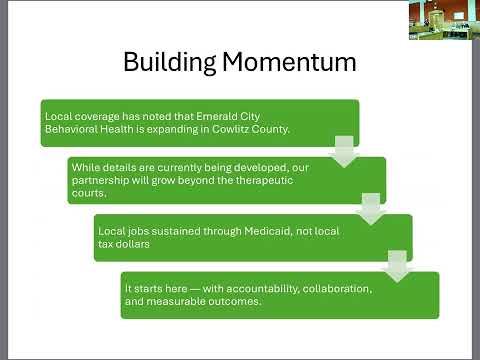
Michael Clark, chief operating officer of Emerald City Behavioral Health, told the Cowlitz County Board of County Commissioners at a workshop that his company could serve as the county’s therapeutic court treatment provider and bill services directly to Medicaid, relieving the county of direct treatment funding.
The proposal would have Emerald City hire and supervise clinicians, provide therapy, case management, peer support and coordinate with probation and court staff; Emerald City would report individual treatment encounters to the court and aggregate outcomes to county leaders, Clark said.
Clark described Emerald City as an established provider with outpatient clinics in Tacoma and Spokane and intensive residential programs, and said it will open an intensive behavioral health treatment facility in Tacoma next year. He said Emerald City treats adults with severe mental illness and co‑occurring substance use disorders and operates an “enhanced services facility,” a step‑down unlocked program for people leaving hospitalization.
“If the court refers, we treat; Medicaid funds the services; the results come back to you,” Clark said. “This partnership is already proven in most all other counties. It’s compliant with every Washington Health Care Authority and DOH requirement.”
Clark framed the model as continuity of care: one consistent clinical team for each therapeutic court participant that would track progress, coordinate step‑down planning for housing and medication, and provide outcome reporting intended to reduce rearrests, jail use and emergency room visits.
Commissioners and members of the bench pressed Clark on capacity and operational details. Commissioner questions focused on whether Emerald City would “import” patients from other counties to sustain a facility, and on guarantees that beds would be reserved for Cowlitz County residents. Clark said operators typically commit a high percentage of capacity to the county they serve (he used a hypothetical “90%” figure in the discussion) and described transport and referral arrangements for occasional out‑of‑county placements.
Judge Hahn, presiding judge for Superior Court, emphasized that therapeutic court programs fall under the court’s jurisdiction and said the courts would need to review and approve any change. Dallas Steelgrange, program manager for therapeutic courts, clarified that funds the county receives for drug court support staff and program operations do not pay for clinical treatment; Medicaid pays for treatment encounters. Steelgrange said existing court funds pay for case managers, emergency housing and program operations, not direct treatment.
Local providers and court staff asked for data. Steve Martin, a superior court judge (he identified himself as a “retired Superior Court judge” during remarks), and others said the presentation relied on national best practices and state examples but lacked Emerald City’s local program‑level outcome data; Clark offered to provide county‑specific or Washington‑state examples and his agency’s outcome reports.
Columbia Wellness CEO Drew McDaniel and other local providers said Emerald City had not reached out to existing county treatment agencies and asked why local agencies were not included in planning. Clark said community engagement was “very fresh” and that Emerald City planned community and stakeholder conversations if the county and courts wish to pursue the proposal.
Commissioners and judges repeatedly said that any formal transition would have to begin with the courts. Commissioner discussion framed the county role as reviewing a court‑led transition plan rather than directing court operations. The board did not take action; commissioners directed staff to refer the proposal to the courts for further discussion and invited Emerald City to provide more detailed data and a transition plan.
Emerald City’s presentation also touched on potential youth services, including a 94‑bed Federal Way youth campus the company is developing; Clark said juvenile services were not yet operational in Cowlitz County but that Emerald City would consider juvenile programs if the courts and community signaled interest.
The discussion closed with multiple requests from judges and commissioners for more detailed, county‑specific outcome data, a clear transition plan addressing existing county employees and case managers, and documentation of Medicaid billing and program compliance. Clark said he would return with additional documentation for court review.
The board did not vote or adopt a resolution at the workshop; members indicated the courts should review and, if the courts approve a plan, bring it back to the commissioners for any county administrative steps.