Get Full Government Meeting Transcripts, Videos, & Alerts Forever!
Get email alerts on the Advisory Opinions topic
No spam. Unsubscribe anytime.
Ethics Commission issues advisory opinions on in‑office lobbying and post‑employment restrictions
Summary
The Florida Commission on Ethics adopted two advisory opinions: one finding an elected mayor's described federal advocacy for his private employer does not violate the in‑office lobbying ban, and another advising a corrections assistant warden that a two‑year representation prohibition will constrain his post‑employment interactions if he takes a private‑sector job with Centurion.
The Florida Commission on Ethics adopted two legally binding advisory opinions at its public meeting: one addressing whether a mayor's private, compensated federal advocacy would violate the in‑office lobbying ban, and another analyzing post‑public‑employment limits for a Department of Corrections assistant warden who has a private‑sector job offer.
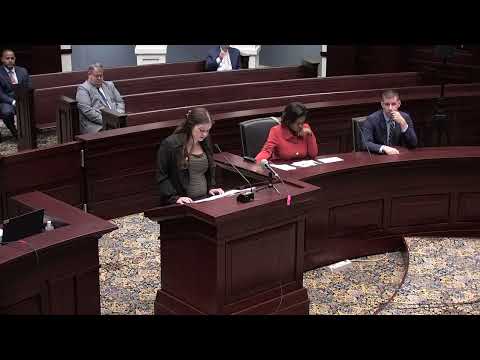
On advisory opinion file 28-19, staff recommended and the commission adopted an opinion that Tim Martin, recently elected mayor of Newberry, would not violate the in‑office lobbying ban if, in his private capacity as national development officer for the John Birch Society, he travels periodically to Washington to advocate on policy issues as part of his normal job duties. The staff memorandum explained that the constitutional ban—quoted in the draft as “A public officer shall not lobby for compensation on issues of policy, appropriations, or procurement before the federal government, the legislature, any state government body or agency, or any political subdivision of the state during his or her term of office”—prohibits being “principally employed for governmental affairs.” Staff concluded Martin’s primary duties, as described to the commission, involve fundraising and not being “principally employed for governmental affairs,” so the described advocacy falls within the “normal course” exceptions in the statutory definition of “lobby for compensation.” The commission voted to adopt the draft opinion by voice vote.
Martin addressed the commission and clarified how he would identify himself on advocacy trips: “I just simply referred to myself as mister Martin,” he said when asked whether he would use the title “mayor.” Martin also told commissioners, “I don't get paid any additional money, for doing any of that. There is no exchange of money, as traditionally probably associated with lobbying,” to describe his role and compensation arrangement.
On advisory opinion file 28-20, staff analyzed a request from an assistant warden at Everglades Correctional Institution who has been offered employment by Centurion, a private vendor that provides inmate health care. Staff concluded that section 112.3185’s procurement‑related restrictions likely do not apply because the assistant warden had not procured or supervised the Centurion contract; however, staff advised that section 112.313(9)(a)4 (the two‑year representation prohibition for certain managerial employees) does apply. Because departmental regions were treated as the operative “agency” for former corrections employees, staff warned that if the assistant warden accepts the Centurion position at Dade Correctional Institution (also in Region 4), the two‑year prohibition will limit his ability to represent Centurion before Region 4 officers on discretionary matters. Staff warned that routine contact may be permissible but that any effort “to influence discretionary decision making by your former agency” for two years would be prohibited. Commissioners adopted the draft opinion after discussion.
Commissioners asked clarifying questions about identification used in advocacy and about the practical limits the two‑year representation ban would impose. Staff repeatedly emphasized the advice is based solely on the facts provided by the requesters and is legally binding only as to those facts.