Get Full Government Meeting Transcripts, Videos, & Alerts Forever!
Get email alerts on the Housing topic
No spam. Unsubscribe anytime.
Port St. Lucie council approves draft housing‑incentives framework, backs near‑term zoning reforms
Summary
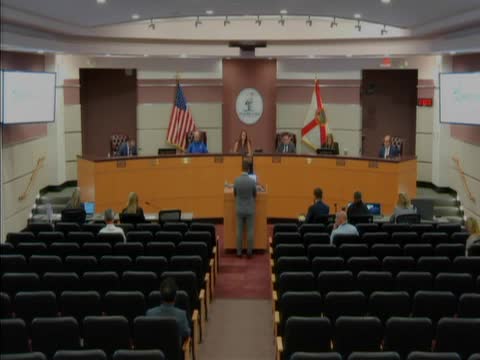
The Port St. Lucie City Council on June 16 approved a draft framework for an "Essential Attainable Housing Incentive Program" and directed staff to pursue near‑term regulatory reforms aimed at expanding attainable housing for essential workers and younger households.
PORT ST. LUCIE, Fla. — The Port St. Lucie City Council on June 16 approved a draft framework for an "Essential Attainable Housing Incentive Program" and directed staff to pursue near‑term, regulatory reforms intended to spur more housing for workers and younger households.
The council voted to approve the draft program language and then approved a second motion to move forward with the so‑called Toolbox Part 2 reforms — regulatory liberalizations such as revisiting the city's minimum single‑family dwelling square footage and the ordinance limiting unrelated occupants in a home. Councilmembers unanimously carried both motions; broader, costlier tools in Toolbox Part 3 (developer fee reductions, mandatory inclusionary zoning and commercial linkage fees) were left for separate consideration.
Why it matters: city staff said Port St. Lucie's 2024 housing needs assessment and a citizen survey (which showed only 18% rated housing availability positively) indicate middle‑income and essential workers are increasingly priced out. Staff framed the draft program as a way for the city to encourage private and nonprofit developers to supply units at price points reachable by essential workers, seniors and younger households without direct city construction of housing.
Staff presentation and council direction Carmen Capizzuto, director of neighborhood services, opened the presentation by summarizing local research and by asking the council for guidance on which incentives to pursue. "What we need today from the city council, is guidance," Capizzuto said. She cited a planning and infrastructure study completed in October 2024 that projected population growth and concluded annexation is fiscally beneficial in many cases.
Deputy City Attorney Russell Ward outlined a three‑part toolbox of options. Toolbox Part 2 covered near‑term, largely regulatory steps: increasing or removing the limit on unrelated persons in a dwelling, reducing or waiving the city's minimum single‑family square footage (currently 1,200 square feet), and creating alternative minimum design standards for projects participating in an incentive program. Ward described Part 3 as broader measures that may carry fiscal costs: bonus density for projects that commit a portion of units to long‑term affordability, targeted zoning reforms, developer fee reductions or land conveyance, and developer contributions or commercial linkage fees to fund affordable units.
Council debate and concerns Councilmembers repeatedly urged a cautious, stepwise approach. Vice Mayor Carballo and Councilman Bona said they supported adopting a clear program vision but favored bringing each major policy (for example, bonus density or fee waivers) back separately with detailed analysis before final approval. Councilman Pickett and others emphasized workforce housing and infrastructure implications, noting that many of the larger incentives rely on available land or annexation.
Several members expressed skepticism about mandatory inclusionary zoning and commercial linkage fees. "Commercial linkage fees are a tax on job creation," Councilman Bona said. Several councilmembers said voluntary developer contributions and pilot projects would be preferable to immediately adopting mandatory, citywide requirements.
Council action and next steps Council approved two discrete actions at the workshop: - Approval of the draft program framework and the city's mission/vision for an "Essential Attainable Housing Incentive Program." (Motion carried; vote recorded as unanimous in the workshop record.) - Approval to pursue the Toolbox Part 2 regulatory reforms (revisiting unrelated‑occupant limits, minimum square footage and alternative design standards) and to defer Toolbox Part 3 for separate policy discussions.
Capizzuto and Ward told the council that many of the Part 2 items would require ordinance changes and, in some cases, comprehensive‑plan work. Staff recommended follow‑up workshops and pilot opportunities — for example, potential redevelopment at the Walton/US‑1 area and other infill parcels — rather than simultaneous adoption of all items.
Direct quotes from meeting participants are drawn from the workshop transcript. Capizzuto: "What we need today from the city council, is guidance." Ward: "My goal is to provide an overview of some of these strategies." Councilman Bona: "Commercial linkage fees are a tax on job creation." Councilman Pickett and others asked staff to return with detailed proposals and impact analysis for each major policy change.
Ending: Staff will return with ordinance language and recommendations for pilot projects and engagement sessions; the council asked for facilitated workshops and for targeted briefings with potential private‑sector partners and lenders before adopting larger, cost‑bearing incentives.