Get Full Government Meeting Transcripts, Videos, & Alerts Forever!
Get email alerts on the Utility Scale Solar topic
No spam. Unsubscribe anytime.
Dinwiddie planning commission deadlocks on 20‑MW Flower Solar rezoning and conditional-use permit
Summary
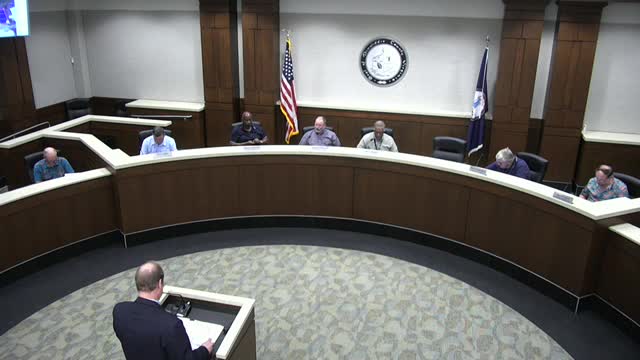
After a three‑hour hearing on June 11, 2025, the Dinwiddie County Planning Commission was split 3‑3 on both the rezoning request (PD‑25‑8) and the conditional‑use permit (C‑25‑4) for a proposed 20‑megawatt Flower Solar project, leaving the matters to the Board of Supervisors without a recommendation.
DINWIDDIE COUNTY, Va. — The Dinwiddie County Planning Commission on June 11, 2025, split 3‑3 on a rezoning request and on a conditional‑use permit for a proposed 20‑megawatt solar facility proposed by Flower Solar LLC, sending both items to the Board of Supervisors without a recommendation.
The project, identified in the packet as PD‑25‑8 (rezoning) and C‑25‑4 (conditional‑use permit), would place a ground‑mounted solar array on five parcels totaling about 196 acres north of Route 460 and south of the Norfolk Southern railroad. Planning staff presented the application and a set of recommended conditions; the applicant and about a dozen residents then spoke during a public hearing that lasted more than an hour.
Planning staff member Mark Bassett opened the hearing by identifying the two cases before the commission: “The case we have for public hearing this evening is PDash25Dash8, and we also have a conditional use permit, CDash25Dash4.” Bassett summarized the key elements in staff’s report, including that panels would occupy roughly 75–76 acres, the fenced area would be about 121.7 acres, a 75‑foot vegetative buffer is proposed around the site, and the applicant removed a previously included 33‑acre parcel from the northern portion of the project.
Steve Romine, an attorney representing Flower Solar LLC, described the revised application and emphasized the company’s characterization of the proposal as a distribution‑connected project. “This is a distribution project, not a transmission project,” Romine said, adding the firm expects the array to interconnect to the Dominion Energy distribution system on the south side of the railroad without a new substation. Romine and other proponents said the project would supply local power, increase grid resiliency for roughly 3,500 households and local businesses, and produce local tax revenues and a one‑time $300,000 payment offered to the county if a revenue‑share option is used.
Planning staff walked commissioners through the recommended conditions tied to the conditional‑use permit. The conditions include required environmental and archaeological surveys and any DEQ and Army Corps approvals, submission of a construction management plan and traffic/road repair plans, a $10,000 landscaping bond for buffer maintenance, requirements for third‑party technical review funding (up to $50,000 per year, county discretion), inspection‑reimbursement provisions for county staff time, and groundwater monitoring with a baseline report and quarterly testing during the first year followed by annual testing.
Residents who own land within and near the project area gave mixed testimony. Several landowners who are participating in the project said leasing or selling portions of the property would provide family income and stabilize estate planning. Alicia Manson, who identified herself as a long‑time Dinwiddie resident and registered nurse, said, “This will bring in revenue for our county.” James Flowers, one of the landowners, said revenues would support family needs.
Opponents focused on local impacts: the private Walker’s Pond Drive access that the project would use, risks to wells and creeks, wildlife and visibility, and emergency access and fire risk. Belinda Inge, who lives on Walker’s Pond Drive, asked, “How will I know if it’s not going to contaminate the well of the chemicals from the solar panels?” Cindy Hargle, another neighbor, told the commission she was skeptical of long‑term environmental effects and asked the commission to “air on the side of caution” and deny rezoning.
The commission debated whether the project fit the county’s comprehensive plan. One commissioner urged adherence to the plan as a guiding document, saying deviation should be rare when the plan is recent. Commissioners also discussed whether promised road improvements and other commitments were sufficiently documented and enforceable.
On the rezoning motion (PD‑25‑8) the commission considered a recommendation of disapproval and the vote resulted in a 3‑3 split. Commissioners then considered the conditional‑use permit (C‑25‑4) with an amendment to add three conditions — requiring (1) specific well testing for adjacent properties, (2) a formal road maintenance agreement, and (3) the applicant’s property‑value guarantee be made a condition — and that vote also ended in a 3‑3 tie.
Because the planning commission is advisory, both tie votes will be forwarded to the Board of Supervisors for final action; the commission record will note the split and the staff‑recommended conditions. Planning staff emphasized that permits required by state and federal agencies (DEQ, Army Corps, VDOT approvals and Dominion interconnection agreements) must be obtained before the CUP could take effect.
Romine and the applicant said they were willing to refine conditions and the road‑maintenance agreement and to include specific well testing of the two adjacent wells if the commission or the Board of Supervisors requests it. Staff also confirmed that decommissioning requirements are detailed in the proposed CUP conditions.
Next steps: both matters will appear on the Board of Supervisors’ docket; the board will take final action on the rezoning and conditional‑use permit and may accept, modify or add conditions based on the record.
Ending — procedural note: commissioners and staff reminded the public that the planning commission’s role is advisory; a tie vote is recorded in the commission minutes and the full board will consider the application and the conditions at a later public meeting.