Get Full Government Meeting Transcripts, Videos, & Alerts Forever!
Get email alerts on the State Budget Sb101 topic
No spam. Unsubscribe anytime.
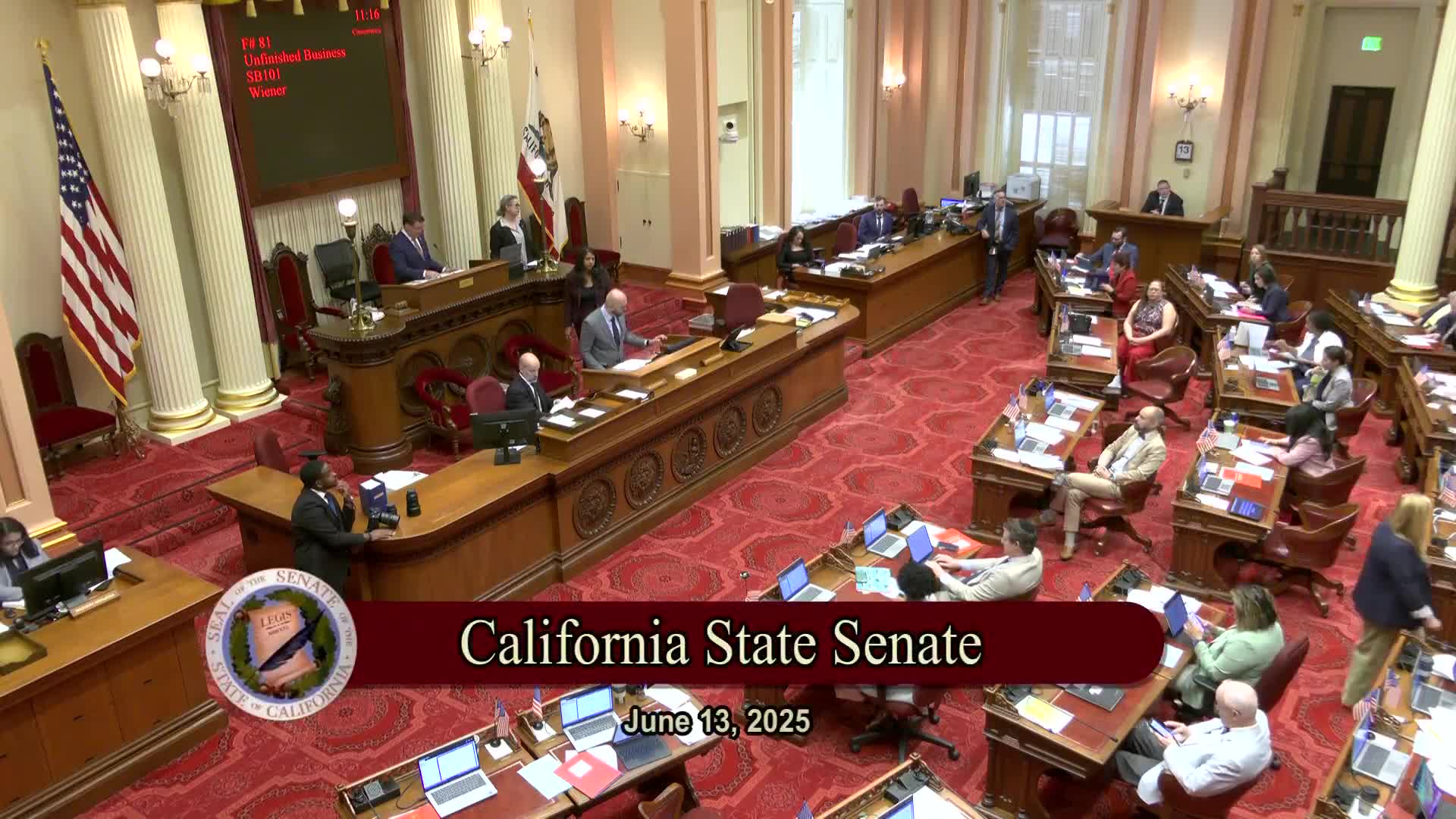
Senate passes SB 101, the 2025 budget act, after extended debate over Medi‑Cal, homelessness and Prop 36 funding
Summary
The California State Senate passed SB 101, the legislative budget package for 2025, after hours of floor debate over revenue volatility, Medi‑Cal changes for non‑citizens, homelessness funding and implementation money for Proposition 36. The bill passed by recorded vote.
The California State Senate passed SB 101, the Legislature’s 2025 budget act, after several hours of floor debate on funding priorities, structural deficits, and program changes affecting Medi‑Cal, homelessness, housing, and criminal justice reform implementation.
Senate Budget Committee Chair Scott Wiener presented SB 101 as the Legislature’s budget package and said it "represents a budget package including $327,700,000,000 in total spending, 231,900,000,000.0 of which is general fund. It maintains 13,200,000,000.0 in combined total reserves." Wiener described the package as preserving significant investments — including reversing proposed cuts to the University of California and California State University systems and funding housing programs such as the low‑income housing tax credit, the Multifamily Housing Program and California Dream For All.
The bill includes targeted responses to the state’s homelessness and transit needs: Wiener said the Legislature added a $1,000,000,000 general‑fund loan to Los Angeles County and a $750,000,000 loan to Bay Area transit systems. The budget also set aside $110,000,000 for initial implementation of Proposition 36, allocated as described on the floor ("50,000,000 for behavioral health services, 30,000,000 for court costs and implementation, and 15,000,000 for pretrial services and to fund public defenders,") and retained an estimated $13.2 billion in combined reserves.
Floor debate reflected deep divisions. Senator Blake Spear supported the bill but warned that it "defer[s] hard decisions to a future date," arguing the budget leans on borrowing and reserves. Multiple senators, including Milo and Choi, argued it relies on fragile revenue sources and does not address a structural deficit; Senator Choi said the budget "appears structurally imbalanced" and cautioned that it depends on "volatile capital gains." Several senators — including Senator Weber Pearson and Senator Perez — defended aspects of the package, saying it shielded many vulnerable Californians from deeper cuts. Senator Weber Pearson stated on the floor, "We will not be disenrolling anyone from Medi Cal... No one currently covered will automatically lose their health care coverage."
Several senators urged additional or different priorities. Senator Strickland and others criticized the budget’s long‑term sustainability. Senator Menjivar warned that Department of Health Care Services figures show enrollment impacts under the proposed freeze would result in losses of coverage over time (she cited DHCS projections that a freeze could produce 32,000 fewer enrollees initially and grow in later years). Senator Adegin, chair of the Senate public safety committee, detailed the $110,000,000 Proposition 36 allocation and emphasized that implementation will require multiple years and cost sharing with counties.
On procedural disposition, the Senate took a recorded vote on SB 101; the chair announced the result on the floor as "Aye 26. No 8. The measure passes." The bill then moved to the next steps in the budget process. Votes recorded on the floor reflect the final legislative passage in the Senate that day.