Get Full Government Meeting Transcripts, Videos, & Alerts Forever!
Get email alerts on the Trails topic
No spam. Unsubscribe anytime.
Carson City outlines 100+ mile trails system, funding sources and starts local e‑bike discussion
Summary
Trails coordinator Greg Bergman told the joint meeting that Carson City manages more than 100 miles of trails, highlighted funding partners and volunteer networks, and urged the committees to consider how to manage electric bicycles consistent with Nevada Revised Statutes and federal land rules.
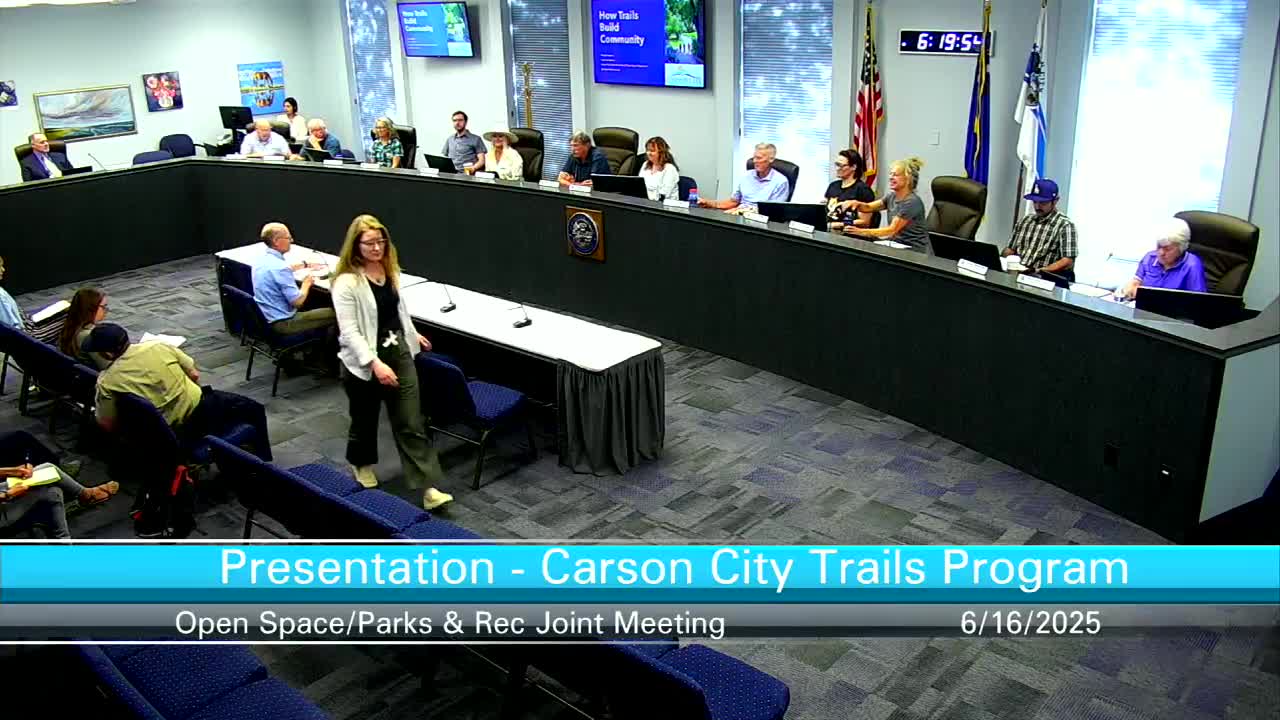
Greg Bergman, trails coordinator, gave a broad overview of Carson City’s trails network and the city’s approach to planning, construction and maintenance. He told the joint Open Space Advisory Committee and Parks and Recreation Commission meeting that trails serve transportation, recreation, public health and economic functions.
The nut graf: Bergman said Carson City now manages a diverse network — more than 100 miles total — and relies on a mix of federal grants, local partners and volunteers to build and maintain trails; he also flagged e‑bikes as an emerging management issue that will require public discussion.
Bergman said the city has more than 100 miles of trails inside its boundary, including over 50 miles of single‑track, more than 25 miles of paved shared‑use trails and roughly 15 miles of accessible double‑track. He also said the city manages over 25 miles of off‑highway vehicle (OHV) trails; the municipality’s OHV area is unusual among cities and supports dirt bikes, side‑by‑sides and other recreational vehicles.
On funding, Bergman listed common federal and state sources the city uses: Recreational Trails Program grants (Federal Highway Administration), Federal Lands Access Program (FLAP) grants for trailheads and access, and Southern Nevada Public Lands Management Act (SNPLMA) funds. He said the Mills Park master‑plan implementation has attracted substantial grant funding over time — noting about $24 million in total funding linked to large park implementation efforts — and that projects often require local matching funds and partner commitments. Bergman credited partners including Muscle Powered, Nevada State Parks, U.S. Forest Service, Visit Carson City and private landowners for key projects such as the Capital to Tahoe Trail.
Volunteers are central to building and maintaining trails, Bergman said; the city’s ability to show volunteer support has helped secure and justify grant funding. He described the typical development process: planning, NEPA and historic‑resource coordination where applicable, easements and partnerships, engineering and then construction to standards (USFS/IMBA for single‑track; AASHTO for paved multi‑use trails).
Bergman spent the last portion of his presentation on electric bicycles. He summarized Nevada Revised Statutes and definitions: an e‑bike is a device with pedals and a motor of no more than 750 watts, divided into three classes (class 1 pedal‑assist to 20 mph; class 2 throttle to 20 mph; class 3 pedal‑assist to 28 mph). He explained that state law generally allows e‑bike use where conventional bicycles are allowed (streets, bicycle lanes, shared‑use paths) but federal land managers may exclude e‑bikes on natural‑surface trails crossing federal lands; local authorities may also regulate shared‑use paths and natural surface trails under certain conditions. “We don’t have an ordinance related to e‑bikes, so we defer to the NRS,” he said.
Committee members asked about trail wear, enforcement and whether city rangers would enforce any local e‑bike rules; Bergman said research indicates properly defined e‑bikes do not create more per‑mile trail wear than conventional bikes, but higher‑power machines and throttle‑style devices can cause localized trail damage. He urged community engagement and public education on e‑bike etiquette and potential speed thresholds as one way to manage mixed use.
Ending: Bergman asked the committees to consider e‑bikes as part of the next round of community engagement and to treat trail planning as a cross‑departmental effort that ties into public health, transportation and habitat protection goals.