Get Full Government Meeting Transcripts, Videos, & Alerts Forever!
Get email alerts on the Budget And Finance topic
No spam. Unsubscribe anytime.
Sheridan council approves FY26 budget, council debate highlights project‑specific restrictions on large reconciliation funds
Summary
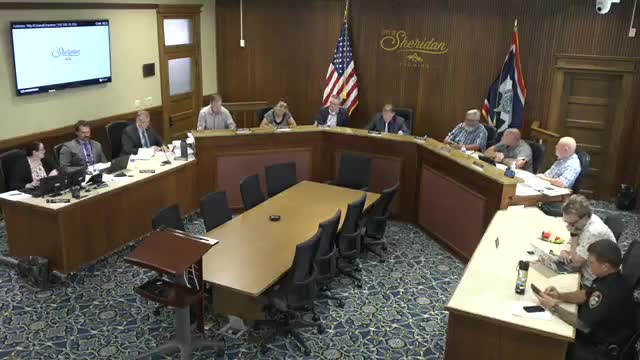
The Sheridan City Council voted 6‑1 on Monday to approve Resolution 17‑25, adopting the fiscal year 2026 budget and certifying the city’s mill levy after a public hearing and extended discussion.
The Sheridan City Council voted 6‑1 on Monday to approve Resolution 17‑25, the fiscal year 2026 budget, and to certify the city’s mill levy following a public hearing and extended council discussion.
City Administrator Stuart McCray told the council that the large reconciliation sum the city expects in November—referenced in the meeting as about $45,000,000 and held in Fund 400—is not flexible for general use and is largely accounted for by project‑specific sources such as capital tax or public‑benefit funds. ‘‘None of that is money that can be redistributed. That’s all accounted for in projects,’’ McCray said.
McCray outlined the timing and process: staff will reconcile fiscal year 2025 at year‑end and present a line‑by‑line reconciliation after June 30 that shows unspent balances and any budget surplus the council may reallocate. He said surplus from unspent line items after reconciliation would be available for council decisions but that Fund 400 monies are project‑specific and not subject to council reallocations. McCray also noted ongoing work to pursue outside grants: he said he expected a positive recommendation for a $500,000 MRG grant toward one 4‑wheel‑drive fire engine the city plans to buy, and that the city’s second hub request of $1,000,000 was likely to be funded at half.
Several council members and the public voiced concern that proposed reductions to street sweeping, pavement preservation, striping and snow removal in the proposed budget would leave critical maintenance underfunded. One council member said the council had been ‘‘assured’’ those items would be prioritized if a budget surplus emerges after reconciliation. Council members raised practical questions about the origin and use of rollover or surplus funding; McCray described surplus as funds left unspent at fiscal‑year close that could be reallocated, distinct from the project‑tied Fund 400 balances.
Council discussion included a question about the local effect of a single mill; meeting remarks estimated the average household effect at about $45 per mill. McCray warned that intentionally not taking the full allowable mill levy can affect eligibility for certain state funding programs; he said the state may view a jurisdiction that declined to take its full mills as less likely to have paid its ‘‘fair share’’ and could be less enthusiastic about awarding State Revolving Fund (SRF) or similar money.
Two proposed amendments to the budget failed. A motion to remove funding for art acquisitions while retaining funds for public‑art maintenance received no second and failed. A second motion to eliminate the city’s membership fees to the Wyoming Association of Municipalities also failed for lack of a second. The council then returned to the main motion to approve Resolution 17‑25 and certified the mill levy; the motion passed 6‑1.
Ending: The council approved the budget; staff will reconcile fiscal year 2025 and return with a line‑by‑line summary of available surplus for council consideration later this year.