Get Full Government Meeting Transcripts, Videos, & Alerts Forever!
Get email alerts on the Tort Reform topic
No spam. Unsubscribe anytime.
Senate committee holds bill to raise Virgin Islands government tort cap after AG urges aggregate cap and other changes
Summary
A bill to raise the maximum judgment amount that claimants may recover against the Government of the Virgin Islands was presented June 12 and held in committee while the attorney general prepares draft amendment language.
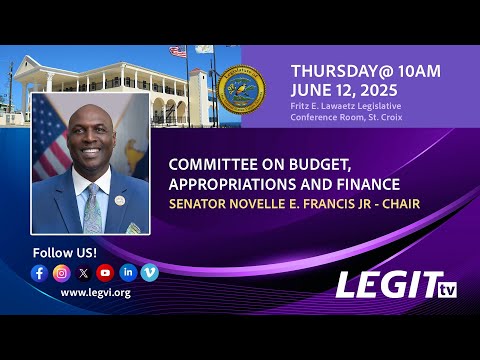
A bill to increase the maximum judgment amount available against the Government of the Virgin Islands was presented and held in the Committee on Budget, Appropriations and Finance on June 12.
Senator Alma Francis Heidegger introduced Bill No. 36‑0042, which would amend Title 33, subtitle 3, chapter 118, section 3411 to raise the statutory cap that currently limits recoveries against the territorial government. "The $25,000 figure has been on the books since the early 1970s," Sen. Francis Heidegger told the committee, and she said lawmakers should update the cap to reflect current costs and allow injured residents greater recovery.
Attorney General Gordon C. Ray appeared as the committee’s invited testifier and recommended a more detailed approach than a simple numeric increase. Ray said courts have interpreted the current statute in a way that allows multiple recoveries from a single incident — multiplying government exposure when there are several plaintiffs. "Although a cap of $25,000 exists, courts within the territory have construed that cap in a manner that's greatly expanded the government's liability," Ray said in his testimony.
What the attorney general recommended: Ray and Christopher Timmons, chief of the Justice Department’s civil division, urged the committee to consider three principal changes if the cap is raised:
- Make any cap an aggregate limit per occurrence or related series of acts, not a per‑plaintiff cap that multiplies with each claimant; Ray offered examples from other states that use both a per‑person limit and a higher aggregate limit for a single incident.
- Add statutory language allowing the government to be substituted as the defendant when an employee is sued for acts within the scope of employment (as in the Federal Tort Claims Act), so employees are not personally liable where the government accepts responsibility up to the statutory cap.
- Reinstate by statute the public‑duty doctrine and clarify exceptions for intentional or willful misconduct. Ray argued that some recent local case law has expanded government exposure by treating general statutory duties as creating a private right of action; a public‑duty carveout would limit liability for duties owed to the public at large.
Ray said the Justice Department would support a moderate increase in the cap if these protective measures were included. "As a result, the Department of Justice would propose limiting any increase in the cap to somewhere between $50,000 and $100,000, but only if the law is amended to make this an aggregate cap on all claims and causes of action to be apportioned among all plaintiffs harmed by a government employee or employees acting within the scope of their duties in a single occurrence," Ray said.
Committee action and vote: Senator Hubert L. Frederick moved to hold Bill 36‑0042 in committee at the chair’s request to allow the attorney general and committee staff to draft specific statutory language implementing the suggested changes. The motion was seconded by Senator Maurice C. James and passed by roll call: Dwayne M. DeGraff, Ray Fonseca, Hubert L. Frederick, Maurice C. James, Kurt A. Viola and Nobel E. Francis Jr. voted yes; one senator was recorded as absent. The clerk recorded "6 yeas, 1 absent." The committee will await proposed drafting language from the Department of Justice and the bill sponsor before further action.
Why it matters: Raising the cap without structural safeguards could substantially increase the government's contingent liabilities, committee members and Justice Department attorneys warned. The committee asked the attorney general to draft amendment language addressing aggregate limits, substitution for employees, and the scope of government duty before the bill is returned to committee.
Ending: The bill remains held in committee at the request of the chair pending DOJ drafting of amendment language and follow-up by the sponsor.