Get Full Government Meeting Transcripts, Videos, & Alerts Forever!
Get email alerts on the School Finance topic
No spam. Unsubscribe anytime.
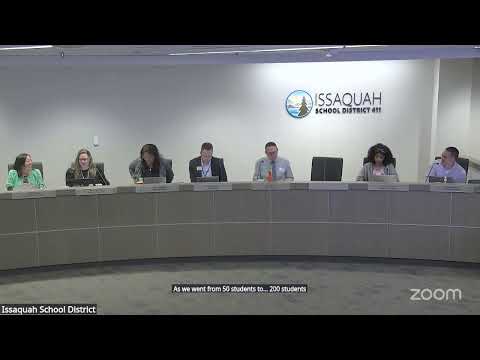
Issaquah School District board hears budget update as enrollment dips; monitoring report accepted
Summary
The Issaquah School District Board of Directors on June 10 received a budget and monitoring report from district finance staff that outlined a shrinking student population, new state funding changes, and continued structural gaps between expenditures and revenue.
The Issaquah School District Board of Directors on June 10 received a budget and monitoring report from district finance staff that outlined a shrinking student population, new state funding changes, and continued structural gaps between expenditures and revenue.
Chief of Finance Operations Martin Tourney and Executive Director of Finance and Budget Mariah Banasic told the board the district expects enrollment to fall by about 300 students (roughly 1.9 percent) for 2025–26, which the presentation said translates to about $4 million in reduced revenue. The board then voted to accept the monitoring report.
The monitoring presentation placed the enrollment loss alongside several legislative changes that affect district finances. Tourney said the state’s adjustments to special-education funding — including a funding multiplier now consolidated to 1.16 and a statutory cap raised to 16 percent — will produce new revenue for the district, and he said that change “kicks out about $1,400,000 in the next year for us.” The district also reported a safety-net apportionment submission of roughly $6,100,000 and an expected MSOC (materials, supplies and operating costs) increase of about $860,000, while transportation funding remains an area the district hopes to address in future sessions.
Banasic summarized enrollment and fund-balance projections: the district expects a net drop in enrollment that, combined with planned curriculum investments and cost pressures such as rising insurance, reduces the fund balance. The presentation said a one-time legislative payment of about $903,000 is expected in June and that updated revenue assumptions and transportation offsets reduce the projected fund-balance decline for 2024–25 from an earlier $9 million estimate to about $5.8 million.
The district reported total federal funding of $8,600,000 (about 2.1 percent of the district’s total budget) and said federal-proposal scenarios under discussion could cut at least 14 percent of that funding. (Transcript figures on the dollar value at risk were inconsistent; see provenance and clarifying details.)
Banasic and Tourney also reviewed the district’s “start/stop/continue” budgeting framework for 2025–26. Notable items presented: an equity-based budget framework, a reduction of the recurring curriculum investment to a $3 million baseline (the presentation said last year’s larger $6.5 million investment is being sunset), continued investments in preschool and before- and after-school care, and targeted reallocations rather than broad expansion in operations.
Board members pressed staff on specifics. Director Mollinis asked for clarification about transition-to-kindergarten funding after the presentation noted the state will fund the existing TK sections (about 75 students) but is not treating TK as part of basic education; staff said the state’s approach supports current sections but does not guarantee additional funding beyond those positions. Director Cline asked whether the district can “recapture” students in Running Start programs; a district staff member said Running Start is a state-guaranteed option that the district must allow, and the district’s online offerings are not designed specifically to replace Running Start but could be an alternative for some students.
Superintendent Talia and finance staff stressed that the district remains structurally underfunded in key categories — special education, MSOC and transportation — and that long-range planning (two- to four-year outlooks) and ongoing monitoring will guide decisions this summer and before the August budget presentation. Tourney and Banasic said staff will finalize documents and a budget guide within about a month and return with a more detailed presentation at the August meeting.
Action taken: the board voted to accept the district monitoring report and later approved the policy governance monitoring calendar for 2025–26.