Get Full Government Meeting Transcripts, Videos, & Alerts Forever!
Get email alerts on the City Budget topic
No spam. Unsubscribe anytime.
Glendale staff outline $12.7 million shortfall; council told to weigh parking fee, lease renegotiations and defunding 33 vacant positions
Summary
City staff told the Glendale City Council it expects to adopt a budget that still leaves roughly a $12.7 million shortfall for 2024–25 after one‑time fixes, and presented revenue options, lease renegotiation and defunding 33 vacant positions as near‑term strategies to reduce the gap.
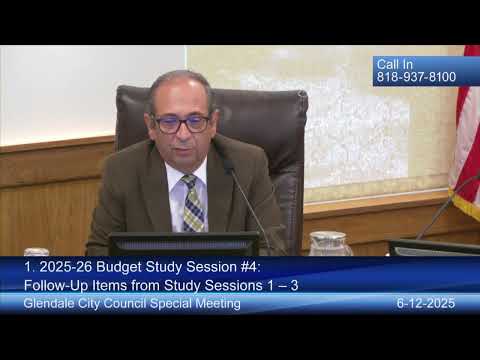
City staff briefed the Glendale City Council on Thursday on a projected shortfall in the city’s 2024–25 budget and options to close the gap ahead of the June 24, 2025 public hearing and adoption.
Assistant City Manager and acting finance director John Tocalian said staff expects to present a proposed budget that would close the immediate year with about a $12.7 million deficit after using roughly $8.6 million of one‑time balancing maneuvers. He said the city’s broader structural imbalance is much larger: “future years, you still have a 30 plus million dollar structural imbalance, moving forward,” and warned reserves could fall near the charter minimum by 2027–28 without durable fixes.
The report lists revenue and spending moves the city could pursue. On revenues, staff said council gave majority support in earlier sessions to a short list of concepts that includes parking fee changes, a half‑cent or quarter‑cent sales tax, a commercial vacancy tax, digital billboards, concierge fees and other smaller items. Tocalian said including the parking fee change in the budget adoption would add roughly $968,000 a year to revenues: “Doing so would increase our revenues by about a million dollars or more specifically about $968,000.”
Staff also described a package of one‑time savings and deferrals used to narrow the 2024–25 gap: cancelling a $2 million transfer to the Fleet Fund, postponing a $10 million transfer to the CIP fund, cancelling a building maintenance transfer and departmental reductions and defunding 33 currently vacant positions (a step staff said would save roughly $3.6 million in the general fund). The city manager said the vacancies were identified in consultation with department heads and the executive team and characterized the hiring pause as a review process rather than permanent eliminations.
Council members pressed staff on details. Council member Garpetian asked whether the “2,200 calls for service” cited for animal control represented distinct people served or simply requests; Police Department staff said that figure is calls for service and that the number of people assisted varies by incident. Tocalian also reported an internal audit on take‑home vehicles: “We have a total of 92 vehicles that are take home, costs annually about $646,000.”
On leases and property revenue, staff presented a complete listing of city leases and noted several coming up for renewal late 2025 and beyond. Council members urged caution when seeking higher market rates for nonprofit arts organizations and small longtime tenants, calling out the Artsakh creative pop‑up program and small businesses such as Urartu Coffee and the Armenian Film Society. Staff said some Artsakh‑area spaces are part of the city’s creative program and one space is vacant and needs roughly $100,000 in rehabilitation.
Staff also identified capital projects that have not expended more than 10% of allocated funds and suggested pausing or delaying some as one‑time ways to reduce pressure on the operating budget. Projects flagged included the Maryland Street/Artsakh Paseo (about $8.7 million remaining, and a $3.75 million shortfall after recent negotiations), Central Park (about $12.7 million remaining and an additional $7.2 million estimated shortfall if bids come in as projected), Pacific natural‑grass and Sports Complex Field 3 among others. Staff cautioned that pausing CIP provides only one‑time relief, not a long‑term solution.
Next steps: staff will prepare the final staff report and proposed budget for the June 24 public hearing and adoption. Council members were asked to submit any remaining questions to the city manager ahead of that hearing so staff can try to respond in the two weeks before adoption.