Get Full Government Meeting Transcripts, Videos, & Alerts Forever!
Get email alerts on the Economic Development topic
No spam. Unsubscribe anytime.
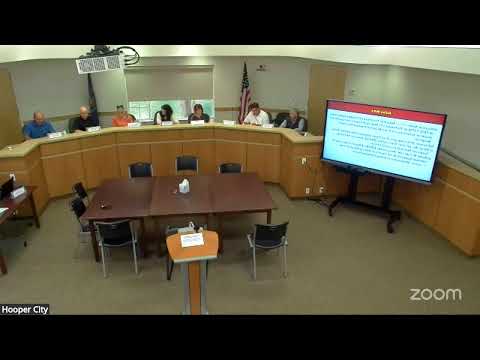
Hooper City Council approves concept for 5500 South development with conditions; rejects city-funded lift station
Summary
Hooper City Council members voted to allow the developer of a proposed project on 5500 South to continue work toward a planned-unit development, provided the city is not asked to use a CRA or existing tax revenues to fund a sewer lift station.
Hooper City Council members voted to allow the developer of a proposed project on 5500 South to continue work toward a planned-unit development (PUD), but set several conditions and said the city should not fund a lift station for the project.
The council’s direction, approved by motion, authorizes the developer to move forward with drafting a development agreement and with zoning and general-plan changes necessary for a commercial corridor and associated housing, provided the city is not asked to establish a community reinvestment area (CRA) or otherwise use existing tax revenues to fund the sewer lift station. The motion also asked that the commercial portion be built according to the build-out assumptions used in the fiscal impact study presented to the council and specified lot-size guidance (acre lots on the west side, half-acre lots on the north; other areas to be decided).
The Terra Stradeck representative told the council their application envisions commercial along 5500 South and residential parcels behind it, and argued the PUD would align with the city’s general plan. "We actually think the PUD follows the general plan very clearly," the representative said. They recommended that any council approval be contingent on a development agreement that settles timing and financing details before final approvals.
Residents who spoke during public comment were divided. Bob Deandoy, a resident who said he lives in Roy, urged the council to welcome a large grocery operator, saying a full-service grocer generates stable sales tax revenue. "Put a grocery store in here... you will see a significant difference," Deandoy said, noting grocery stores tend to be "cash cows" for local sales-tax receipts. Maggie Medina Harris, who said she owns property in the area, emphasized long-term local benefits: she said her family had paid to hook up to a pump station years earlier and that jobs and convenience would be reasons to support development.
Other residents opposed the idea of the city funding the lift station. Several commenters asked that the developer fund required infrastructure or ensure commercial build-out before residential construction begins. One attendee said the developer "can fund the whole thing" and that city residents should not be asked to pay through higher taxes or redirected tax revenues.
Council members and staff referenced a fiscal-impact study by LRB (presented to council) while discussing the project’s likely tax benefit. Council members summarized study figures during debate: one member said the analysis showed roughly $107,000 per year in local taxes under one calculation and cited an alternate figure of about $172,000 per year over a multi-decade period; council members said those numbers were smaller than some had expected and depend on the scenario used.
Council members asked for more detail about financing options before committing city funds. Several council members said they were not prepared to authorize the city to be financially responsible for the lift station; instead they directed staff and the developer to negotiate a development agreement that would define responsibilities and staging. The council’s motion included that the project proceed only if elements (commercial build-out, lot sizes, open-space requirements in any patio/55+ zone) were documented in the development agreement and that changes to the general plan and relevant code be brought back for formal approval.
The motion to give the developer direction was made by Council Member Flowers and carried on an affirmative vote. The council asked staff to schedule follow-up meetings and to bring technical experts (on CRA/tax increment financing and sewer financing) to a future work session so the council could make an informed decision about financing options and the proposed development agreement.
Next steps the council outlined include: drafting and negotiating a development agreement, preparing any necessary general-plan or zoning amendments, a staff review of the LRB fiscal-impact assumptions, and additional public and council work sessions. The developer and city agreed to set further meetings to finalize those details.