Get Full Government Meeting Transcripts, Videos, & Alerts Forever!
Get email alerts on the Orm Budget Liability Caps topic
No spam. Unsubscribe anytime.
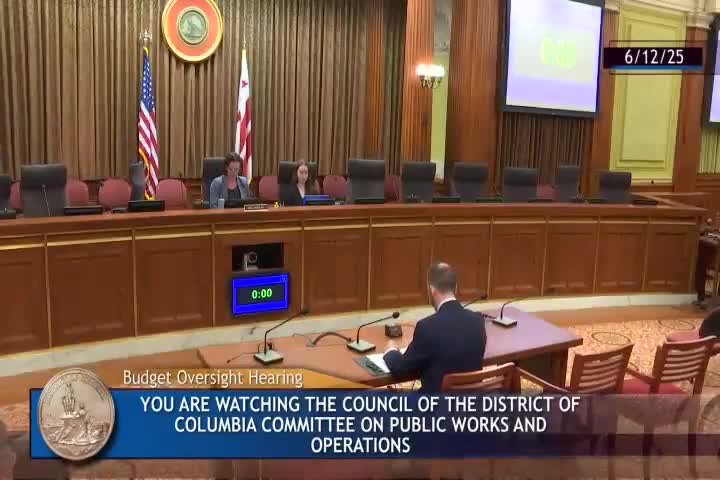
Risk office defends FY26 budgets as council questions proposed liability caps in BSA subtitle
Summary
The Office of Risk Management presented its FY26 budgets and responded to council concerns about a Budget Support Act subtitle that would cap damages for settlements; ORM officials said caps provide fiscal certainty but some council members warned about limiting payouts for severe harms.
The Committee on Public Works and Operations reviewed the Office of Risk Management—s (ORM) FY26 budget and questioned proposed Budget Support Act language that would cap damages in certain claims. Jed Ross, chief risk officer and ORM director, testified the agency—s FY26 operating lines would continue core programs—workers' compensation, tort settlements, captive insurance and risk prevention and safety—while noting funding shifts to reflect claim trends and insurance market costs.
Ross described the four ORM budget codes and figures: the employee compensation fund (BG0) is proposed at $18,285,541 with 51 FTEs; the settlements and judgments fund (ZH0) at $24,000,000 (an increase of $2,975,241); the captive insurance account (RJ0) at $11,732,526 with six FTEs; and the ORM operational budget (RK0) at $4,465,127 with 32 FTEs. He said RJ0 includes additional funding for insurance and professional services such as property appraisals.
Why the proposed caps matter Committee members pressed Ross on a proposed BSA subtitle that would limit damages to $500,000 for single incidents and $1 million for intentional wrongful acts. Ross defended caps as a tool to protect the public fisc and to create a more efficient settlement process, saying in testimony that limits "balance the need for individual compensation against the larger public consideration, of curtailing awards that often far exceed economic losses." He noted many states use caps and that neighboring jurisdictions have lower limits than those proposed.
Council members raised concerns about capping damages for catastrophic harms. One member cited two recent large settlements involving catastrophic injury and death and said it was difficult to see how caps would adequately compensate victims in those cases. Ross acknowledged the tension, but said the lack of caps can lead to very large jury awards and unpredictable liabilities that strain city finances and impede settlement negotiations.
Claims data and trends Ross told the committee that in FY24 there were nine claims exceeding the proposed limits; in FY25 to date, ORM has received 1,234 total claims and 12 that exceed the proposed limits (five without a specified demand amount). He said the average cost per claim historically is about $8,760, though he cautioned that single catastrophic cases can be orders of magnitude higher and that constitutional claims are handled differently. Ross said the settlements and judgments fund has been exceeded in past years and that the cap is intended to provide fiscal predictability and judicial economy.
Other ORM priorities: prevention and fleet risk Ross described ORM—s risk prevention and safety program, which conducts safety inspections, manages worker compensation claims and coordinates the How Am I Driving program for district drivers. He said ORM intends to improve vendor and provider relations to increase the number of medical providers available to injured workers and to improve claims handling. On fleet safety, Ross described pilots for intelligent speed assistance devices and telematics to improve driver behavior and said pilots are planned with other agencies.
Next steps and committee concerns Committee members asked how pending cases would be treated if caps take effect. Ross said the statutory application would generally apply to judgments or settlements finalized after the effective date, and that cases filed in court on or after the effective date would be subject to the limits. Several members said the policy warrants more public discussion before codifying limits that could affect families who suffered catastrophic losses.