Get Full Government Meeting Transcripts, Videos, & Alerts Forever!
Get email alerts on the Technology Budget Octo topic
No spam. Unsubscribe anytime.
Council committee presses OCTO on $165.7 million FY26 proposal, public‑safety cameras and federal broadband funding
Summary
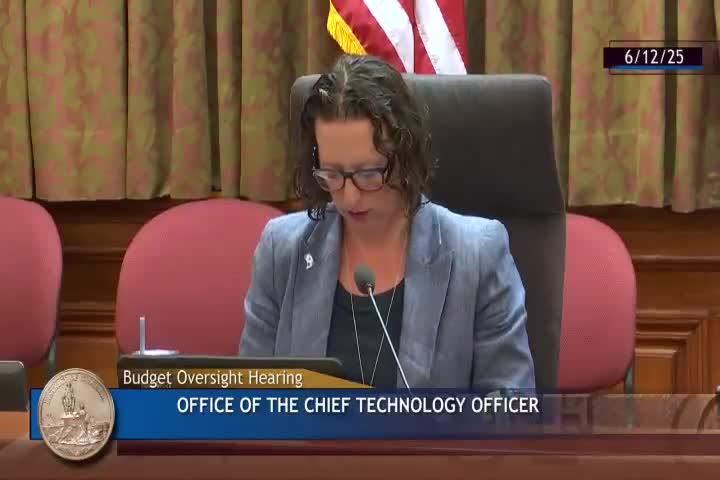
The Committee on Public Works and Operations questioned the Office of the Chief Technology Officer on Mayor Bowser—s proposed FY26 GrowDC budget, pressing for detail on a new public‑safety camera rollout, federal BEAD program funds and cybersecurity and AI governance.
The Committee on Public Works and Operations heard testimony June 12 on Mayor Muriel Bowser—s proposed fiscal year 2026 budget for the Office of the Chief Technology Officer (OCTO). Stephen Miller, OCTO chief technology officer, said the proposal includes an operating request of $165,728,818 and a capital request of $15,941,638.
Miller told the committee the proposal relies heavily on federal and special‑purpose revenue: "The proposed budget for OCTO includes $93,000,000 in local funds, $27,000,000 in special purpose funds, $46,000,000 in federal funds, and $16,000,000 in capital funds," he said. He also described a $3.7 million local enhancement to begin a multi‑year modernization of government camera systems and said some SPR increases align with new federal customers coming on to DC Net.
Why this matters: the committee pressed OCTO for detail on projects that affect public safety, resident services and the district—s use of federal broadband dollars. Council members sought clarity on timelines, security, and how grants such as BEAD will be spent given recent federal guidance and mapping changes.
OCTO—s priorities and projects OCTO—s testimony and budget documents identify several major projects: a multi‑year public‑safety camera modernization that begins in FY26 with an initial tranche of about 2,000 cloud‑based cameras and is planned to reach roughly 6,000 across government facilities by FY28; a Microsoft Azure‑based Cloud Data Exchange to migrate APIs and integrations and create an API marketplace; continued development of the MyOutOfSchoolTime (MOST DC) portal; a $4.5 million allocation for digital services modernization (dc.gov redesign and resident portals); and expanded cybersecurity investments.
On cameras, Miller said the FY26 enhancement will fund an initial 2,000 smart, cloud‑based cameras covering DGS sites, DC Public Schools and other city locations, with agency partners to prioritize installations in higher‑crime areas. He said the multi‑year rollout aims to unify a fragmented camera estate and to create roughly $2.1 million in cost savings compared with current systems. When pressed about security and network protection, Miller said the cameras will run on the city—s secure fiber network and will be managed under a centralized governance model to ensure consistent security controls.
Federal broadband funding and BEAD Miller said about $44.2 million of OCTO—s federal request is tied to the Federal Broadband Equity, Access, and Deployment (BEAD) program, but added that NTIA issued a 90‑day extension and additional guidance in early June. "We cannot provide further updates on the BEAD program at this time," he said, while encouraging subgrantee applicants to be prepared to resubmit when OCTO resumes its competitive process. He also said OCTO and eligible entities are awaiting updated FCC fabric maps required for final planning.
Service delivery, portals and enterprise tooling Miller described a $5.7 million request for improvements to OCTO—s service‑delivery platform and a separate capital allocation to support ServiceNow licensing, HR employee portal functionality, an asset management/CMDB effort, and a secure file transfer capability. He said the MOST DC portal—built with Microsoft Power Platform and Esri GIS—has seen early adoption since its DCPS registration window opened May 21, and OCTO plans additional agency onboarding and parent‑facing improvements in FY26.
Cybersecurity, AI and the Budget Support Act Miller emphasized continued cybersecurity funding and said the Budget Support Act (BSA) subtitle on cybersecurity and artificial intelligence will "refine and clarify the scope of OCTO's authority." He said the language aims to strengthen centralized enterprise IT governance for security and to clarify that AI governance belongs within IT oversight. Miller described ongoing work to implement single sign‑on, multi‑factor authentication and AI governance services for agencies and said OCTO provides AI review and trainings under the mayor—s February 2024 AI order.
Committee concerns and next steps Committee members pressed OCTO on BEAD timelines, on how SPR funds align with federal customer contracts for DC Net, and on concrete milestones for the dc.gov redesign (Miller said content auditing is about 25% complete and a homepage launch is expected within three to six months of the fiscal year start). On camera privacy and security, Miller said the project will include centralized policies and layered network protections.
Miller closed by arguing the investments will modernize city services: "With these investments, we will continue to unleash the possible and propel district residents and businesses safely into the future with technology," he said.
Looking forward: the committee asked OCTO for written detail on BEAD planning, DC Net contracts with federal customers, and the security and governance plan for the camera program. The OCTO portion of the hearing concluded before the committee moved to the Office of Risk Management.