Get Full Government Meeting Transcripts, Videos, & Alerts Forever!
Get email alerts on the City Budget topic
No spam. Unsubscribe anytime.
Council adopts FY 2025–26 budget after contentious debate; vacancy, police and youth funding remain flashpoints
Summary
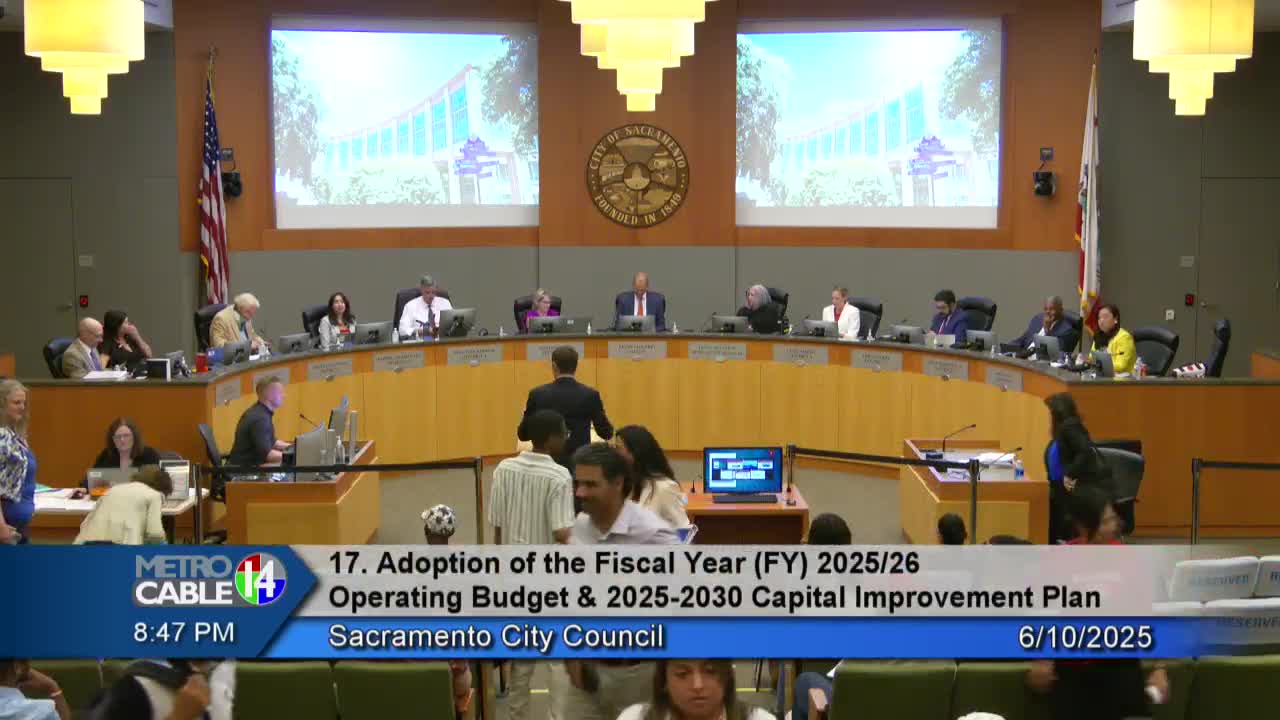
The Sacramento City Council adopted the FY 2025–26 operating budget and capital improvement program on June 10 after extended public comment and debate over how to balance police vacancies, youth prevention and other priorities.
The Sacramento City Council adopted the city’s fiscal year 2025–26 operating budget and five‑year capital improvement program on June 10 after extended public comment and hours of council deliberation.
City Finance Director Pete Coletto presented the balanced budget package and described a set of one‑time restorations — including $1.3 million for youth violence prevention, funding for the city’s field network and preservation of a diversity, equity and inclusion position — while warning that the city faces a structural deficit in future years.
Why it matters: The $1.6 billion operating and capital program (approximately $800 million general fund) sets spending levels for core municipal services, capital projects and one‑time restorations. Council members and dozens of public speakers pressed the council on whether the budget does enough for youth services and prevention and whether it over‑prioritizes police overtime and vacancies.
Key votes and what the council approved - Motion: Adopt the FY 2025–26 operating budget and capital improvement program. Moved by Council member Phil Dickinson. The council adopted the budget after roll-call voting recorded in the transcript; at least one council member voted no, and a transcript inconsistency on the roll call is noted below.
Budget highlights and staff rationale - Restorations: Staff restored $1.3 million for youth violence prevention contracts, $500,000 for the Fuel Network (immigrant/refugee legal and support services) and retained a DEI staff position. Senior program fees will increase only for non‑residents; city residents who use senior programs will not see fee hikes. - Funding sources: The restorations are financed by a mix of federal one‑time reserves, reallocated Measure L funds for libraries, adjustments to city attorney staffing classifications (one‑time), projected fund balance and the deletion of some vacant positions across several departments. - Outlook: Coletto said the budget is balanced for 2025–26 but the city still projects a structural deficit in future fiscal years (he cited an estimated shortfall of roughly $60 million for FY 2026–27 before state or other changes).
Public comment and council debate - More than 30 members of the public addressed the council on budget priorities. Many speakers — including youth organizers, community‑based organizations and family members of victims of gun violence — urged more sustained investment in prevention, youth services and community programs. Speakers repeatedly urged the council to redirect vacant police‑department funds to community programs. - Other speakers, including business and neighborhood representatives, urged the council to retain funding for police and other core city services and warned that policing vacancies and reliance on overtime degrade public safety. - Council members debated tradeoffs between protecting core services and increasing prevention spending. Several members asked staff to return in the fall with a vacancy analysis and proposals for longer‑term structural solutions.
Vote details and transcript note - The transcript records a voice vote and then a roll-call sequence that records “yes” votes for several council members and a “no” from Council member Mai Vang. The audio transcript contains inconsistent statements about one member’s vote (Council member Kaplan). Staff and the city clerk should be consulted for the official roll‑call record. The council’s stated outcome: budget adopted.
Next steps - Staff will return to budget and audit committee in the fall with a vacancy analysis (impact of eliminating long‑standing vacancies) and policy options for long‑range balancing strategies. The council also directed staff to preserve the restored youth and field‑network funding in the short term.
Ending: The adopted budget avoids current‑year layoffs and preserves restoration items the council prioritized, but the council acknowledged the city faces difficult choices in coming years to close structural shortfalls.