Get Full Government Meeting Transcripts, Videos, & Alerts Forever!
Get email alerts on the Budget Downtown Investments topic
No spam. Unsubscribe anytime.
Witnesses urge preserving FY26 downtown economic investments while debating subsidies and priorities
Summary
Developers, business groups and civic advocates testified to the Committee on Business and Economic Development about downtown revitalization proposals in the mayor's FY26 budget support act, backing some plaza-and-parks funding and the Office-to-Anything program while urging scrutiny of large subsidies and transparency on tax incentives.
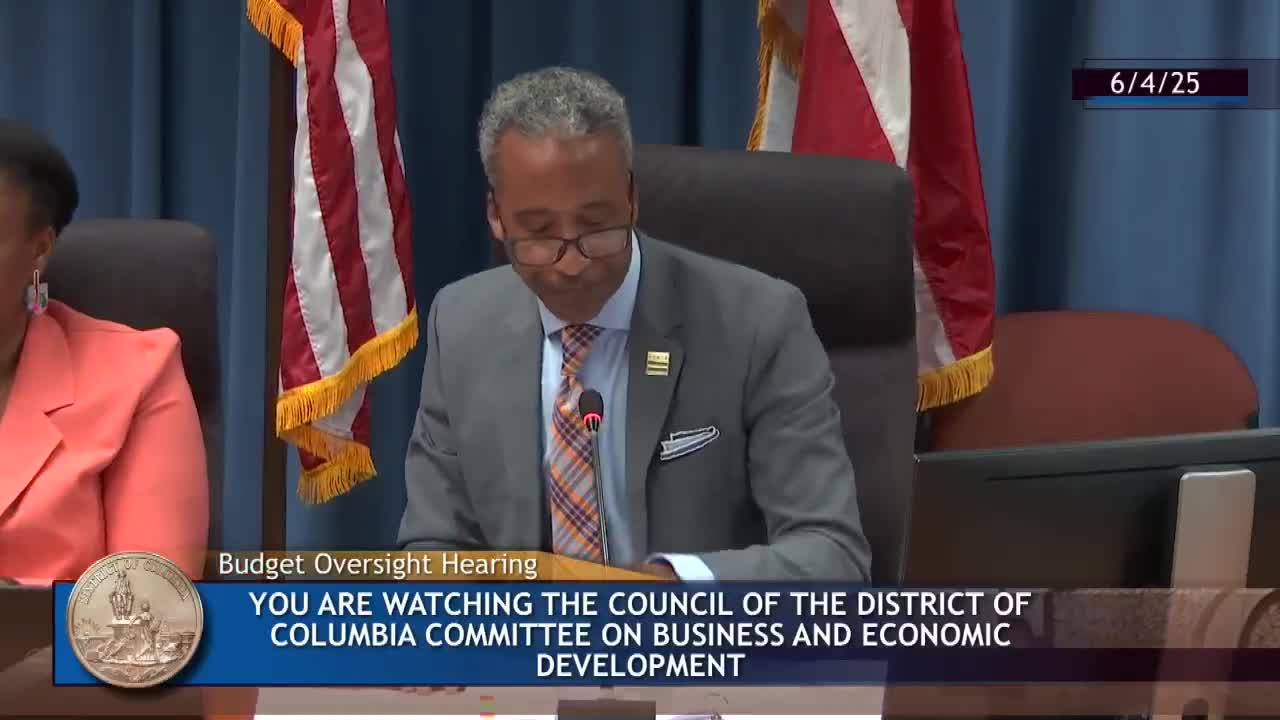
Council members heard competing views Thursday on the mayor's FY26 economic development proposals, particularly a package of downtown investments and tax incentives included in the Budget Support Act (BSA).
Pro-development speakers said select changes and funding will help reactivate downtown and support projects converting underused office space. "We strongly support the economic revitalization initiatives in this budget," Liz DeBarrows, chief executive officer of the DC Building Industry Association, told the Committee. She listed line items the association supports, including $8,000,000 for a public plaza at Gallery Place/Chinatown and $2,400,000 to launch a DC Tech Ecosystem Fund.
The BSA also contains an Office-to-Anything-type program (referred to in testimony as the Central Washington Activation Program amendment) designed to encourage repurposing downtown office stock into other uses. Developers said modest statutory edits would make several near-ready projects eligible for tax relief that would bridge financing gaps. "We just need language changes to make our project eligible for the program," Stephen Roediger of Rift Valley Capital said of a planned boutique hotel in Chinatown.
But budget critics warned the same downtown-focused proposals risk skewing limited public resources toward high-profile commercial projects rather than basic services and neighborhood needs. "The mayor's economic development vision prioritizes public money for a stadium and corporate giveaways over the people who are the backbone of DC's economy," Shira Markoff, director of economic policy at the DC Fiscal Policy Institute, told the Committee. She argued that elements of the mayor's agenda concentrate benefits downtown while providing little specific support East of the River.
Other witnesses urged caution on new or expanded tax incentives. DCBIA and several business representatives said program simplifications, such as changes to the Parking Benefit Equivalent rules, reduce compliance burdens for employers. At the same time, nonprofit advocates and policy groups pressed the Committee for greater transparency on who benefits from incentives such as the Qualified High Technology Company credits (QHTC) and other abatements.
Committee staff and witnesses also discussed implementation tools: enhanced small-business supports such as Main Street grants, targeted grants for neighborhood commercial districts, and a stronger permitting and technical-assistance pipeline to capture conversions and retain neighborhood-serving retail.
The hearing produced no final vote; council members and staff said they will continue to solicit written comments and agency responses as the markup process proceeds.