Get Full Government Meeting Transcripts, Videos, & Alerts Forever!
Get email alerts on the Medicaid Expansion Kill Switch topic
No spam. Unsubscribe anytime.
Panel warns budget 'kill switch' could end Ohio Medicaid expansion for about 770,000 people
Summary
A panel of health-care leaders, providers and advocates told a Columbus Metropolitan Club forum that a provision in Gov. Mike DeWine’s proposed state budget would automatically end Ohio’s 2014 Medicaid expansion if the federal Medicaid matching rate falls — a change panelists said could strip coverage from about 770,000 Ohioans and sharply reduce behavioral-health services across the state.
A panel of health-care leaders, providers and advocates told a Columbus Metropolitan Club forum that a provision in Gov. Mike DeWine’s proposed state budget would automatically end Ohio’s 2014 Medicaid expansion if the federal Medicaid matching rate drops — a change panelists said could strip coverage from about 770,000 Ohioans and sharply reduce behavioral-health services across the state.
“If that number drops, it automatically eliminates Ohio’s expansion. It’s that simple,” said Greg Moody, director of professional development at the John Glenn College of Public Affairs at The Ohio State University, describing the provision commonly called a “kill switch.”
The kill switch would terminate expansion if the federal matching rate for the expansion population falls even slightly from its current level — currently discussed in testimony as about a 90% federal share and 10% state share — without leaving discretion to the state to keep the program, panelists said. Amy Bush Stevens, a consultant to the Health Policy Institute of Ohio, said the loss of expansion coverage would shift many people to uninsured status or to plans they could not afford.
“The biggest group would become uninsured,” Stevens said, and added that some might wind up on employer plans or the insurance marketplace but face affordability barriers such as high premiums and deductibles.
Why it matters: Medicaid expansion supplies the primary funding stream for behavioral-health treatment capacity, panelists said. Amy Bush Stevens said federal dollars tied to the expansion brought “over $1,000,000,000” for services for the expansion population in 2024 alone, covering outpatient counseling, case management, residential treatment and behavioral-health hospital services. She also noted that in the first four years of expansion about 630,000 Ohioans received treatment for mental illness or substance use disorders.
Rochelle Martin, executive director of NAMI Franklin County, described the program’s effect on families, saying coverage has allowed people to get therapy, outpatient services and case management that stabilize households. “People do get care right this moment,” she said, describing callers seeking help and local referral networks.
Providers said the consequences would be most severe in rural communities. Oyama Garrison, president and CEO of Maryhaven, said many rural hospitals and local providers rely heavily on patients covered through Medicaid expansion and warned that clinics and programs could close if the expansion ends.
“You think homelessness is bad now? Just wait,” Garrison said, listing medication loss, the end of case management and therapy programs, and the potential disappearance of more than 55 programs she reviewed as examples of what could be lost if expansion is cut.
Panelists pointed to local systems that depend on the expansion. The state’s 50 local Alcohol, Drug and Mental Health (ADAMH) boards, they said, have used expansion-related funding to shift resources toward prevention, recovery supports and crisis response — including a new crisis care facility opening this summer in Columbus — rather than concentrating only on treatment.
Speakers gave statewide and local figures during the discussion. The panel cited roughly 770,000 Ohioans covered by expansion and said about 115,000 of them live in Franklin County; those numbers were provided during audience Q&A by panelists and moderators. Panelists also described how the loss of expansion would increase demand for jail and emergency services and force ADAMH boards to reallocate money away from prevention and recovery supports back to treatment.
The federal budget process was part of the discussion. Moody noted that some federal Republican lawmakers have resisted Medicaid cuts, while other federal reconciliation proposals under consideration include financing changes that could reduce certain federal Medicaid funding streams without changing the federal match rate that triggers Ohio’s kill switch. Amy Bush Stevens warned that some proposed federal changes target financing mechanisms — for example, state hospital-provider taxes and other ways states draw federal dollars — and those proposals were unresolved.
Audience members asked how residents could act. Panelists urged advocacy and explained practical steps: consult the Health Policy Institute of Ohio’s website for county-level data and materials, contact state legislators and Gov. Mike DeWine before the June 30 budget deadline, and volunteer or share personal stories with lawmakers. “This is advocacy, advocacy, advocacy,” Oyama Garrison said.
No formal votes or official actions were taken at the forum. The discussion focused on the possible effects of pending state and federal budget actions and on advocacy and public education.
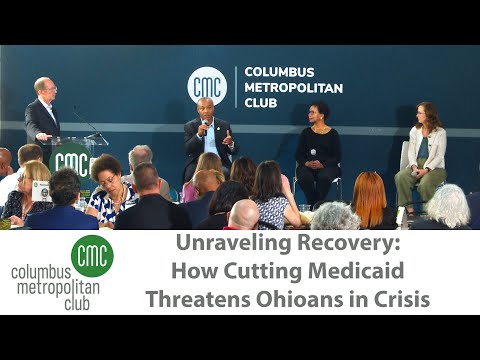
The forum was hosted by the Columbus Metropolitan Club at the Ellis and included speakers representing Maryhaven, NAMI Franklin County and the Health Policy Institute of Ohio, along with audience questions from local nonprofit and health-care representatives.