Get AI Briefings, Transcripts & Alerts on Local & National Government Meetings — Forever.
Redding council allows short-term rentals in Downtown Mixed Use District, rejects 50% cap
Summary
After public comment and debate, the City Council adopted staff-recommended changes to the short-term rental ordinance allowing vacation rentals in the Downtown Mixed Use District under a citywide buffer and other limits; the measure passed 4–1.
The Redding City Council voted 4–1 to amend the city zoning code to allow vacation rentals in the Downtown Mixed Use District, adopting staff’s Option B and removing a Planning Commission proposal to cap short-term rentals at 50% of multifamily units per building.
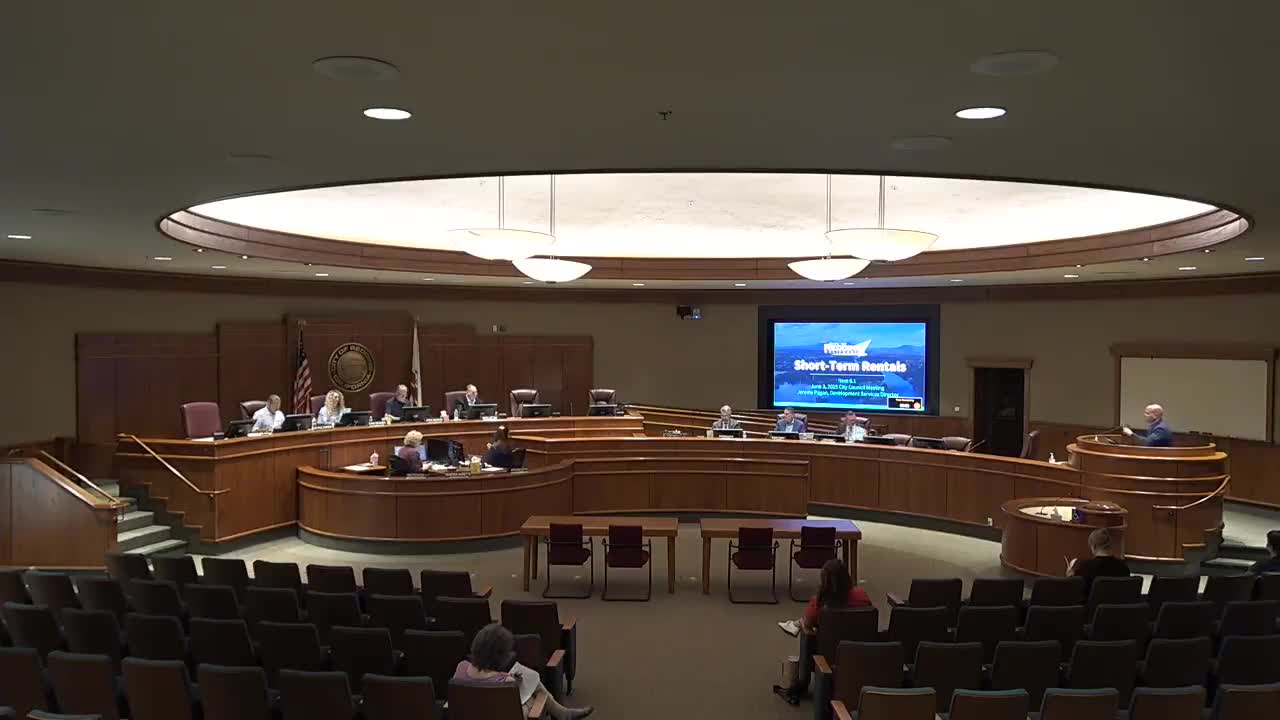
The ordinance change, introduced by Jeremy Pagan, director of development services, updates Redding Municipal Code section 18.43 to permit short-term rental conversions of existing multifamily units in the Downtown Mixed Use District (DMUD) while applying the city’s existing 600-foot buffer where the DMUD abuts single-family neighborhoods. Pagan told the council the change responds to requests from downtown property owners and aligns with the downtown specific plan’s goals of promoting tourism and commerce. “The proposed change would mean that the 600 foot buffer would apply,” Pagan said during his presentation.
Why it matters: Council members and public commenters framed the decision as a balance between encouraging downtown vitality and protecting housing stock and neighborhood character. Supporters said carefully sited short-term rentals help attract visitors, increase transient occupancy tax (TOT) revenue and support downtown businesses. Opponents, including some on the Planning Commission, warned liberalizing conversions could reduce housing available to local renters.
During public comment, Christy Meredith, the owner of Meredith Short Term Rentals, urged the council to allow mixed-use buildings to operate vacation rentals with modest per-building caps rather than the 50% rule. “The current proposed idea of allowing 50% STRs in apartment buildings within this district makes no sense in real life application,” Meredith said, arguing a small fixed cap per building would be easier to manage than a percentage rule. A downtown business owner who identified only by first name said parking and curbspace are already tight and asked for safeguards so guests do not use limited commercial parking.
Council members pressed staff on three recurring issues: the effect on affordable housing, how the 600-foot buffer would apply along the southeast boundary of the downtown planning area, and parking. Pagan reported staff’s parcel-level analysis that the DMUD contains roughly 300 market-rate multifamily units potentially eligible for short-term conversion (about 2–3% of the city’s total multifamily stock) and said many of those units are priced at lower affordability levels but are not deed-restricted affordable housing.
The Planning Commission had recommended Option A, which included a 50% per-building cap on short-term rental conversions; staff presented Option B (the original staff language) as an alternative. Vice Mayor Lata moved to adopt Option B and remove the Planning Commission’s 50% cap. The motion specified adoption of the ordinance summary and that the council find the action exempt from the California Environmental Quality Act (CEQA). The vote was: Council member Audette — yes; Council member Danuka — no; Council member Resner — yes; Vice Mayor Lata — yes; Mayor Muns — yes. The motion carried 4–1.
On parking, staff said legally nonconforming apartment units converted to short-term rentals in the DMUD would not be required to add off-street parking at the time of conversion; new construction remains subject to standard parking requirements (generally one space per unit unless reduced through other allowances). Pagan said short-term rental occupants would be subject to the city’s on-street parking rules.
The ordinance also clarifies that buffer rules apply only where multifamily units abut single-family zones, and it contains minor wording changes (for example, changes to how occupant counts are described and updates to government-code references).
Ending: Council adoption allows downtown property owners new flexibility to operate vacation rentals in the DMUD under the citywide buffer and other clarifications. The ordinance summary and CEQA exemption will be prepared for publication as directed by the council. The council vote was 4–1 in favor of the staff-recommended Option B.