Get Full Government Meeting Transcripts, Videos, & Alerts Forever!
Get email alerts on the Behavioral Health Services topic
No spam. Unsubscribe anytime.
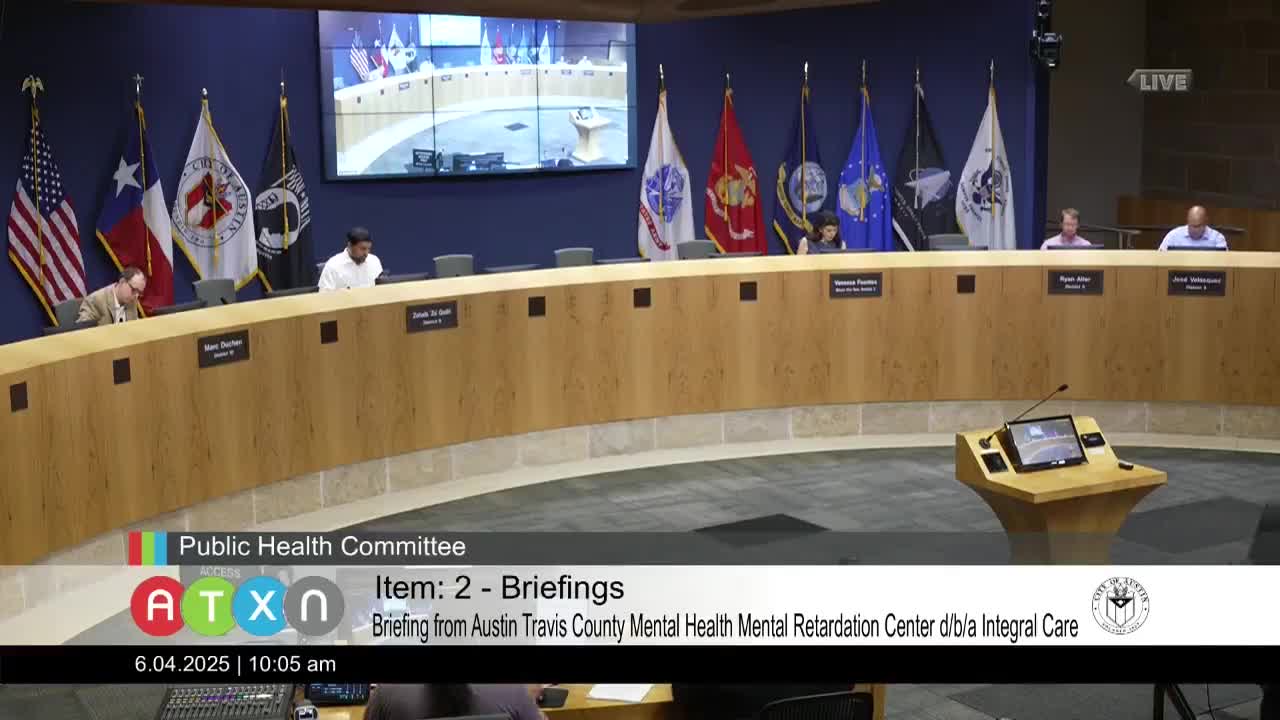
Integral Care outlines crisis services, housing programs and city funding at Public Health Committee
Summary
Integral Care, Austin-Travis County's local mental health authority, briefed the City Council Public Health Committee on its crisis continuum, housing programs and funding risks, including roughly $4 million in city-supported contracts subject to renewal during the coming budget cycle.
Integral Care, the local mental health authority for Austin and Travis County, told the City Council Public Health Committee on June 4 that it operates a wide crisis and housing continuum supported in part by city contracts totaling about $18,000,781.
The briefing, delivered by Dawn Hanley, chief operations officer and vice president of Integral Care, and other agency leaders, described crisis hotlines, psychiatric emergency services (PES), mobile crisis teams embedded in the 911 center and multiple housing programs including tenant-based and project-based permanent supportive housing.
The presentation said Integral Care served just under 30,000 individuals in fiscal 2024 and provided roughly 426,000 unique services across more than 30 programs and about 120 contracts. Hanley said the organization employs about 1,000 staff. “We provide services to adults and family and children who are experiencing a mental illness need or behavioral health needs through substance use and intellectual and developmental disability,” Hanley said.
Elizabeth Marrero, Integral Care’s provider network and authority officer, told the committee the city is projected to invest more than $24.6 million in the behavioral health system of care in FY25, with the largest allocations directed to housing and homeless services (about $10.3 million) and substance use/HIV services (about $1.35 million). Marrero described the certified community behavioral health clinic designation Integral Care holds and the agency’s approach of braiding state, federal and local funding to draw down additional dollars.
Committee members pressed for detail about funding at risk. Integral Care said several city-funded contracts expire September 30, 2025, and highlighted three items it considers at particular risk: a homeless health and wellness team ($541,714), the therapeutic diversion program contract ($2,000,000 currently set to end 9/30/2025) and an expansion of the mobile crisis field response (referred to as EM-CUT) with an incremental city funding amount of about $1,500,000 in the current contract. “That’s just the expanded dollar amount, not the full team,” Marrero said about the EM-CUT figure.
Committee members also asked about broader federal funding reductions. Integral Care reported roughly $7 million in reductions tied to the end of ARPA and other one-time federal streams and said about $4 million of the city’s investments in Integral Care programs will be part of the committee’s budget discussions.
The briefing included data on clinical need: depressive disorders were the top diagnosis; about 40% of clients served had co-occurring substance-use disorders; more than half of those served were children and families in that program area; and roughly 40% had chronic medical needs. Hanley noted the agency’s system of care emphasizes the least-restrictive setting and that services range from crisis hotline and mobile crisis to outpatient clinics, crisis residential care and permanent supportive housing. “Having that connection with us up front when that first occurs and then moving through our system of care really helps divert the overuse of the emergency department,” Marrero said.
Committee members thanked Integral Care staff for the presentation and asked the agency to provide reports with the underlying evaluation data referenced during the briefing, including a study the agency said shows multi-million-dollar systemwide cost savings tied to the mobile crisis model.
The meeting record shows committee members identified roughly $4 million in city-funded Integral Care investments that will be considered in the upcoming budget cycle; Integral Care staff said the county and Central Health are also providing significant partner funding for crisis and diversion work.
The committee approved the minutes from its May 7 meeting prior to the Integral Care briefing. The motion to approve was made by Council Member Vanessa Velasquez and seconded by Vice Chair Dugan; there were no objections and the minutes were approved.