Get Full Government Meeting Transcripts, Videos, & Alerts Forever!
Get email alerts on the Gaza Ceasefire Humanitarian Aid topic
No spam. Unsubscribe anytime.
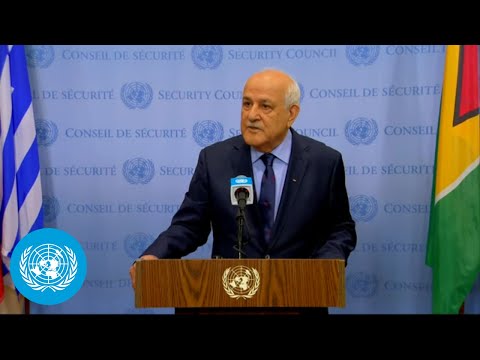
Palestinian envoy at U.N. urges immediate Gaza ceasefire, backs U.N. humanitarian mechanisms and two‑state conference
Summary
A Palestinian ambassador at a New York press briefing said the Arab group is pursuing a coordinated plan through the U.N. Security Council, the General Assembly and an international conference to secure an immediate ceasefire in Gaza, expand humanitarian aid through U.N. mechanisms and press for steps toward a two‑state solution.
A Palestinian ambassador at a United Nations press briefing in New York said the Arab group is pursuing a coordinated plan through the U.N. Security Council, the General Assembly and an international conference to secure an immediate ceasefire in the Gaza Strip, scale up humanitarian assistance and advance the two‑state solution.
The ambassador said the plan’s “number 1 objective” is “bringing an immediate ceasefire and stopping this war of genocide against our people in the Gaza Strip, to stop it immediately, to provide the Palestinian people, especially in the Gaza Strip, with humanitarian assistance to the scale they need,” and to begin reconstruction and accountability efforts.
The diplomat told journalists the Arab group is pushing for the Security Council to act on a humanitarian draft resolution crafted by elected members of the council (the “E‑10”). The ambassador said one E‑10 member had engaged a permanent member on the draft and that the council would report developments “at 12:00” about what the E‑10 would proceed to do. He said the group favors delivering aid through established U.N. mechanisms, including UNRWA, which he said has “400 stations in the Gaza Strip” to reach people across the territory.
“The mechanism of the UN is the solid one,” the ambassador said, adding that ad hoc distribution points set up outside U.N. channels had produced scenes of civilians being shot before they could reach aid. He told reporters that those incidents had been reported by media, including a CNN correspondent.
On parallel diplomatic tracks, the ambassador said Spain had prepared a draft humanitarian resolution for the General Assembly and that the international conference meant to press the two‑state agenda has moved from concept to detailed planning. He said a concept note and eight roundtables with co‑chairs have been established; he identified co‑chairs and leaders from Europe, the Arab world and other regions, mentioning Canada, Mexico, Brazil, Senegal, Egypt, Japan and Indonesia among participants.
The ambassador said he expects “a large number of high officials” at the conference — ministers and some heads of state — and that the conference will be “action oriented,” asking leaders to make concrete commitments, including recognition of the state of Palestine or substantive financial support for institution‑building and Gaza reconstruction. He cited the International Court of Justice’s advisory opinion as finding the occupation illegal and said the General Assembly had adopted a resolution giving mandate to the planned international conference.
When asked whether any of the roughly “40 or so” countries that have not recognized the state of Palestine would do so ahead of the conference, the ambassador said leaders who urge action should “lead by example” but did not list countries that had committed to recognize Palestine. On U.S. and Israeli participation, he said both had attended some preparatory meetings “at a lower level” and in some cases did not speak; he added participation is a state choice and that no country is formally barred from attending.
Throughout the briefing the ambassador repeatedly urged journalists to report from Gaza if they could. “I invite each and every one of you to go to the Gaza Strip…to tell the story of the crime that is undertaking against the Palestinian people,” he said, and argued that independent reporting could help hold perpetrators to account.
The ambassador also addressed broader international pressure, saying statements from some European countries had recently shifted and that he expects continued increases in diplomatic and public pressure on Israel. He urged states to consider practical national measures, including declaring restrictions on settlers’ travel or boycotting settlement goods, and cited Chile’s recent steps as an example.
The press briefing combined updates on Security Council and General Assembly efforts, details about planning for the international conference, and a public appeal for increased journalistic coverage of humanitarian conditions in Gaza. The ambassador said the plan aims for the conference to take place soon and for the General Assembly to have any draft humanitarian text circulated and available to the secretariat in line with procedural timing, so member states could act by the end of the following week.
Questions from reporters included whether a permanent Security Council member was engaging on the humanitarian draft, and a query from Farnoosh Amiri of the Associated Press asking whether any of the 40 countries would recognize Palestine ahead of the conference; the ambassador said he expected announcements but provided no firm commitments.
The ambassador closed by saying the Arab group and its partners “will not leave a stone unturned” to end the fighting, calling for an immediate and sustainable ceasefire and scaled humanitarian assistance through U.N. mechanisms, and thanking reporters for covering the unfolding efforts.