Get Full Government Meeting Transcripts, Videos, & Alerts Forever!
Get email alerts on the Public Safety Housing topic
No spam. Unsubscribe anytime.
RHA outlines summer safety push for six public‑housing 'hot spots,' pledges youth jobs, lease enforcement and de‑escalation training
Summary
Leaders of the Richmond Redevelopment and Housing Authority told the Public Safety Standing Committee they will expand summer youth employment, launch de‑escalation training, run community outreach events and use lease enforcement at six public‑housing "big 6" sites after a rise in homicides year‑to‑date.
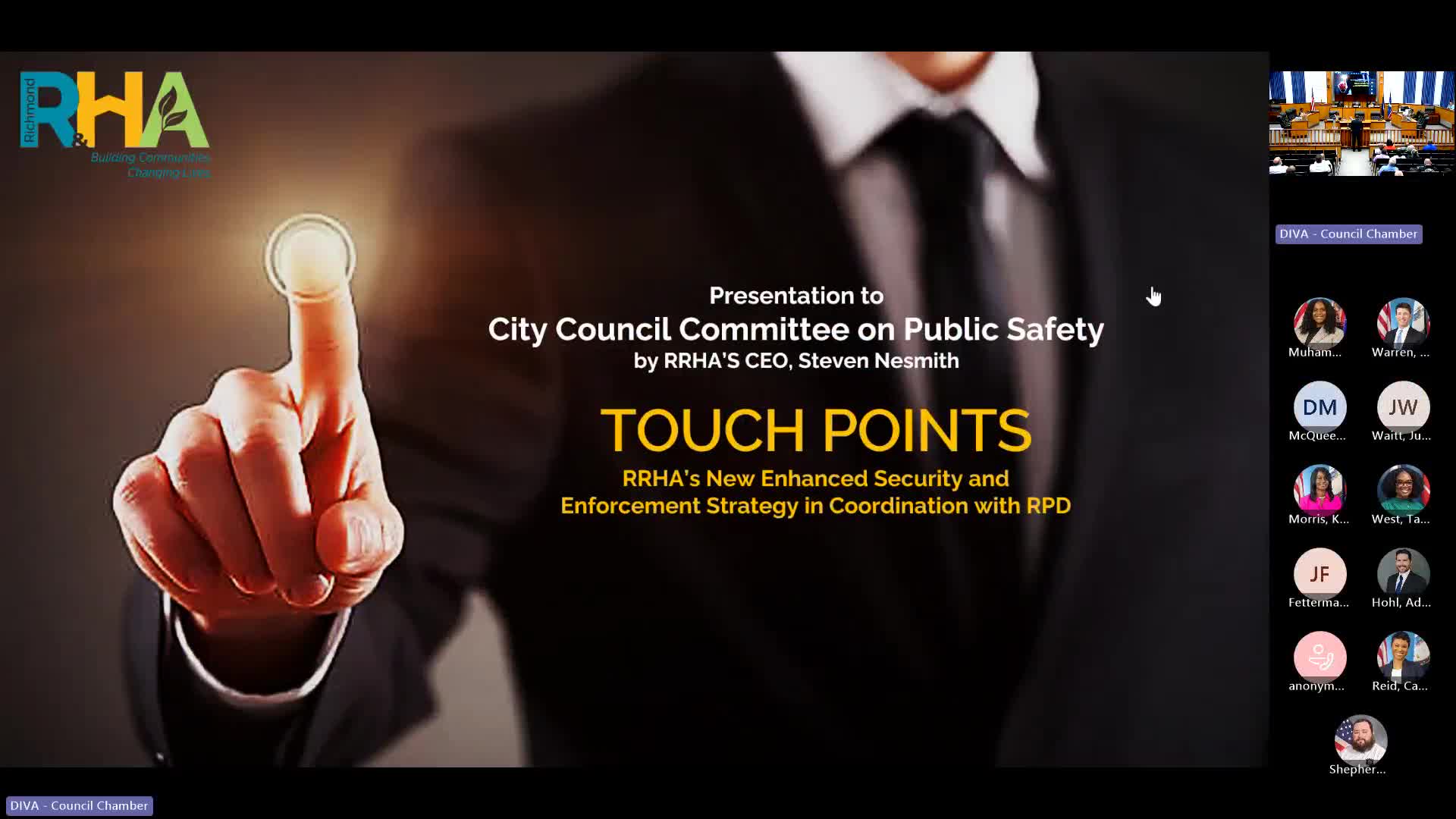
Steven Nesmith, chief executive officer of the Richmond Redevelopment and Housing Authority, told the Public Safety Standing Committee that the authority will expand youth employment and community outreach and step up lease enforcement after a year‑to‑date increase in homicides.
The presentation, given May 20 (time not specified on transcript) and summarized to the committee by Nesmith, said overall crime is down year‑to‑date but "we are 3 more homicides than we were at this time last year," a statistic Nesmith called a "sense of urgency." Nesmith said the RHA will focus activity on the six highest‑crime public‑housing sites (the "big 6") and partner with the Richmond Police Department and other agencies on a summer and year‑round strategy.
Nesmith told the committee the authority will pursue several tracks: deploy RHA security and coordinate with RPD at designated hot spots; offer de‑escalation training for youth through third‑party providers and faith partners; expand safe‑space recreation and job placements for youths; and use lease enforcement where apartments are used to sell drugs or harbor firearms. "We got people in these units selling, harboring guns and drugs. We're gonna use what's called our, better use of what's called our 21 30 lease enforcement, and that is you're gonna be you'll give me a citation. And when we see things are wrong, then, you have 21 days to abate or correct what's going on. If not, you're gone," Nesmith said.
Ralph Stuckey, RHA vice president for resident services, described the authority's summer youth employment work. He said the authority has partnered with the city and the mayor's youth programs; the city program received roughly 800 applications and expects to place about 750 youths citywide, and RHA will reserve 50 positions for public‑housing residents. "That group will be coming from the city," Stuckey said, adding RHA will offer mentoring placements across agency offices and continue STEM and computer lab programming begun during the COVID period.
Corey Franklin, senior vice president of affordable housing at RHA, described on‑site de‑escalation specialists who meet residents and property managers after incidents to attempt to diffuse disputes and keep both parties housed. Franklin also described community cleanup and visibility events such as Earth Day cleanups, community walks with RPD, and a planned National Night Out at public‑housing sites.
Richmond Police Chief Rick Edwards said law enforcement and community partners will run pop‑ups and hot‑spot events. He and Nesmith cited a recent ATF search in which agents and RPD recovered guns and drugs in public‑housing units; Edwards said many violent episodes escalate from fights that bystanders record and post on social media. "There are numerous videos where there are fistfights that are being filmed, placed on TikTok, other social media forums that escalate into real world gun violence," Edwards said.
JJ Minor, president of the Richmond branch of the NAACP, described a June 6 community event ("Local Day Out" or similar) aimed at outreach, crime prevention and resident engagement; he urged broader council participation at the hot‑spot events. Nesmith and RPD said they will publicize the events and coordinate with council members.
Committee members asked for metrics and follow‑up. Nesmith said RHA will measure immediate outputs such as how many youths are placed in safe spaces and employment, changes in crime statistics month‑to‑month and progress on resident self‑sufficiency (for example, placements into college or jobs). He agreed to return with an update in a few months.
Discussion (not a formal committee vote) also touched on recruitment limits for new officers, the need to avoid over‑policing while increasing visibility, and resident fears of retaliation for reporting. Nesmith and RHA staff said they will continue community meetings in each of the big‑6 sites and rely on resident leaders and the tenant council to promote an anonymous tip line tied to early interventions.
The committee invited RHA and police to return with a fall update.