Get AI Briefings, Transcripts & Alerts on Local & National Government Meetings — Forever.
Tulsa Fire Chief details FY26 budget, pins overtime pressure on pay, parental leave and vacancies
Loading...
Summary
Tulsa Fire Chief Michael Baker told councilors the department’s FY26 spending plan holds staffing flat but faces rising overtime costs driven by negotiated pay increases, longevity and expanded leave use — including parental leave that has cost about $868,500 so far this fiscal year — and outlined steps to curb overtime.
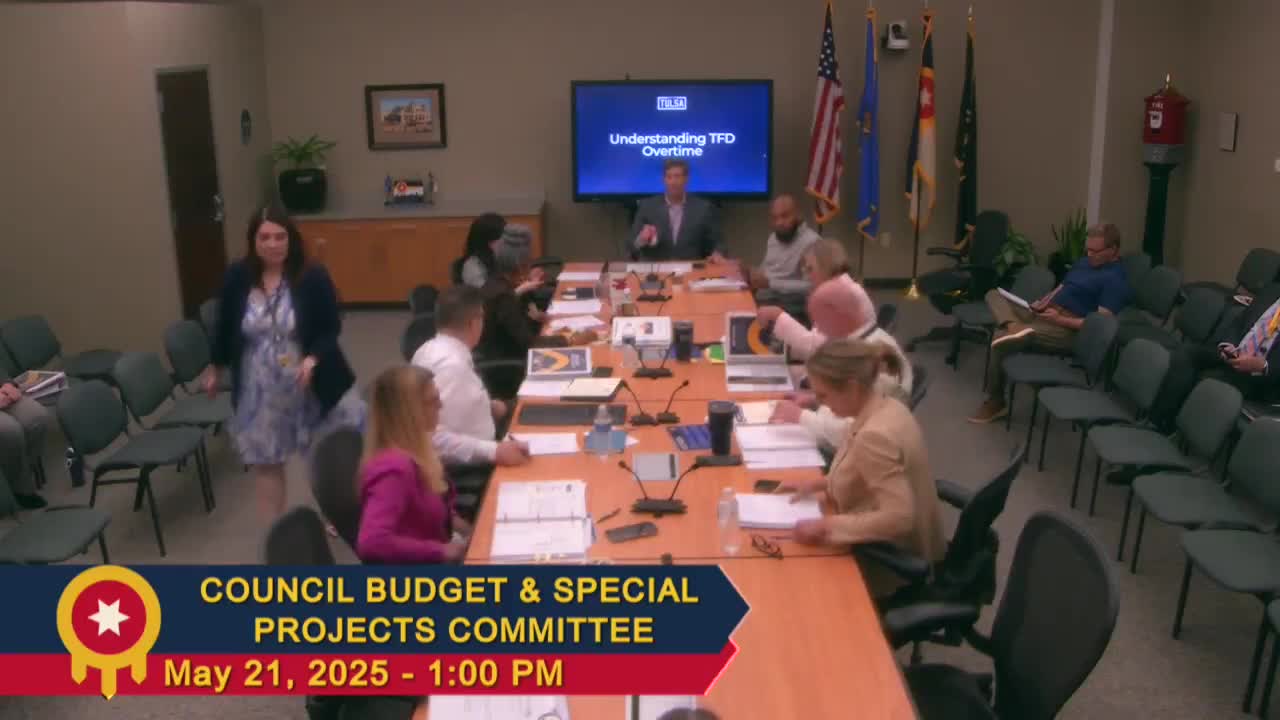
Tulsa Fire Chief Michael Baker told the City Council on May that the department’s proposed fiscal 2026 budget does not add new firefighter positions but faces rising overtime costs tied to salary contract increases, growing longevity pay and use of negotiated leave benefits.
Baker said the department has proposed “0 new positions” in FY26 and is keeping routine non-capital spending largely flat while maintaining short-term capital to replace fleet and station support items. He highlighted a set of short-term capital requests including a UTV to support water-rescue operations, drones to expand the department’s first-responder drone program, fitness-equipment replacement and Class A foam replacements after a late‑year chemical fire near Charles Page.
The chief told the council that contractual pay increases — including negotiated steps across ranks from firefighter through deputy chief — and a large increase in longevity pay have pushed the cost of overtime up even when total overtime hours are stable. He said longevity pay has risen sharply over negotiation cycles and that all elements of a member’s compensation (stipends, education pay and longevity) feed into overtime-rate calculations.
Baker said parental leave negotiated in 2023 is a major driver of callback overtime this year. From July 1, 2024, through the day of the meeting, the department averaged three members per shift on parental leave and Baker said the department has incurred about $868,500 in overtime costs to cover those absences so far this fiscal year. He told councilors that while three parental-leave absences alone would normally be manageable, the department combines parental leave with other leave categories (vacation, comp time, sick, injury, military, etc.), producing frequent callbacks to reach minimum staffing.
Baker explained how minimum staffing and the contractual maximum number of people allowed off per shift create a frequent need to call back personnel. He estimated that calling back 27 firefighters to meet minimum staffing for a 24‑hour period would cost roughly $40,000 — a figure he described as a “significant amount of cost.”
To reduce overtime pressure the department said it is accelerating hiring and an academy schedule (interviews in July, start in October), pursuing a 25% reduction in division staff overtime through flex scheduling, improving overtime data collection to target high-cost categories, enforcing sick‑leave policy where violations are identified and suspending out‑of‑state USAR deployments to limit lengthy callback and FEMA‑reimbursement exposure.
Baker and city staff also described categories of overtime that are reimbursable (special events, some code‑enforcement details, FEMA deployments, hazmat responses) and categories that are not. He said the department has become more granular in overtime coding to identify reimbursable events and control nonreimbursable costs.
Councilors asked for clarifications about overtime rules, minimum call‑back guarantees and deployment reimbursement. Baker and councilors confirmed that callbacks carry a guaranteed minimum period (the department cited three- to four-hour minimums for most callbacks, with longer guarantees depending on the situation and contract), that time-and-a-half rather than triple time is the standard overtime multiplier, and that FEMA reimbursements can take months to obligate — leaving the city to front costs in the interim.
Ending: Baker said the department hopes the October academy and continued management steps will reduce callback demand through spring break and other peak periods; he and finance staff asked councilors to bear in mind the city’s broader budget constraints as contract negotiations continue.