Get Full Government Meeting Transcripts, Videos, & Alerts Forever!
Get email alerts on the Courts And Judiciary topic
No spam. Unsubscribe anytime.
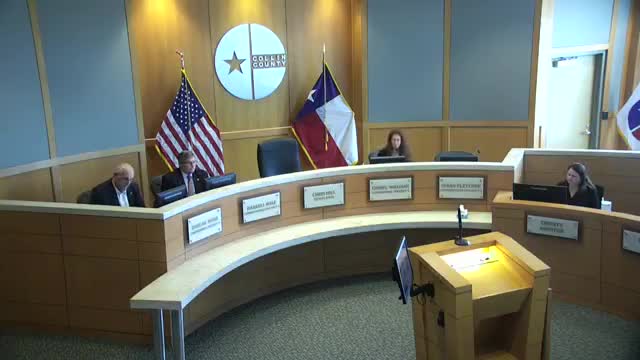
County court judge tells commissioners Collin County needs up to 11 county courts by 2030
Summary
A Collin County county court judge told the commissioners court that population growth and changes in law and caseloads mean the county will need additional county courts of law, but the courthouse lacks physical space for new courtrooms.
A county court at law judge told the Collin County Commissioners Court that the county should plan for as many as 11 county courts of law by Jan. 1, 2030, and that the courthouse lacks the physical space to add the courts now.
The judge, speaking at the commissioners court at the request of Commissioner Webb, said the Office of Court Administration (OCA) calculates Collin County needs 8.6 county courts now — effectively nine — and projected case-growth means the county will need two more by 2030, a total of 11. "If you extrapolate that out, by 01/01/2030 we should be about 11 county courts out there that are needed," the judge said.
The judge said population growth is the main driver. He told the commissioners that Collin County's population has grown from roughly 700,000 when County Court No. 6 was added to about 1.3 million today and could reach about 1.6 million by 2030. He said OCA workload data show Collin County judges are carrying about 22% more workload than the benchmark and that adding two courts would bring workload to roughly 100% of the OCA standard.
Beyond population, the judge described statutory and procedural changes that have affected dockets. He cited changes to civil discovery and expedited civil dockets, criminal code adjustments such as changes to DWI sentencing and deferred adjudication that reduced jury trials, and the decriminalization of low-level THC offenses as factors that temporarily reduced filings. He also described a recent uptick in eminent-domain cases and eviction appeals.
The judge credited technology with improving court operations, noting the county's move to e-filing, a document-management system (Odysee), Zoom for remote hearings and a juror-summons system that sends jurors directly to courtrooms instead of central jury rooms. Those changes helped preserve operations during the COVID-19 pandemic, he said, and reduced some preexisting physical constraints.
But he said physical courtroom capacity remains a limiting factor. He told the court two rooms that had been earmarked for county-court growth were reassigned to the district courts during building planning. "We don't have any space to add to it, which is why now I think we're looking towards the courthouse to actually be expanded," the judge said.
The judge urged commissioners to consider future legislative changes when planning new courtrooms — for example, bills that would expand civil jurisdiction or increase jury sizes to 12 in higher-value civil cases — and recommended designing jury boxes to accommodate 12 jurors plus alternates.
Commissioners asked about temporary measures such as rotating judges between courtrooms or night court; the judge said he did not see those as practical long-term solutions and reiterated that expanding the courthouse remains necessary. The judge also warned of new pressures from increased filings if the Legislature reverses decriminalization of THC or changes DWI jurisdiction, and he described an increase in filings related to municipalities along the North Texas Tollway corridor that can affect Collin County dockets.
The presentation did not include a formal request for specific funding at this meeting; the judge framed his remarks as a needs assessment to inform planning for a courthouse addition and to guide commissioners as they consider future bonds and construction timing.