Get Full Government Meeting Transcripts, Videos, & Alerts Forever!
Get email alerts on the Transportation And Public Safety topic
No spam. Unsubscribe anytime.
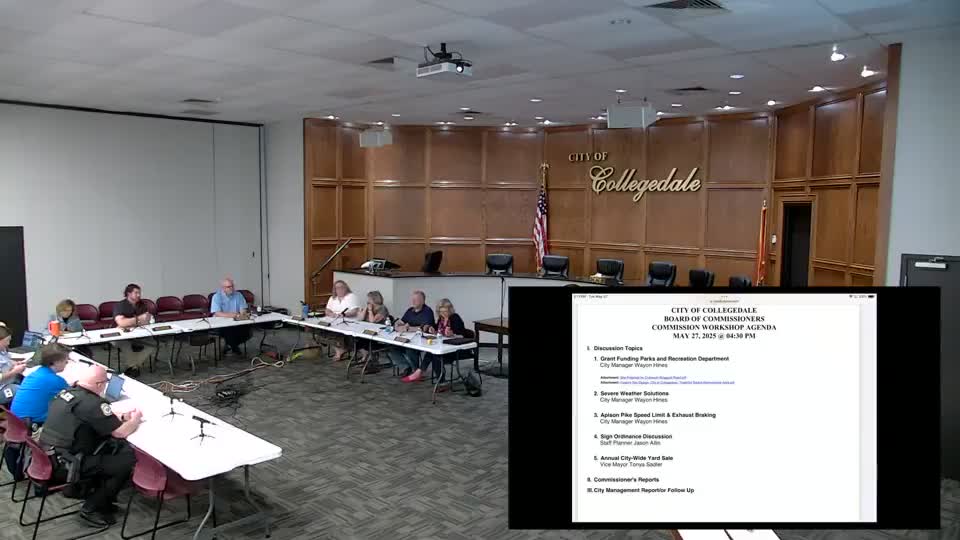
Commission debates speed limits, bus stop safety and limits on compression braking on Appison Pike
Summary
Collegedale commissioners discussed setting a consistent speed limit on the newly handed‑over sections of Appison (Absinthe) Pike, concerns about multiple bus stops and pedestrian safety, and separate conversation about regulating — but not fully prohibiting — compression (exhaust) braking.
Collegedale commissioners debated whether to set a consistent speed limit through the newly developed Appison Pike corridor and discussed related pedestrian and school bus safety concerns.
Staff said the original design used an 85th‑percentile approach and that some sections adopted a 45 mph limit while other sections are 40 mph; staff recommended 40 mph throughout. Commissioners and residents pointed to a cluster of bus stops and new apartment construction in a one‑mile stretch and said the higher posted speed where there are many bus stops and sidewalk users was unsafe. One commissioner noted that Chattanooga reduced its posted speed to 40 mph when it accepted a section of road in a prior phase and questioned whether state practice considered bus stop density when setting limits two decades ago.
Several commissioners favored consistency over frequent speed changes, noting drivers gain speed on downhill segments. A few commissioners opposed lowering some sections, saying residents would view changes as attempts to write more tickets. Staff said the commission could act once the entire final phase is turned over; the commission agreed to verify the state process required to change posted limits and to revisit the question when the last phase opens to the city (staff said the handover could occur in June, with a July workshop discussion).
Separately, commissioners discussed complaints about trucks using compression (exhaust) braking through residential areas. Staff cited Municipal Technical Advisory Service (MTAS) guidance: cities may regulate compression braking but cannot completely prohibit it under state equipment statutes; effective enforcement requires technical testing and state trooper support. Commissioners asked staff to re‑check MTAS materials and consult troopers about enforcement options and signage; staff warned signage that states “exhaust braking prohibited” can be misleading if the city lacks enforcement tools and that unenforceable signs may create community frustration.
Commissioners also asked staff to audit school bus stops, review options for moving bus stops into apartment complexes where turnouts exist, and consider adding pedestrian crossing devices at locations with high crossing activity while acknowledging TDOT’s historical reluctance to approve mid‑block crossings.