Get Full Government Meeting Transcripts, Videos, & Alerts Forever!
Get email alerts on the Policing topic
No spam. Unsubscribe anytime.
Council adopts ordinance to ban traffic‑stop quota policies after community, police talks
Summary
Houston City Council passed an ordinance making it city code that law enforcement may not require minimum quotas for traffic stops; supporters said the ordinance removes an institutional incentive for non‑safety stops, and sponsors said community and police stakeholders reached consensus in drafting it.
The Houston City Council adopted an ordinance prohibiting police‑department quota policies for traffic or ticketing stops on a vote during the meeting, moving the practice from departmental policy to city code.
Council action: The ordinance, introduced by Councilmember Edward Pollard and cosponsored by Councilmember Sasha Jackson and other members, passed on a voice vote (transcript: “All in favor say yes. Those opposed, nay. Motion passes.”). The ordinance language bars internal rules that would require or measure officers by a minimum number of stops or citations and makes the prohibition part of the municipal code.
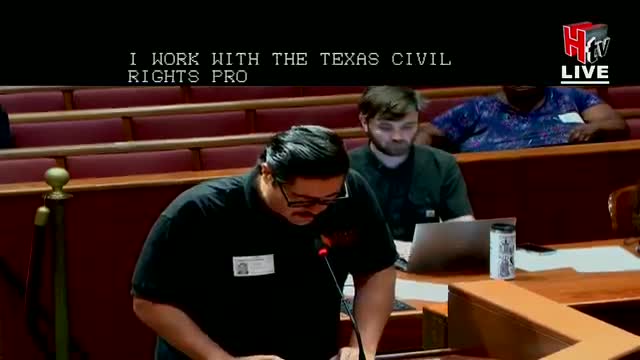
Why it matters: Supporters said municipal ordinances give the policy greater durability than an internal department policy and reduce incentives that can lead to unnecessary non‑safety traffic stops. Christopher Rivera, representing the Textile Rights Project and an advocate for the change, cited state law and city data showing a rise in non‑safety stops and racial disparities; he told the council that “non‑safety traffic stops … are not only very common, but also very dangerous for Houston drivers.”
Support from community and law enforcement: Councilmember Sasha Jackson, a sponsor of the ordinance, drew on personal experience and said quota‑style directives incentivize volume over safety: “Policies that pressure officers to meet citation quotas make these kinds of interactions more likely,” she said. Councilmember Jon Ramirez, who described training cadets on search and seizure, said he supported the ordinance and credited HPD Chief Troy Finner (and Chief Diaz’s earlier administrative action) for rescinding quota policies under the current administration while noting a local ordinance would limit future chiefs from reinstating them.
Legal and statutory references: Advocates cited Texas law that already bars quota systems in some contexts. Christopher Rivera cited Section 720.002 of the Texas Transportation Code in urging the council to add municipal enforcement; other public commenters invoked the Sandra Bland Act and studies of traffic‑stop outcomes to underscore disparities tied to non‑safety enforcement.
Outcome and implementation: The ordinance passed by voice vote; the transcript did not record a roll‑call tally. Sponsors and supporters said it represents a first step toward broader traffic‑enforcement reform, and council members signaled plans to track implementation and related data collection to measure impact.
Ending: Councilmembers and commenters described the vote as a consensus outcome reached after months of community engagement, data review and meetings involving police advocates and civil‑rights groups; several speakers said additional reforms will be needed to address racial disparities and to shift enforcement priorities toward crashes and fatal‑risk behavior.