Get Full Government Meeting Transcripts, Videos, & Alerts Forever!
Get email alerts on the Housing Policy topic
No spam. Unsubscribe anytime.
Commission recommends approval of ordinance limiting transfer of downtown affordable-housing credits tied to public financial support
Summary
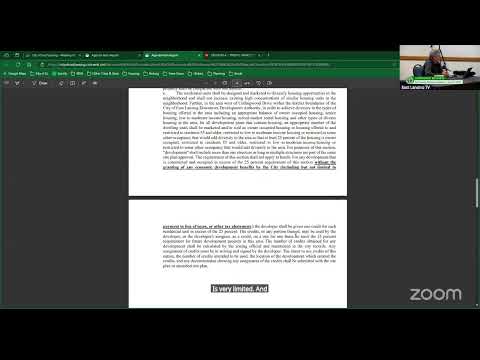
The East Lansing Planning Commission voted May 28 to recommend City Council approval of Ordinance 15-46, which would bar the transfer of downtown diversified-housing credits when the project producing those credits received city financial assistance such as tax increment financing or payment-in-lieu-of-taxes.
The East Lansing Planning Commission on May 28 recommended City Council approval of Ordinance 15-46, an amendment to the city’s diversified housing requirement that would restrict transferability of credits generated by certain projects that received public financial assistance. The commission voted in favor of the recommendation; the ordinance will proceed to city council for final consideration.
Planning staff summarized the proposed amendment as a targeted change to the city’s zoning requirement that, in certain downtown locations, 25% of units in multifamily projects must be owner-occupied, affordable, or restricted to 55-plus occupancy. The current code allows a project that builds more than the required share to transfer “credits” to other downtown developments. The proposed ordinance would remove the ability to transfer those credits when the project generating the credits has received economic development assistance from the city — such as tax increment financing (TIF) or payment-in-lieu-of-taxes (PILOTs).
Council Member Brendos (addressing the commission at the request of council) explained the origin of the amendment. He said earlier downtown projects that produced the credits had received public support for remediation or public parking and that the council did not intend for those publicly supported projects to generate transferable credits that could be sold to enable much larger student-oriented developments elsewhere in the downtown.
Commissioners discussed whether restricting transfers would discourage developers from producing downtown affordable or workforce housing and whether the change was necessary given current development activity. Supporters said the amendment is narrowly drawn to apply only when a project received public financial assistance and would preserve the original intent of the diversified-housing requirement. One commissioner said the staff explanation that the restriction applies only to developments receiving public financial assistance addressed concerns raised at prior meetings.
A motion recommending approval to city council was made and seconded; the commission adopted the recommendation in a roll-call vote. The vote tally recorded on the meeting record: Commissioners Chapin, Hendricks, Lapine, Overbey and Ceballeski voted yes; Chair Sullivan voted no. The ordinance will be forwarded to City Council for its consideration.