Get Full Government Meeting Transcripts, Videos, & Alerts Forever!
Get email alerts on the Hydropower topic
No spam. Unsubscribe anytime.
Northwest River Partners tells Richland council hydropower remains region’s backbone amid fish, staffing and reliability concerns
Summary
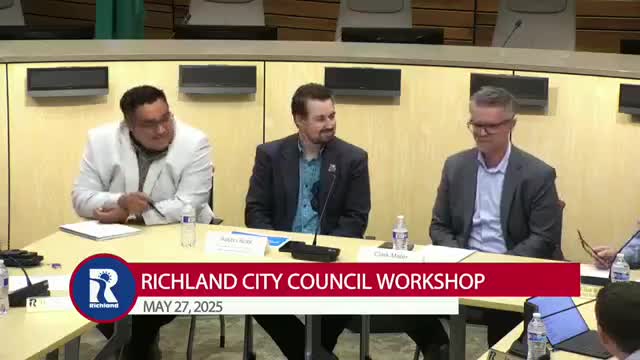
Clark Mather, executive director of Northwest River Partners, told the Richland City Council on May 27 that hydropower remains the foundational source of electricity for the region and for the City of Richland.
Clark Mather, executive director of Northwest River Partners, told the Richland City Council on May 27 that hydropower remains the foundational source of electricity for the region and for the City of Richland.
Mather said the City of Richland receives about 99.5% of its electricity from the Bonneville Power Administration, and that Bonneville’s 2023 fuel mix was roughly 78% hydropower and about 11% from Columbia Generating Station—“just shy of 90% carbon free,” Mather said. He and colleagues from Northwest River Partners argued that the Federal Columbia River Power System (FCRPS) provides large amounts of clean, affordable energy and supports river navigation and irrigated agriculture.
Why this matters: Council members asked how the ongoing public debate over dam operations and proposed removals would affect reliability, fish returns and local rates. Presenters said a loss of the Snake River federal projects would pose serious regional reliability and economic risks and that investments paid by BPA customers support extensive fish‑and‑wildlife mitigation programs.
The presentation: Mather and other Northwest River Partners staff—Austin Rohrer, deputy executive director, and Victor Valerio, outreach and research manager—reviewed data on adult salmon and steelhead returns and framed outreach to broaden public support for hydropower. Mather cited Bonneville Dam adult counts, saying the agency recorded about 456,000 salmon and steelhead returns in 1938 and about 1.77 million in 2024 at Bonneville, and that Lower Granite Dam returns in 2024 were roughly ten times the 1999 counts. The presenters emphasized that those long‑term counts are publicly available via University of Washington data (DART), and urged reliance on measured returns rather than anecdote.
Fish, tribes and data: Council members pressed presenters on tribal testimony that fish runs were larger before large‑scale development and on differences between historical oral accounts and modern counting methods. Mather said tribal oral histories and treaty interests are not dismissed, but that for modern trend analysis the usable baseline begins with counts taken when federal dams began operations (for example, 1938 at Bonneville). He described ongoing collaboration opportunities—including a Phase 2 implementation plan to explore fish passage above Grand Coulee and Chief Joseph dams—while stressing tribal perspectives vary by nation and should be consulted directly.
Reliability and capacity concerns: Presenters argued the Snake River projects collectively can provide more than 3,000 megawatts of generating capacity at full output and remain important to avoid blackouts during extreme weather. Mather and Rohrer pointed to past regional extremes when Bonneville maximized hydro output and, for backup, purchased costly emergency imports (the presenters cited roughly $300 million in emergency purchases during a winter emergency) to avoid outages. They noted projected Northwest load growth of roughly 30% in the next decade (Pacific Northwest Utilities Conference Committee forecasts), which would add thousands of megawatts of new demand.
Outreach and public opinion: Austin Rohrer described the “Our Power. Our Water.” ad campaign, launched in 2020, that targets 18–54 audiences across the Northwest with location‑targeted creative, EV‑charging station ads with QR landing pages, influencer posts, earned media explainers and social campaigns. Rohrer said campaign metrics show a large shift of the target audience from unfavorable to neutral or favorable toward hydropower and that the group is shifting strategy toward activation and grassroots engagement.
Operational and program concerns: The presenters raised staffing and maintenance worries at some federal projects—reporting staffing levels at some Snake River projects as low as about 60% of prior norms—and said reduced staffing could affect maintenance and fish operations. They also flagged concern about the Supplemental Environmental Impact Statement (SEIS) process and a regional energy study led by Pacific Northwest National Laboratory, warning those processes could be framed in ways that increase pressure on the federal projects.
Questions from council: Council members asked for comparisons to recent dam removals on the Klamath River; presenters pointed out that Klamath projects had far less generation capacity (about 163 MW total) and no fish passage systems, unlike the Snake River federal projects. Councilors also asked about causes of salmon declines; presenters cited complex, multi‑factor causes including sea surface temperature effects in the ocean, harvest and predation (including sea lions), as well as freshwater impacts. They cited a 2021 NOAA report that links increasing sea surface temperatures to major mortality impacts for Chinook.
Outcomes and next steps: No formal council action was taken. Northwest River Partners asked for feedback and encouraged council engagement in federal and regional processes that affect hydropower operations, staffing and mitigation funding. Council members discussed keeping rate and reliability implications in mind when evaluating proposed federal changes and requested clearer, dam‑specific materials for public outreach.