Get Full Government Meeting Transcripts, Videos, & Alerts Forever!
Get email alerts on the Housing Inspections topic
No spam. Unsubscribe anytime.
Committee refers apartment inspection ordinance to full council after broad debate; vote 10-0
Summary
Houston's Proposition A Committee voted 10-0 to recommend an ordinance that would create a high‑risk rental building (HRRB) registry, revive the Apartment Standards Enforcement Committee (ASEC) and strengthen enforcement, including fines and possible certificate‑of‑occupancy actions, while adding tenant supports and landlord training.
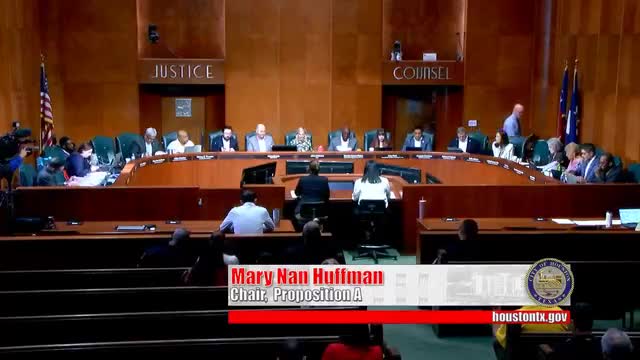
Houston’s Proposition A Committee voted 10-0 on May 27 to recommend for full‑council consideration an ordinance aimed at addressing substandard conditions in multifamily housing through a high‑risk apartment inspection program, a reconstituted Apartment Standards Enforcement Committee and new tenant and landlord support measures.
The ordinance would amend Chapter 10 of the Houston Code of Ordinances to create a High Risk Rental Building (HRRB) registration triggered when a property receives 10 or more habitability citations within a 12‑month period. Registered properties would receive initial and follow‑up inspections by city departments, mandatory landlord training for HRRB owners or agents and expanded enforcement powers, including misdemeanor fines and potential revocation of a certificate of occupancy. Committee members moved the measure to the full council with favorable consideration; the referral passed 10‑0 in roll call.
Council Member Plummer, who presented the ordinance, said the measure is “to protect our residents from substandard and dangerous housing conditions” and described the approach as shifting the city from reactive enforcement to prevention. Plummer also emphasized tenant supports: “This ordinance isn’t about enforcement against bad actors. It’s fundamentally about empowering our tenants so that they can advocate for themselves.”
Key provisions described in the committee discussion and the ordinance text: - HRRB registration trigger: 10 or more habitability citations within 12 months, targeting repeat, serious offenders. - Inspections and follow‑up: initial and subsequent inspections by relevant departments as outlined in the proposed Chapter 10 amendments. - Enforcement: proposed misdemeanor fines (text references fines ranging from $2.50 to $2,000 per violation per day in the draft) and, for persistent violations, potential revocation of certificate of occupancy by Houston Public Works and civil action by the city attorney. - Tenant supports: a complaint support and referral program to assist tenants in HRRBs and a publicly accessible directory of HRRBs with contact information. - Landlord requirements: annual BlueStar (HPD) training or equivalent for owners/management of HRRBs — the draft specifies at least 10 hours annually and certification of completion within 30 days of registration. - Senior living provision: a limited requirement that senior living facilities maintain a single common area with permanent or temporary backup power and a refrigerator capable of storing temperature‑sensitive medication during extreme weather events; the ordinance text frames this as a narrow, targeted requirement. - ASEC: formal revival and authorization of the Apartment Standards Enforcement Committee (ASEC) — defined in the draft as a multi‑department coordinating body to maintain a citywide enforcement database, protect due process and recommend policy changes.
Presenters cited city data and operational context. Plummer’s office said the city has roughly 5,000 apartment complexes and that about half of Houston residents rent apartments. She and staff reviewed nine years of 311 data (2016–2024) showing steady complaint volumes and a spike in 2024; her staff emphasized the limits of 311 data because many tenants call council offices, tenant advocates or the media instead of 311.
Houston Police Department and apartment enforcement staff spoke about overlapping programs. Matthew Simon, who identified himself as leading HPD’s apartment enforcement unit, told the committee he supports coordinated efforts but warned the city already maintains remedial and crime‑based property lists and suggested harmonizing lists to avoid duplicative enforcement burdens. HPD also advised attention to how the draft would interact with existing municipal code provisions.
Stakeholders at the meeting urged several refinements: industry representatives asked for clearer definitions of “owner” when ownership is through LLCs, developers and affordable‑housing providers asked for careful calibration of the 311‑based trigger so that repeated nuisance calls do not automatically place properties on a high‑risk list, tenant advocates urged strong anti‑retaliation protections and a displaced‑tenant fund, and residents recommended using fines to help tenants relocate when safety risks force displacement.
The presenter acknowledged remaining procedural steps. Committee members and staff discussed scheduled next steps: the sponsor requested amendments and comments by June 13 and aimed to submit a final version to the mayor’s agenda office for possible full‑council consideration later in June.
Votes at a glance Motion: refer the apartment inspection ordinance to the full city council agenda with favorable consideration. Mover: Council Member Plummer. Second: not specified in the transcript. Vote (roll call): Huffman — yes; Peck — yes; Jackson — yes; Evan Shabazz — yes; Flickinger — yes; Castillo — yes; Martinez — yes; Ramirez — yes; Carter — yes; Plummer — yes; Alcorn — yes. Tally recorded in the transcript as 10 yes, 0 no.
Why it matters: Committee members and public speakers framed the proposal as a major change in how Houston addresses multifamily habitability — combining enforcement, tenant assistance and landlord training into a centralized, data‑driven program. Supporters said the measure gives the city stronger, coordinated tools to address repeat offenders; critics and industry representatives urged clearer definitions, careful calibration of the trigger and assurance that enforcement will not inadvertently penalize compliant owners.
What’s next: The committee referred the item to the full council with favorable consideration; the sponsor plans to accept amendments and to resubmit a revised draft for the mayor’s agenda office by mid‑June. The ordinance will still require final legal vetting and interdepartmental coordination prior to any implementation.