Get Full Government Meeting Transcripts, Videos, & Alerts Forever!
Get email alerts on the Licensing Reciprocity topic
No spam. Unsubscribe anytime.
Board clarifies reciprocity process for out‑of‑state surveyors, approves two‑reviewer evaluation
Summary
The Tennessee Board of Examiners for Land Surveyors agreed to handle requests from out‑of‑state license holders by allowing applicants to submit evidence that their prior licensure met Tennessee's minimum standards; two board reviewers will assess equivalency and may approve applications administratively.
The Tennessee Board of Examiners for Land Surveyors on May 20 agreed to a formal process for handling reciprocity-like applications from surveyors licensed elsewhere, clarifying that Tennessee does not practice universal reciprocity but will accept evidence that an applicant's prior licensure met Tennessee's statutory standards.
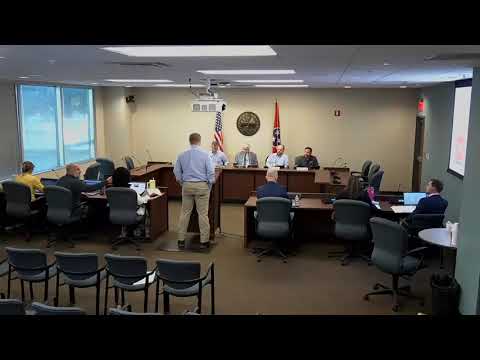
The action follows a public appearance by Matt Lawrence, who described his experience seeking a Tennessee license after becoming licensed in Kentucky. Board members and legal staff discussed TCA 62-18-110 and the five pathways listed in TCA 62-18-109, concluding the statute gives the board discretion to deem out-of-state qualifications "satisfactory to the board." Kyle (staff member) read the reciprocity statute aloud during the meeting and legal staff explained options for an equivalency review.
The board motion adopted a handling process: applicants who claim their out-of-state licensure met Tennessee's minimum standards will submit documentation of the other jurisdiction's requirements at the time of their licensure; two board reviewers will examine the materials and may grant administrative approval if they determine the other jurisdiction's standards were equivalent or greater. The motion passed by voice vote.
Board members stressed this is not an automatic license-by-reciprocity program. Legal staff and board members explained that if the other jurisdiction's minimum requirements fall short of Tennessee's statutory thresholds the board retains discretion to deny equivalency. Board members also said applicants should submit syllabi or other course materials when relying on coursework from colleges or other providers.
The board asked staff to publish guidance explaining the new review process and to route formal inquiries to staff for case-by-case evaluation.
The board also invited any applicant with questions to submit a written inquiry so staff can provide an individualized response rather than attempt to resolve hypotheticals in public meeting discussion.