Get Full Government Meeting Transcripts, Videos, & Alerts Forever!
Get email alerts on the Free Tax Preparation Vita topic
No spam. Unsubscribe anytime.
State-supported VITA grants expand free tax-prep services; advocates urge continued funding
Summary
CDM, Accounting Aid Society and a Community Action Agency told the appropriations subcommittee that state grants enabled expansion of Volunteer Income Tax Assistance sites across Michigan, returning millions in refunds and lowering filing fees for low- and moderate-income taxpayers.
Jessica Achmoudi, policy director at the Community Economic Development Association of Michigan (CDM), told the House Appropriations Subcommittee on Labor and Economic Opportunity that state grant funding has allowed 17 grantees to expand Volunteer Income Tax Assistance (VITA) sites across Michigan for the 2025 filing season.
"Free tax preparation services primarily offered through the Volunteer Income Tax Assistance or VITA program provide no cost tax filing assistance to low and moderate income households, seniors, veterans, and people with disabilities," Achmoudi said, adding that VITA helps filers claim earned credits and avoids costs charged by unregulated paid preparers. CDM reported grantees were approaching $70,000,000 in total refunds returned to taxpayers and estimated roughly $15,000,000 saved in filing fees across that grant period.
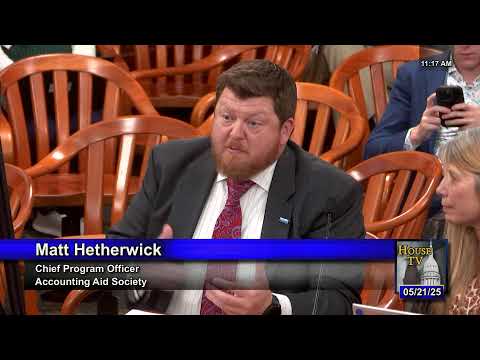
Matt Heatherwick, chief program officer at the Accounting Aid Society, described operational changes enabled by funding, including pop-up sites, virtual filings and a hybrid service model pilot approved by the IRS. Heatherwick said his organization has grown volunteer capacity to nearly 400 active volunteers contributing more than 14,000 hours and expects to prepare about 25,000 tax returns this year, returning more than $33,000,000 in refunds and credits to clients.
Tammy Farnham of a Community Action Agency described using grant funds to expand into neighboring counties, run mobile units and host pop-up sites in rural areas. "We have some that are open in the evenings and on the weekends," Farnham said, noting virtual services and targeted sites on bus lines to reach residents without transportation.
Committee members asked about volunteer recruitment, training and program accuracy. Witnesses described an annual IRS certification process for volunteers, supervised shadowing with experienced preparers, multi-step testing for advanced returns, and background checks. Heatherwick said Accounting Aid typically requires volunteers to complete 8 hours of tax law and software training plus additional shadow time and that quality-review responsibilities are restricted until volunteers have multiple years of experience.
Witnesses urged continued state funding to sustain sites beyond April 15 and to close service gaps in rural and underserved communities. CDM asked the subcommittee to support continued investment; Achmoudi said without state support "we risk losing the progress we've made" because many VITA programs rely on state funds to fill gaps left by federal dollars.
No formal committee votes were taken during the hearing.