Get Full Government Meeting Transcripts, Videos, & Alerts Forever!
Get email alerts on the Complete Streets Bunce Road topic
No spam. Unsubscribe anytime.
Bunce Road rehabilitation draws sharp public split over shared-use path; council says administration moving forward
Summary
Residents and advocacy groups packed City Hall on May 19 to oppose and support a proposed multimodal (shared-use) path on Bunce Road; council leaders said the administration has finalized the plan and there was no ordinance before council to vote on that night.
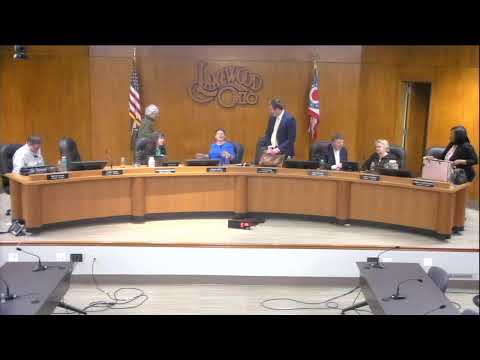
More than two dozen residents spoke May 19 at City Hall as the Bunce Road rehabilitation project—specifically a proposed 10‑foot shared‑use path—became the most contested item in a long council meeting.
Why it matters: Bunce Road is a frequently used north–south corridor in Lakewood. Supporters say a maintained, multiuse surface will provide a safer, year‑round route for pedestrians, people with mobility aids, and cyclists; opponents say the route’s frequent driveways and intersections, tree‑lawn impacts and loss of green space create safety and neighborhood‑character problems.
Supporters argued the path will expand safe options for travel. James Mirdink, a Bunce Road resident, told council the wider surface would give children and older pedestrians a place to walk and bike: “As they get older, I like the idea of them having another option and a wider sidewalk to bike on.” Emily Lindberg, a Lauderdale Avenue resident, said the project is an opportunity to “reclaim our public right-of-ways” for people and trees instead of car parking.
Opponents cited driveway conflicts, reduced green space and lost mature trees. Kim McDonald, a Bunce Road resident, said mixing faster micro‑mobility and bicycles with pedestrians on one path risks safety problems and that the project mailing did not make the scope clear. “It feels like our comments don’t matter,” she said, describing neighborhood frustration over process and notice. Tim McDonald, who has lived on Bunce Road for 47 years, said the corridor’s traffic has increased markedly since a nearby gas station and that the project would bring an “asphalt path… 40 feet from my front door.”
Several speakers disputed one another’s claims about public sentiment. Amy Herberger, who organized signatures supporting the project, said a petition collected 363 signatures in under a week and that 85% were Lakewood residents; she said the petition gathered local support faster than an opposing petition that organizers said had roughly 950 signatures. That number and the geographic composition of signers were presented by speakers; council did not independently validate the totals during the meeting.
Process and status: Council President Keppel told the public that the administration had finalized the design and that “as of right now this plan has been finalized—it's moving forward—and there's nothing for us to vote on.” Council members and neighborhood advocates asked for additional public engagement, and several council members suggested convening advisory meetings where residents, engineers and elected officials could discuss trade‑offs outside the formal council‑meeting format.
Next steps: There was no council vote to adopt or reject the path the night of May 19. Councilmembers said they will continue listening, and the administration and public‑works staff will follow up with more detailed information and, potentially, joint advisory sessions to review tree impacts, sight lines, intersection treatments and maintenance commitments.
Ending: The debate highlighted a broader tension in Lakewood planning: how to balance multimodal transportation, tree canopy and neighborhood character while ensuring meaningful public notice and ample opportunities for co‑creative design.