Get Full Government Meeting Transcripts, Videos, & Alerts Forever!
Get email alerts on the Transportation Funding topic
No spam. Unsubscribe anytime.
TMP advisory board reviews funding analysis, asks members to produce one‑page recommendations for consultants
Summary
Members of the Transportation Master Plan advisory board reviewed the plan's funding analysis, discussed gaps between local needs and regional grant eligibility, and agreed to prepare a one‑page set of findings and recommendations for the TMP consultant and city staff.
Members of the Transportation Master Plan advisory board spent the first hour of a special session reviewing the plan's funding analysis and possible strategies to close a large gap between identified projects and likely local revenues.
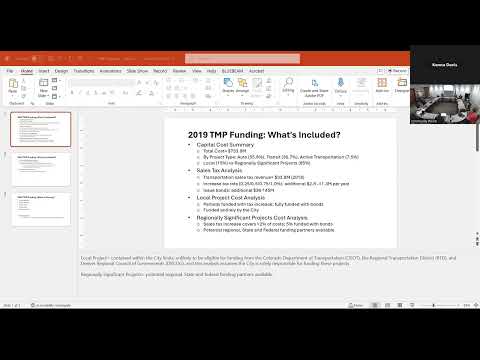
The board heard a staff presentation summarizing the TMP's capital-cost breakdown and current projected revenue streams, including local sales‑tax revenue. A staff member said the plan's revenue estimate “in 2018 dollars” showed sales tax revenue of about $33,800,000 and that potential bonding scenarios ranged widely. Board members were told the TMP lists projects totaling billions of dollars and that, after funding assumed local projects, the city would still lack funding for regionally significant projects unless it secured grants or partnerships.
Why this matters: the TMP sets the road map for which streets, trails and transit projects the city will prioritize over the coming decades. The board emphasized that many smaller, local projects are unlikely to qualify for regional, state or federal grant programs; the staff presentation and discussion focused on how to phase projects, bundle work with neighboring jurisdictions, and pursue grant matches to make larger projects feasible.
Board discussion and detail
Presenters explained a basic distinction used in the plan: “local projects” are those wholly within Littleton city limits and unlikely to be eligible for CDOT, RTD or DRCOG funding, while “regionally significant projects” can draw from regional, state or federal sources. The presentation reviewed several grant and program sources discussed in the TMP: Transportation Improvement Program (TIP) subregional and regional calls, HSIP (High Injury Network / Highway Safety Improvement Program) safety grants, Safe Routes to School programs, ARPA-era (pandemic) grant sources used previously, and Arapahoe County open space (ACOS) grants for trail access.
Board members discussed project bundling and opportunistic coordination with utilities and neighboring jurisdictions as ways to reduce mobilization and overall cost. One member summarized: breaking large projects into smaller phases or pairing street rebuilds with utility work can cut costs 10–20 percent and make otherwise unaffordable projects feasible.
A number of participants also noted that the TMP was adopted in 2019 and that cost estimates and project lists in that document may no longer reflect more recent corridor studies, the ADA transition plan or more recent project scoping. One board member pointed to a TMP total that was discussed as roughly $7.7 billion in the 2019 plan and said the board should confirm which projects remain in scope and what portions are still unfunded.
Board direction and next steps
The board agreed to provide a concise deliverable to staff and the TMP consultant: a one‑page set of findings and recommendations that summarizes gaps in the current funding chapter, suggested additions (project phasing, bundling, clearer financial‑priority statements), and candidate ideas for new revenue or financing strategies to investigate. Staff said they will fold the board's one‑page submissions into the consultant scope and the TMP update process.
No formal votes were taken during the funding discussion; the outcome was a board direction to prepare written recommendations for staff and the consultant.
Who spoke
Mark Flank, a resident of the Southbridge neighborhood, said residents and trail users “are entitled to know how we got to where we are today” with certain trail design decisions and asked that the board review funding and decision documents for transparency. Staff members and board members — identified in the meeting as Derek (public works), Emily (staff member), Chris (staff) and others — provided the slides and led the grant‑eligibility discussion. Jess Dunley, who leads the Development Services group in Community Development, was identified later in the meeting as a resource on development‑related funding and sidewalk requirements.
What the board asked staff to provide
- Fold board one‑page findings and recommendations into the consultant scope. - Clarify which TMP projects from 2019 remain active and provide an updated project cost breakdown. - Provide examples of funding/program tools (e.g., targeted sales‑tax allocations, dedicated streets funds, grant match approaches) for the board to consider.
Clarifying details
- Sales‑tax revenue figure cited in presentation (2018 dollars): approximately $33,800,000. - TMP 2019 total referenced by participants: roughly $7.733 billion (board members said the TMP lists projects and a detailed cost table; they recommended checking the TMP for the exact breakdown). - Bonding range mentioned during discussion: roughly $36 million up to about $145 million (participants noted the range is large and should be clarified). - Grants and programs discussed: TIP (regional and subregional), HSIP safety grants, Safe Routes to School, ARPA/“Safer Main Streets”/Revitalizing Main Streets, and Arapahoe County open space (ACOS) grants. - Implementation idea emphasized: project phasing, project bundling with adjacent jurisdictions/utilities, and pursuing grant matches to leverage local dollars.
Proper names referenced
Littleton City; Arapahoe County; CDOT (Colorado Department of Transportation); DRCOG (Denver Regional Council of Governments); RTD (Regional Transportation District); Transportation Improvement Program (TIP); HSIP; Safe Routes to School; Arapahoe County Open Space (ACOS); Mineral Mobility East project; Broadway Corridor; Jess Dunley; Mark Flank; East Community Center; Littleton Public Schools (LPS); Bicycle Colorado; Safer Streets Littleton.
Community relevance
Geographies affected: Downtown Littleton, Broadway, Mineral, Santa Fe, Windermere, Southbridge neighborhood, local trails. Impact groups: residents, trail users, students and families (LPS), commuters, small businesses in downtown Littleton.
Provenance
Evidence for this summary appears in the meeting transcript where staff presented the funding slides and board members discussed funding buckets, TIP eligibility, and grant opportunities (transcript excerpt: “Yes. It's fine. So the approach that we took was kind of to first review what is in the current plan for funding” and later “So that is the funding.”).