Get Full Government Meeting Transcripts, Videos, & Alerts Forever!
Get email alerts on the Senior Services Strategy topic
No spam. Unsubscribe anytime.
Dallas officials outline senior strategic plan progress; consultants stress communication, mobility and food security
Summary
Office of Community Care and Empowerment and consultant Guidehouse briefed the committee on a senior services strategic plan that identifies mobility, social isolation and food insecurity as top needs and will deliver a final plan for adoption this fall.
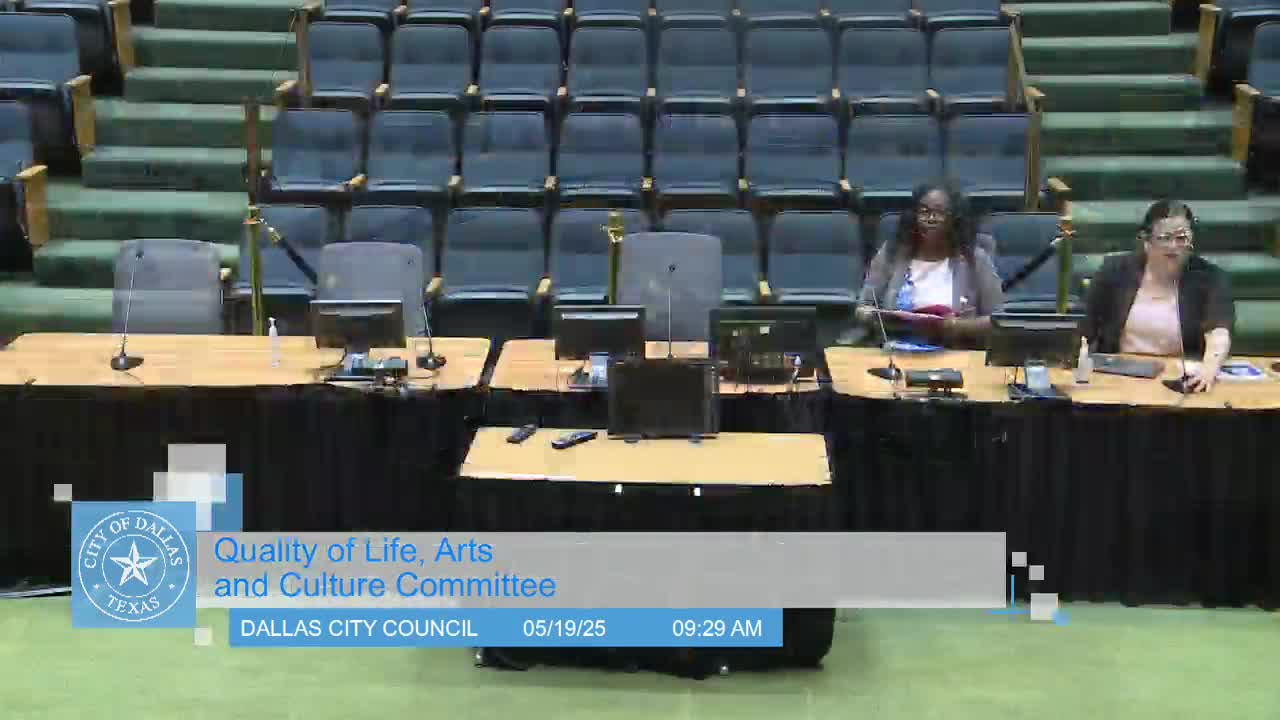
The city’s Office of Community Care and Empowerment (OCCE) told the Quality of Life, Arts and Culture Committee on May 19 that it is near completion of a senior services strategic plan designed to guide city investments and partnerships for older adults over the next three to five years.
“Now we are home to over 150,000 older adults,” Tabitha Taylor, the city’s Age‑Friendly Officer, told the committee, summarizing the plan’s scope as a citywide effort to identify needs, opportunities and recommended actions for older residents. Jessica Gallaschow, director of OCCE, said consultant Guidehouse was retained after a 2024 procurement and that a final plan is expected in June with council adoption targeted for fall 2025.
Guidehouse consultants Rick Henley and Jason (Jay) Wright described phase 1 (assessment) deliverables completed for the city: a demographic profile (60+, 65+, 70+, 85+ cohorts), a senior services index cataloging city services, an organizational survey of community providers, district listening sessions and a five‑language citywide survey. Henley said the citywide survey yielded a modest response (about 219 digital and 245 paper responses) but that qualitative outreach — listening sessions with providers, the Senior Affairs Commission and public sessions — added important context.
Guidehouse said it organized findings into eight service domains and ranked them by prevalence of need. The three domains showing the highest citywide need were mobility and transportation, social isolation, and food insecurity; level-two needs included health care access, technology and affordable housing; level-three included aging in place and financial security. “Most people were pretty satisfied with the services they received from the city of Dallas,” Henley said, “but they have trouble finding information and accessing services.”
Consultants demonstrated that OCCE will receive an interactive Power BI tool allowing staff and, later, council offices to zoom into ZIP-code level indicators and domain subitems (for example, broadband access) so districts can identify tactical priorities. Council members requested follow-up briefings for individual districts so each council office can use the data in local planning.
Committee members asked about specific issues raised during outreach. On employment and volunteering for older adults, staff said existing workforce‑support contracts are often targeted at people with disabilities and access barriers; committee members asked OCCE to identify gaps and potential partnerships to expand job opportunities for older adults who want to work. On housing, members asked staff to analyze shared‑housing, accessory dwelling units and other models that address isolation and affordability; Guidehouse confirmed those models are in scope for further research.
Guidehouse and OCCE emphasized implementation. Taylor said the city does not want “a plan that will sit on the shelf” and said recommendations will include action items with timeframes and measurable indicators. Henley added that the plan will include an implementation dashboard so the public can track progress on goals and actions. Staff said implementation funding requests have not been finalized; some potential pilots could be considered as part of ARPA reprogramming conversations.
Next steps: OCCE and Guidehouse expect a final draft in June; consultants will present to the Senior Affairs Commission in August and the city will seek final adoption in fall 2025. Committee members recommended ongoing district‑level listening and an annual implementation update, and asked staff to include caregiver supports and nonprofit partners in the implementation strategy.