Get Full Government Meeting Transcripts, Videos, & Alerts Forever!
Get email alerts on the Substance Use Outreach topic
No spam. Unsubscribe anytime.
Philadelphia committee reviews outreach strategies as Kensington substance crisis evolves
Summary
City officials, providers and peers told a City Council special committee that outreach is essential but must be better coordinated, tracked and resourced; DBHIDS described current programs and pledged data and a bed-registry RFP by summer.
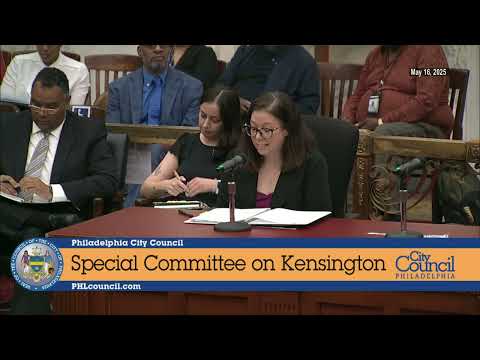
PHILADELPHIA — The Philadelphia City Council Special Committee on Kensington on Tuesday heard program updates from the Department of Behavioral Health and Intellectual disAbility Services and testimony from health-system clinicians, peer workers and police officials about outreach to people with substance use disorder in Kensington.
Committee Chair Ketsi Lozada convened the hearing on Resolution 240760, which directs the committee to explore outreach best practices. Amanda David, interim deputy commissioner and director of behavioral health at DBHIDS, told the panel that outreach teams and mobile units are “the bridge between crisis and care.”
DBHIDS described a network of street-based teams and complementary services that operate across the city. Those include a contracted homeless outreach network coordinated through Project HOME’s Outreach Coordination Center, Mobile Outreach and Recovery Services (MORS), two wound‑care vans operated with Kensington Hospital, hospital “warm handoff” programs that use certified recovery specialists, and a Community Wellness Engagement Unit (CWU) assigned across all 10 council districts. David said the DBHIDS outreach network represents “over 50 staff members consisting of 25 two‑person teams” and is available 24 hours a day, seven days a week.
City and provider witnesses gave concrete measures of recent activity. DBHIDS cited about 1,500 MORS engagements in the past year and said individuals with more outreach contacts have higher placement rates — “individuals who have had one contact with outreach have a 17 percent placement rate, whereas individuals who have had five plus contacts have a 46 percent placement rate,” David said. She also said the department recorded 346 connections to treatment and housing last year (a citywide figure, she added). Police officials said a week‑to‑week count in the Kensington footprint showed 368 unsheltered people this week, down from 412 at the same time last year.
University of Pennsylvania clinicians urged continued investment in outreach and rapid clinical links. Jean Marie Perrone, director of the Center for Addiction Medicine and Policy (CAMP) at Penn, called outreach “essential” and said people referred through outreach are more likely to engage and remain in care. Penn’s telephone Care‑Connect warm line (484‑278‑1679) operates daily and Penn staff said they handled roughly 12,500 calls in 2024 and more than 3,000 patients by telehealth over the past several years.
Peers and outreach workers described trust‑building as a multi‑step process. Diamond Stahl, a certified recovery specialist who works in Kensington, said outreach “saved my life” and described repeatedly returning to people who initially refuse services. Lawrence Jackson, a DBHIDS case manager who works with MORS and at the wellness court, said continuity of contact and follow‑up case management are crucial when someone does accept placement.
Committee members pressed for outcome data and operational details. Several council members said they wanted routine dashboards that break down monthly engagement numbers, unduplicated counts, treatment completions and whether placements were in the Kensington crisis footprint. DBHIDS staff said they do track placements and outcomes at the program level and agreed to provide requested data to the committee. David also said the department publishes a treatment availability database on its website and that a city RFP to procure a more robust bed‑registry/bed‑tracking system is expected to be released by the end of the summer.
Police officials described partnership models that pair officers with crisis clinicians. Philadelphia Police Department officials said the East Service Detail conducts two counts a week in the Kensington footprint and partners with outreach teams on co‑response efforts. Deputy Commissioner Pedro Rosario and Sergeant Michael Hansen described team models intended to slow encounters so clinicians and peers can engage safely and follow up.
Witnesses also described operational gaps. Clinicians and treatment providers warned that new adulterants in the street supply — notably xylazine and a newer sedative referenced in testimony — produce atypical withdrawal and wound complications that can make some patients reluctant to enter standard treatment settings. Penn and hospital representatives said severe withdrawal cases have required ICU care and that this evolving drug supply complicates decisions about where and how people are safely admitted to treatment.
Multiple speakers — including council members and peer workers — urged services that also address community quality of life: coordinated, low‑barrier “one‑stop” spaces offering hygiene, wound care, rapid medication initiation (including mobile methadone services), housing navigation and trauma‑informed support, alongside outreach. Several members of the committee said residents have repeatedly asked that mobile services be coordinated so they do not repeatedly operate at the same doorsteps without community input.
DBHIDS and partner agencies committed to several follow‑ups: provide the committee with more granular engagement and outcome data; share recent unsheltered counts from Office of Homeless Services and police; and proceed with the bed‑registry RFP process to improve real‑time placement coordination. No vote or formal policy change occurred at the hearing.
The committee recessed after more than three hours of testimony and public comment, with members and witnesses agreeing to continue working on data sharing, a treatment‑bed registry and coordinated mobile services to link people to care while addressing neighborhood impacts.