Get Full Government Meeting Transcripts, Videos, & Alerts Forever!
Get email alerts on the Fire Service Assessment topic
No spam. Unsubscribe anytime.
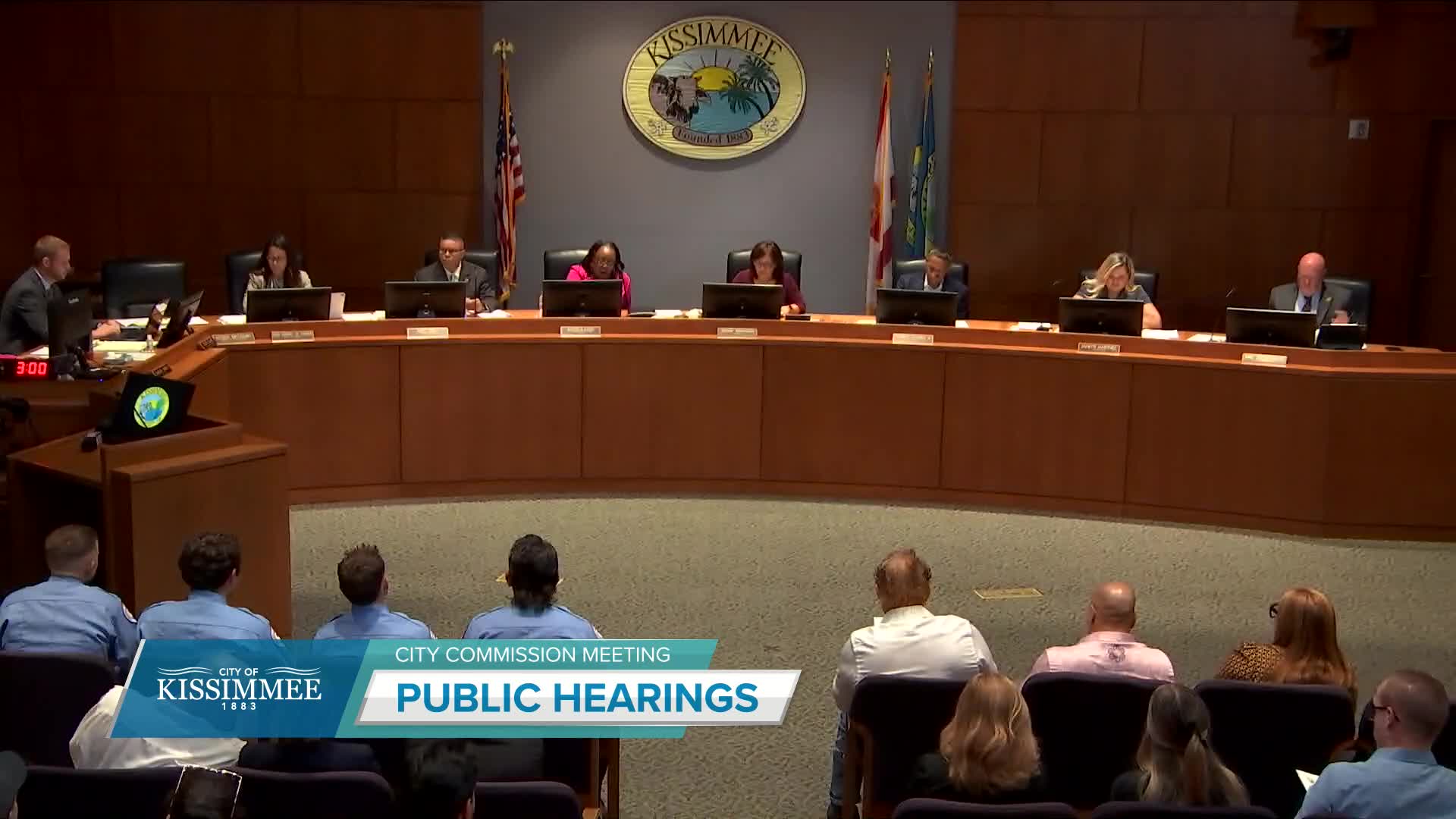
Kissimmee Commission adopts citywide fire assessment to fund fourth shift after contentious public hearing
Summary
After a three-hour public hearing with residents, fire employees and experts testifying for and against the plan, the Kissimmee City Commission adopted an ordinance and a companion resolution to place a citywide fire service assessment on the tax roll to fund a fourth shift and related fire services. The measures passed 4–1.
The City of Kissimmee on Tuesday approved a citywide fire service assessment and a resolution setting assessment rates to fund a fourth shift for the Kissimmee Fire Department.
The ordinance authorizing special assessments and a companion initial annual assessment resolution passed by a 4–1 vote after an extended public hearing in which firefighters, union leaders and residents urged passage while other residents, church leaders and real estate stakeholders urged caution or delay. Commissioner Alvarez cast the lone recorded vote against both measures.
Supporters including Kissimmee firefighter Joshua Clark, president of the Kissimmee firefighters’ union, said the fee is intended to improve retention, candidate pools and firefighter health by reducing overtime and shifting to a four-shift staffing model. “This fire fee gives us exactly that. It's not about politics. It's not about profit,” Clark said during public comment. Family members of firefighters and department employees also described sleep deprivation and mental-health strains and urged action.
Opponents said the assessment will add a recurring cost to property owners and renters and expressed concern about affordability, the way the charge is presented on the tax bill, and the risk of future increases. Resident Dominic DiPolla said the new charges are squeezing homeowners; Michael Biagioni, speaking for himself, called the change a “procedurally subtle” substantial increase and urged separate billing or clearer disclosure. James Lowe, immediate past president of the Osceola Association of Realtors, asked the commission to pause to allow more stakeholder talks, saying small increments can affect homebuyers and those on fixed incomes.
City and external legal advisers told the commission their approach follows Florida law for special assessments. Attorney Mark Lawson, who advised the city during the study, said the assessment methodology uses two tiers: a flat per-parcel charge and a proportional charge based on improvements. Lawson described the legal framework and the data sources used to allocate cost. He said notices were mailed to property owners and an online calculator was provided so owners can look up parcel-specific estimates. “I assert to you that that's proportional and not arbitrary,” Lawson said of the two-tier approach.
The resolution adopted by the commission sets a revenue target of about $6.1 million for the assessment to fund department staffing and the fourth shift for the fiscal year beginning Oct. 1, 2025. Staff and consultants described the proposed structure in public testimony as: a flat charge of $105 per tax parcel and a proportional charge of $0.56 per $1,000 of assessed improvement value (after subtracting land value), with indexing limited to the lesser of personal income growth and 2 percent annually. Staff said the intent is to apportion fixed readiness costs (facilities, equipment and staffing) fairly across parcels while reflecting relative risk from improved value.
The city attorney and staff noted timing constraints tied to the county tax-roll certification process; the tax roll must be finalized weeks before the tax collector issues bills. Staff also said the city sent the statutorily required mailed notices—around 24,400 notices—and published public hearing notices. The assessment, once certified to the county tax roll, will appear on property tax bills unless the commission changes course.
The commission first voted 5–0 to accept the consultant’s “Simplified Fire Protection Assessment Apportionment Strategy” report as competent, substantial evidence supporting the assessment. Later, after the public hearing, the ordinance and the implementing resolution were approved 4–1 (Commissioner Alvarez voting no). The commission directed staff to implement the assessment as adopted and to proceed with required administrative steps to certify the roll.
Supporters said the assessment will help stabilize staffing, lower overtime and improve response reliability as Kissimmee grows. Opponents reiterated concerns about affordability, transparency on billing, and potential long-term increases despite the 2 percent indexing cap.
The commission did not adopt a delay or separate-billing approach urged by some speakers. City staff said they will continue outreach and that an online calculator and written materials are available on the city website to let property owners see parcel-level charges.
The full implementing documents recorded in the meeting packet include the ordinance language authorizing assessments, the consultant report prepared by Dr. Owen Beich for Community Solutions Group/GAI, and the resolution setting rates and directing staff to transmit the assessment roll to the county tax collector for certification.