Get Full Government Meeting Transcripts, Videos, & Alerts Forever!
Get email alerts on the Economic Development topic
No spam. Unsubscribe anytime.
Norfolk awards corridor grants to 32 businesses; city seeks funding to expand program
Summary
Norfolk’s Economic Development Department presented results of a pilot Commercial Corridor Grant Program funded with ARPA dollars: 167 applications, 99 passing technical review, 32 businesses awarded about $1.4 million in grants and staff reporting roughly $7 million in leveraged private investment and additional state funds.
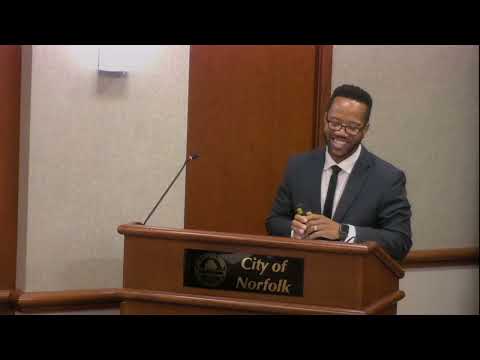
Sean Washington, director of economic development for the city of Norfolk, told the Planning Commission the Commercial Corridor Grant Program used American Rescue Plan Act (ARPA) funds to target underperforming commercial corridors and help sustain small businesses.
Washington said the program, launched after a 2022 allocation of ARPA dollars, combined urban design studies, technical assistance for small businesses, and direct grants. “We wanted to make sure that we kind of targeted those funds and targeted our efforts,” Washington said, describing a three‑pronged approach of design consulting, technical assistance for tenants and landlords, and two tiers of grants (up to $50,000 for building owners and up to $25,000 for tenants).
Washington said the pilot covered four corridors — 30th/5th Street, Riverview, East Little Creek and Lafayette Boulevard — and produced four rounds of awards. From 167 applications 99 passed technical review; 32 Norfolk businesses received funding totaling about $1,400,000, he said. He added that the program required a minimum 10% match by grantees and that the city counted private leverage and follow‑on grants when measuring returns. “Based on our $1,400,000…it was actually a $7,000,000 overall ROI,” Washington said, noting the city also helped secure a $700,000 award from the Virginia Department of Housing and Community Development’s Industrial Revitalization Fund tied to the Riverview Theater project.
Why it matters: Washington framed the program as a pilot that reduced vacancy, improved building conditions and catalyzed private investment. He said council has asked staff to continue the program and that Economic Development has requested additional funds in the FY26 budget for two next corridors — Church Street and Sewell’s Point commercial corridor — with work expected to begin near July 1 if funded.
Details of the grant structure and program operations presented to commissioners: - Grants: up to $50,000 for building owners (roofing, electrical, plumbing) and up to $25,000 for tenants (equipment, signage, façade work); owners with multiple parcels could apply for up to two buildings in select corridors. - Eligibility: applicants must demonstrate a degree of stability (Washington said staff typically required a tenant lease in place for at least six months on the tenant side before disbursing tenant grants). - Metrics: Washington reported 167 applications, 99 cleared technical review, 32 businesses funded and roughly $1.4 million in grants deployed in the pilot; staff report city counts of about $7 million in follow‑on private or leveraged investment attributable to the program, including the state grant for the Riverview Theater.
Commissioners asked about items in the conceptual plans that are outside the grant scope — landscaping, bike lanes and other infrastructure — and Washington confirmed the conceptual studies included aspirational elements the city would not directly fund through the grant program but that the design documents can be used to request other city or state funds. He also confirmed that maintenance of public landscaping or right‑of‑way features was not funded by the grant program.
Where it goes next: Washington said the department will expand corridor work if council funds it in FY26, return with specific implementation plans for Church Street and Sewell’s Point, and continue to coordinate design work with civic leagues, business associations and neighborhood task forces.
Ending: Commissioners praised the outcomes discussed in the presentation and asked follow‑up questions on eligibility, measurement of return on investment and coordination with other city investments. Washington said staff will return with additional corridor rollouts after council funding decisions.